

The words that let the CFTC bar an event contract from a federal exchange are “gaming” and “involve.” On 20 August, Chairman Michael S. Selig told the agency’s new Innovation Advisory Committee that the statute defines neither, leaving contracts “at risk of rejection based upon arbitrary whims or political biases.”
ProphetX CEO Dean Sisun had filed a comment letter ahead of the same meeting arguing that a two-sided, peer-to-peer exchange under federal oversight “is not simply another way to package the state sportsbook model.”
The CFTC register lists ProphetX LLC as a designated contract market from 11 June 2026, so its intervention comes from inside the federal lane it wants protected.
Read together, the regulator and the operator are making the same diagnosis from different positions: the line the whole category stands on is not fully written down. The machinery answers it anyway.
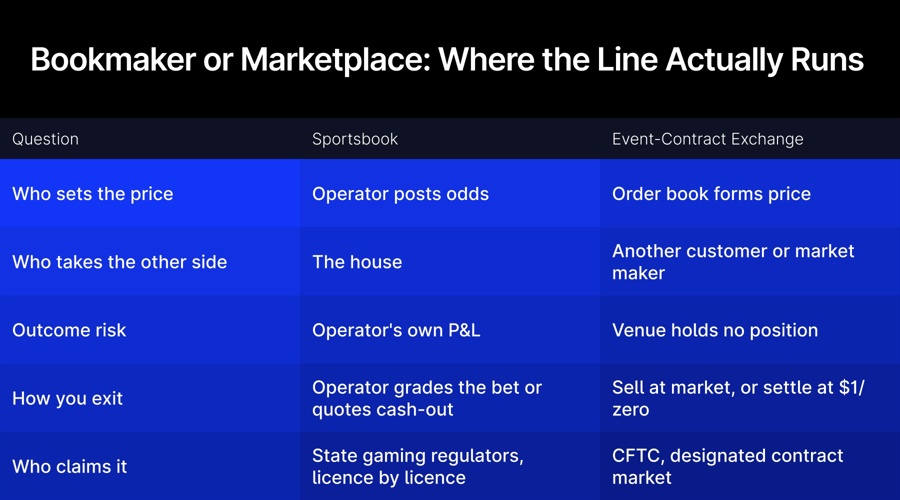
How the Models Differ
|
Question |
Sportsbook |
Event-Contract Exchange |
|
Who sets the price? |
The operator posts and moves the odds. |
An order book forms the price; the venue does not post odds. |
|
Who takes the other side? |
The house is the counterparty and wins what the customer loses. |
Another customer or market maker takes the other side; the venue should hold no position. |
|
How does a position end? |
The bet pays at the locked odds, or expires worthless. |
The contract can trade before settlement, then settles at $1 or zero. |
|
Which regulator claims it? |
State gaming regulators, licence by licence. |
For retail-facing US venues, the CFTC through designated contract market status. |
|
Main regulatory weakness |
State rules vary, but the model itself is clearly treated as gambling. |
The federal test turns on “involve” and “gaming,” terms the statute does not define. |
|
First management action |
Map the product state by state. |
Test the product against price formation, counterparty structure, settlement, collateral and venue neutrality. |
Three Tests Draw the Line
The table gives the short version. The longer test starts with three mechanics: price formation, counterparty risk, and settlement.
Who Sets the Price?
A bookmaker publishes its own odds and moves them to balance its book and keep its margin inside the price. On an event-contract exchange, price comes out of an order book.
Kalshi’s explainer says its contracts trade between one and 99 cents, settle at $1 or zero, and read as live probability: a question with a 40% chance of resolving yes should trade around 40 cents.
Sisun makes the same point in regulatory terms: preserve competitive price formation and venue neutrality.
Who Takes the Other Side?
At a sportsbook, the operator is the counterparty to every ticket, and your win is its loss.
An exchange matches you against another participant: a customer with the opposite view, or a market maker quoting both sides. ProphetX describes its model in those terms, with users trading directly with one another while the venue takes no directional position.
Sisun’s second recommendation draws the same line inside the exchange camp: affiliated liquidity should supplement independent flow, not replace it.
If the venue’s own affiliate is on the other side of most customer trades, the model starts to look less like an exchange and more like a sportsbook.
How does the position end?
A bet is a claim on the operator: it pays at the locked odds when the book grades the event, and until then it exists only on the operator’s books.
An event contract is a listed instrument. Kalshi’s version settles at $1 if the outcome happens and zero if it does not; both sides of a matched pair post the full dollar when they trade. Until the event is resolved, the holder can also sell the contract in the order book at the current market price.
Where the Money Comes From
The distinction shows up most clearly when the same outcome is priced in both models. A sportsbook turns it into a bet against the house; an exchange turns it into a contract between two market participants.
The Same Coin Flip, Priced Twice
Run an illustrative $1,000 through each model; the figures are assumptions, not any firm’s terms. At a US sportsbook, a common two-way price is -110 on both sides: stake $110 to win $100.
If $500 is staked on each side, the book collects $1,000, pays the winners about $955 including returned stake, and keeps roughly $45. The margin lives inside the accepted price.
On an exchange, a 50/50 event trades around 50 cents, so the same $1,000 buys roughly 2,000 contracts before fees. The venue earns a fee on the transaction, alongside the price rather than inside it.
Who Carries the Outcome Risk?
The bookmaker carries it. An unbalanced book is real exposure to the result, which is why odds move and why books manage which bets they take. The exchange carries none of it if the venue remains neutral. A venue with no position has no stake in who wins, only in volume.
Ask who loses money when the customer wins; if the answer is the operator, that is the sportsbook model, whatever the product calls itself.
Which Regulator Claims Each Model
The answer starts with federal designation, but it does not end there. State gambling regulators still claim authority when the product reaches residents through sports-outcome markets.
The Federal Claim Runs through Designation
For a retail-facing US prediction market, the federal route runs through designation as a contract market under the CFTC.
The Commission’s March notice said any prediction-market venue offering swaps or futures to the general public must register as a designated contract market.
Novig launched nationally on 4 August, after the CFTC granted designated contract market status to its Ludlow Exchange LLC subsidiary on 16 June. ProphetX LLC is listed separately on the CFTC register as designated from 11 June.
Selig told the committee the Commission would defend that jurisdiction in court and exercise it. Amendments to Parts 38 and 40, expected soon, would modernize listing rules and add retail protections.
The package also includes a rewrite of Rule 40.11, which bars contracts that involve, relate to, or reference terrorism, assassination, war, gaming, or activity unlawful under state or federal law.
The problem is that “gaming” and “involve” do most of the work, but neither term is defined. Sisun’s third recommendation attacks the gap from the operator side: a conditions-based Section 4(c) framework with categorical standards for settlement, surveillance and integrity instead of contract-by-contract review.
States Still Claim the Same Product
Federal designation does not by itself settle how states treat sports-outcome products offered to their residents. The CFTC sees a listed event contract; state gaming regulators see a wager on a sporting event and apply their own gambling statutes.
That is the conflict behind the Nevada case. A court barred Kalshi from serving state residents, and the Nevada Gaming Control Board later accused the company of failing to stop trading from inside the state. The regulator has asked the court for $120,000 a day from Kalshi for the alleged violations.
The courts are now testing whether federal derivatives law displaces those state claims. On 28 August, the Ninth Circuit held that Kalshi had not shown the Commodity Exchange Act likely preempted Nevada’s gaming regulations for sports event contracts.
On 2 September, New Jersey’s attorney general asked the US Supreme Court to review whether sports wagers on prediction markets can avoid state sports-gambling laws.
The CFTC’s prediction-market rulemaking had already drawn more than 1,500 comments across the same divide: derivatives infrastructure on one side, gambling in financial dress on the other.
Where the Models Are Converging
The mechanical line is cleanest when a sportsbook is taking bets and an exchange is listing neutral contracts. The commercial market is less tidy.
Sportsbook-style products are appearing on federally designated exchanges, while sportsbook operators are looking at the CFTC route. Novig is the clearest example on the exchange side.
The company said its first week after national launch produced more than $125 million of notional volume, and parlays were roughly a third of the activity. A parlay, the signature sportsbook product, now runs at scale through a federally designated exchange.
The traffic also moves in the other direction. DraftKings filed its first event-contract templates with the CFTC in May for DKeX, pursuing the federal route as an alternative to state-by-state sportsbook licensing.
That is why the CFTC’s June proposal matters. It would not bless every sports contract simply because it sits on an exchange. The proposal would define “gaming” and “involve,” set public-interest factors, and treat player-injury and discrete-action contracts as likely contrary to the public interest.
The product menus are converging, even if the operating models remain different.
Why Should Brokers and Exchanges Care?
Brokers and exchanges are not only watching this category from the outside. Some are exploring listings, distribution, liquidity, technology or client access as prediction-market volumes grow.
FM’s guide to why brokers and exchanges are racing in covers that commercial case, including the growth from $9 billion of volume in 2024 to $40 billion in 2025.
The regulatory question is therefore also an operating question. Before a firm lists, routes, white-labels or promotes event contracts, it needs to know whether the product behaves like a neutral exchange instrument or like a wager against the house.
The answer sits in the mechanics: price formation, counterparty exposure, settlement, collateral and venue neutrality. The checklist below is the structural screen to run before the next launch, partnership or product review.
What This Means Now
As of early September 2026, the federal regulator has said its statutory dividing line is undefined and has proposed rules to start defining it.
Operators are filing letters to shape those rules, states are enforcing gambling law against designated venues, and product menus on both sides are converging.
Until the CFTC finalizes those definitions, firms will still need to classify products by how they actually work.
Reusable Checklist: Event Contract or Sportsbook?
Use the checks below as a first classification screen. If most answers are “yes,” the product looks closer to a sportsbook; if most are “no,” it looks closer to an event-contract exchange.
- Does the operator post and move the odds?
- Is the operator the customer’s counterparty?
- Can the operator profit from the customer’s loss on the event?
- Does the customer mainly exit through settlement or an operator cash-out quote?
- Is the payout based on locked betting odds rather than $1/zero contract settlement?
- Is the product authorised under a state gaming licence rather than a CFTC designation?
- Does customer money sit inside a state sportsbook client-money framework?
- Would a state regulator treat the product as gambling if offered to residents?
- If the venue failed, would the customer’s claim be against the operator rather than against segregated collateral or exchange/clearing rules?
If the answers are mixed, the product needs deeper legal review before launch, distribution or promotion.
The words that let the CFTC bar an event contract from a federal exchange are “gaming” and “involve.” On 20 August, Chairman Michael S. Selig told the agency’s new Innovation Advisory Committee that the statute defines neither, leaving contracts “at risk of rejection based upon arbitrary whims or political biases.”
ProphetX CEO Dean Sisun had filed a comment letter ahead of the same meeting arguing that a two-sided, peer-to-peer exchange under federal oversight “is not simply another way to package the state sportsbook model.”
The CFTC register lists ProphetX LLC as a designated contract market from 11 June 2026, so its intervention comes from inside the federal lane it wants protected.
Read together, the regulator and the operator are making the same diagnosis from different positions: the line the whole category stands on is not fully written down. The machinery answers it anyway.
How the Models Differ
|
Question |
Sportsbook |
Event-Contract Exchange |
|
Who sets the price? |
The operator posts and moves the odds. |
An order book forms the price; the venue does not post odds. |
|
Who takes the other side? |
The house is the counterparty and wins what the customer loses. |
Another customer or market maker takes the other side; the venue should hold no position. |
|
How does a position end? |
The bet pays at the locked odds, or expires worthless. |
The contract can trade before settlement, then settles at $1 or zero. |
|
Which regulator claims it? |
State gaming regulators, licence by licence. |
For retail-facing US venues, the CFTC through designated contract market status. |
|
Main regulatory weakness |
State rules vary, but the model itself is clearly treated as gambling. |
The federal test turns on “involve” and “gaming,” terms the statute does not define. |
|
First management action |
Map the product state by state. |
Test the product against price formation, counterparty structure, settlement, collateral and venue neutrality. |
Three Tests Draw the Line
The table gives the short version. The longer test starts with three mechanics: price formation, counterparty risk, and settlement.
Who Sets the Price?
A bookmaker publishes its own odds and moves them to balance its book and keep its margin inside the price. On an event-contract exchange, price comes out of an order book.
Kalshi’s explainer says its contracts trade between one and 99 cents, settle at $1 or zero, and read as live probability: a question with a 40% chance of resolving yes should trade around 40 cents.
Sisun makes the same point in regulatory terms: preserve competitive price formation and venue neutrality.
Who Takes the Other Side?
At a sportsbook, the operator is the counterparty to every ticket, and your win is its loss.
An exchange matches you against another participant: a customer with the opposite view, or a market maker quoting both sides. ProphetX describes its model in those terms, with users trading directly with one another while the venue takes no directional position.
Sisun’s second recommendation draws the same line inside the exchange camp: affiliated liquidity should supplement independent flow, not replace it.
If the venue’s own affiliate is on the other side of most customer trades, the model starts to look less like an exchange and more like a sportsbook.
How does the position end?
A bet is a claim on the operator: it pays at the locked odds when the book grades the event, and until then it exists only on the operator’s books.
An event contract is a listed instrument. Kalshi’s version settles at $1 if the outcome happens and zero if it does not; both sides of a matched pair post the full dollar when they trade. Until the event is resolved, the holder can also sell the contract in the order book at the current market price.
Where the Money Comes From
The distinction shows up most clearly when the same outcome is priced in both models. A sportsbook turns it into a bet against the house; an exchange turns it into a contract between two market participants.
The Same Coin Flip, Priced Twice
Run an illustrative $1,000 through each model; the figures are assumptions, not any firm’s terms. At a US sportsbook, a common two-way price is -110 on both sides: stake $110 to win $100.
If $500 is staked on each side, the book collects $1,000, pays the winners about $955 including returned stake, and keeps roughly $45. The margin lives inside the accepted price.
On an exchange, a 50/50 event trades around 50 cents, so the same $1,000 buys roughly 2,000 contracts before fees. The venue earns a fee on the transaction, alongside the price rather than inside it.
Who Carries the Outcome Risk?
The bookmaker carries it. An unbalanced book is real exposure to the result, which is why odds move and why books manage which bets they take. The exchange carries none of it if the venue remains neutral. A venue with no position has no stake in who wins, only in volume.
Ask who loses money when the customer wins; if the answer is the operator, that is the sportsbook model, whatever the product calls itself.
Which Regulator Claims Each Model
The answer starts with federal designation, but it does not end there. State gambling regulators still claim authority when the product reaches residents through sports-outcome markets.
The Federal Claim Runs through Designation
For a retail-facing US prediction market, the federal route runs through designation as a contract market under the CFTC.
The Commission’s March notice said any prediction-market venue offering swaps or futures to the general public must register as a designated contract market.
Novig launched nationally on 4 August, after the CFTC granted designated contract market status to its Ludlow Exchange LLC subsidiary on 16 June. ProphetX LLC is listed separately on the CFTC register as designated from 11 June.
Selig told the committee the Commission would defend that jurisdiction in court and exercise it. Amendments to Parts 38 and 40, expected soon, would modernize listing rules and add retail protections.
The package also includes a rewrite of Rule 40.11, which bars contracts that involve, relate to, or reference terrorism, assassination, war, gaming, or activity unlawful under state or federal law.
The problem is that “gaming” and “involve” do most of the work, but neither term is defined. Sisun’s third recommendation attacks the gap from the operator side: a conditions-based Section 4(c) framework with categorical standards for settlement, surveillance and integrity instead of contract-by-contract review.
States Still Claim the Same Product
Federal designation does not by itself settle how states treat sports-outcome products offered to their residents. The CFTC sees a listed event contract; state gaming regulators see a wager on a sporting event and apply their own gambling statutes.
That is the conflict behind the Nevada case. A court barred Kalshi from serving state residents, and the Nevada Gaming Control Board later accused the company of failing to stop trading from inside the state. The regulator has asked the court for $120,000 a day from Kalshi for the alleged violations.
The courts are now testing whether federal derivatives law displaces those state claims. On 28 August, the Ninth Circuit held that Kalshi had not shown the Commodity Exchange Act likely preempted Nevada’s gaming regulations for sports event contracts.
On 2 September, New Jersey’s attorney general asked the US Supreme Court to review whether sports wagers on prediction markets can avoid state sports-gambling laws.
The CFTC’s prediction-market rulemaking had already drawn more than 1,500 comments across the same divide: derivatives infrastructure on one side, gambling in financial dress on the other.
Where the Models Are Converging
The mechanical line is cleanest when a sportsbook is taking bets and an exchange is listing neutral contracts. The commercial market is less tidy.
Sportsbook-style products are appearing on federally designated exchanges, while sportsbook operators are looking at the CFTC route. Novig is the clearest example on the exchange side.
The company said its first week after national launch produced more than $125 million of notional volume, and parlays were roughly a third of the activity. A parlay, the signature sportsbook product, now runs at scale through a federally designated exchange.
The traffic also moves in the other direction. DraftKings filed its first event-contract templates with the CFTC in May for DKeX, pursuing the federal route as an alternative to state-by-state sportsbook licensing.
That is why the CFTC’s June proposal matters. It would not bless every sports contract simply because it sits on an exchange. The proposal would define “gaming” and “involve,” set public-interest factors, and treat player-injury and discrete-action contracts as likely contrary to the public interest.
The product menus are converging, even if the operating models remain different.
Why Should Brokers and Exchanges Care?
Brokers and exchanges are not only watching this category from the outside. Some are exploring listings, distribution, liquidity, technology or client access as prediction-market volumes grow.
FM’s guide to why brokers and exchanges are racing in covers that commercial case, including the growth from $9 billion of volume in 2024 to $40 billion in 2025.
The regulatory question is therefore also an operating question. Before a firm lists, routes, white-labels or promotes event contracts, it needs to know whether the product behaves like a neutral exchange instrument or like a wager against the house.
The answer sits in the mechanics: price formation, counterparty exposure, settlement, collateral and venue neutrality. The checklist below is the structural screen to run before the next launch, partnership or product review.
What This Means Now
As of early September 2026, the federal regulator has said its statutory dividing line is undefined and has proposed rules to start defining it.
Operators are filing letters to shape those rules, states are enforcing gambling law against designated venues, and product menus on both sides are converging.
Until the CFTC finalizes those definitions, firms will still need to classify products by how they actually work.
Reusable Checklist: Event Contract or Sportsbook?
Use the checks below as a first classification screen. If most answers are “yes,” the product looks closer to a sportsbook; if most are “no,” it looks closer to an event-contract exchange.
- Does the operator post and move the odds?
- Is the operator the customer’s counterparty?
- Can the operator profit from the customer’s loss on the event?
- Does the customer mainly exit through settlement or an operator cash-out quote?
- Is the payout based on locked betting odds rather than $1/zero contract settlement?
- Is the product authorised under a state gaming licence rather than a CFTC designation?
- Does customer money sit inside a state sportsbook client-money framework?
- Would a state regulator treat the product as gambling if offered to residents?
- If the venue failed, would the customer’s claim be against the operator rather than against segregated collateral or exchange/clearing rules?
If the answers are mixed, the product needs deeper legal review before launch, distribution or promotion.


