


A $4.5 billion US large-cap stock fund now has two crypto-sensitive companies at the top of its portfolio.
The Fundstrat Granny Shots US Large Cap ETF’s Sept. 4 holdings snapshot ranked Bitcoin-treasury company Strategy (MSTR) first at 3.02% and retail financial platform Robinhood Markets (HOOD) second at 2.99%. Together they represented 6.01% of the portfolio. The fund, known by its ticker GRNY, reported $4.533 billion in assets and 42 holdings as of Sept. 3.
GRNY owns equities, not Bitcoin, and describes itself as an actively managed US large-cap fund. Yet its two largest holdings connect shareholders to crypto through public companies: Strategy through its Bitcoin treasury and Robinhood through a trading business that includes crypto.
The snapshot demonstrates one route by which crypto-linked volatility can reach investors in a generalist stock portfolio. One fund cannot establish that mainstream managers broadly are replacing direct crypto allocations with proxy stocks.
The ranking followed an equal-weight reset and an MSTR rally
GRNY’s Aug. 21 rebalance notice said all holdings would be reset to equal weight. Strategy and Robinhood were already in the portfolio and remained there; neither was a new addition.
The reset added Freeport-McMoRan, Intel, Lockheed Martin, Micron Technology, SiriusPoint and Vertiv. It removed Air Products and Chemicals, American Express, Broadcom, Meta Platforms, Northrop Grumman, PNC Financial Services and Texas Pacific Land, according to the fund sponsor’s full rebalance announcement.
With 42 positions reset to equal weight, a simple starting benchmark is about 2.38% per holding. MSTR rose from a $119.25 close on Aug. 21 to $144.82 on Sept. 3, a gain of about 21.4%, based on historical closing prices. That appreciation plausibly accounts for a substantial part of its rise above the equal-weight baseline and into first place.
The exact path is not public. ETF.com reported $334.82 million of net creations for GRNY on Aug. 20, one day before the reset, but that figure does not identify which securities absorbed the cash and is not a complete post-rebalance flow series. The available data cannot cleanly divide MSTR’s current weight among purchases, fund creations or redemptions, and price appreciation.
The fund’s governance also makes a singular “Tom Lee bet” an imprecise description. A June SEC filing says Lee and Ken Xuan are jointly and primarily responsible for day-to-day securities management, while Qiao Duan and Stephen Foy oversee trading and execution.
The record therefore supports a narrower reading: GRNY retained MSTR at an equal-weight rebalance, after which a sharp price increase helped push the stock to the top. It does not disclose enough to reconstruct every trade or assign the position to one individual.
Strategy and Robinhood transmit crypto risk in different ways and should not be treated as interchangeable proxies.
| Company | GRNY weight on Sept. 4 | Main crypto linkage | Important caveat |
|---|---|---|---|
| Strategy | 3.02% | Large corporate Bitcoin treasury | Shareholders also take financing and capital-structure risk |
| Robinhood | 2.99% | Crypto trading inside a retail financial platform | Crypto is one part of a diversified revenue base |
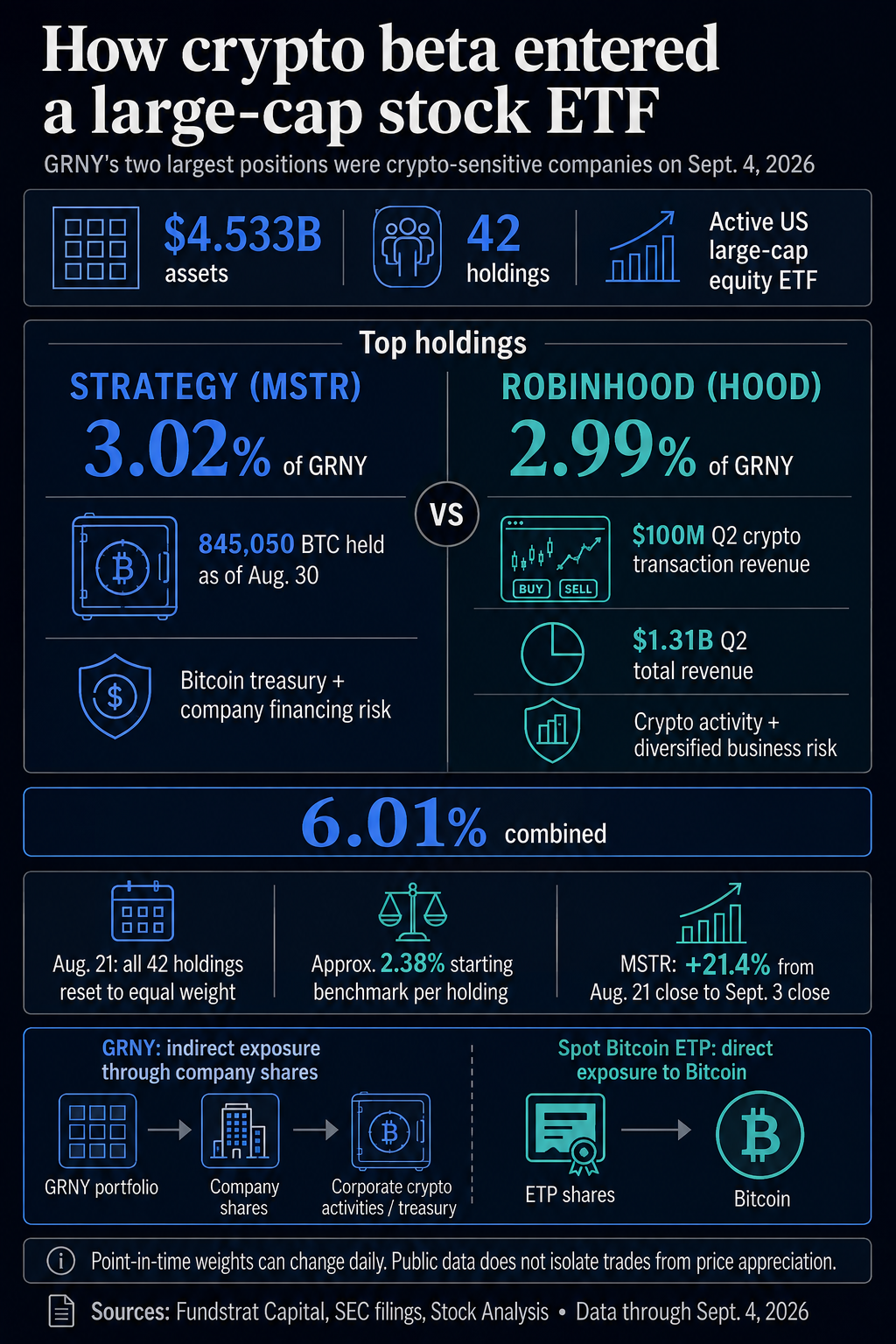
Strategy reported holding 845,050 BTC as of Aug. 30. Changes in Bitcoin’s value are consequently central to the company’s balance sheet. MSTR’s price can also reflect leverage, financing terms, security issuance, its software business, and the premium or discount investors place on its treasury strategy.
Robinhood’s connection is operational. The company reported $100 million of crypto transaction revenue in the second quarter, within total revenue of $1.31 billion. Crypto-market activity can affect its trading volumes and revenue, alongside equities, options, interest income, customer assets and the rest of its product mix.
The combined 6.01% is therefore not equivalent to a 6.01% Bitcoin allocation. It is exposure to two businesses whose sensitivity to crypto prices and activity arises through different channels and comes bundled with company-specific risks.
A direct spot-Bitcoin product is structurally different. BlackRock says the iShares Bitcoin Trust ETF seeks to reflect the price of Bitcoin and holds Bitcoin as its portfolio asset. GRNY’s shareholders instead hold operating-company stocks chosen by an active manager. Its net asset value can transmit some combination of Bitcoin moves, crypto-trading activity and equity-specific valuation changes even when an investor never buys a spot-Bitcoin fund.
Crypto beta can thus extend beyond dedicated crypto products because listed companies carry that sensitivity into broader equity portfolios. The exposure is disclosed, and GRNY has not changed its stated mandate. The wrapper changes the character of the risk: a spot product largely tracks its underlying asset, while MSTR and HOOD add management, financing, regulation, execution and stock-market valuation.
GRNY remains one example rather than proof of an industry-wide migration. Establishing a broader shift would require comparable holdings and flow data across active equity funds over time. The Sept. 4 snapshot establishes the more limited point: after an equal-weight rebalance and an MSTR rally, a generalist large-cap ETF’s two biggest positions were crypto-sensitive companies. Its shareholders were absorbing part of their volatility whether or not crypto exposure was why they bought the fund.


