

The crucible of financial services has always catered for
risk-takers, first and foremost. Yes, marketplaces are used by all sorts of
participants, including risk mitigators and the like, but the ones who seek the
grandest rewards often take the greatest risks. It is a deeply ingrained brute
fact that will never change.
Digital assets, commonly referred to as crypto, have evolved
from a niche asset class into a significant component of modern financial
markets. As adoption has grown across both retail and institutional investors,
their influence on brokerage business models, market infrastructure and
regulatory expectations has expanded considerably.
Gazing across the lush savannah of financial services today,
the sector with the most “risk”, arguably, is crypto. Having arrived only in
the space of the last decade, at least in a tradeable, convertible, smooth
fashion that’s available for all levels of the market pyramid, not just the
elite few.
Cryptocurrencies, as a concept, have enabled everyone, ranging from
the average Joe to top-tier prop trading desks on Wall Street, to take
inordinate risks – with a view to raking in inordinate rewards.
Catering for all the understandable demand in crypto,
brokers have stepped into the fold to assist. And why wouldn’t they? Where an
asset can be lawfully traded, regulated intermediaries often facilitate market
access, subject to applicable licensing requirements.
However, what retail
brokers probably didn’t expect is the pace at which crypto adoption would
filter through to the retail trading community, which has pounced on the
high-risk, highly volatile asset class offered by the likes of Bitcoin , Ethereum
and XRP.
In response to the gushing torrent of speculators with
varied trading strategies and approaches to capturing returns, retail brokers
have taken on yet another ledger of orders, flow and liquidity. Not only must
they risk-manage stocks, foreign exchange (FX), and commodities, but there is
now a far thornier commodity being traded across the financial savannah.
Retail
brokers believed they were adding another asset class when they embraced
cryptocurrency. In reality, they were beginning a transformation into
something entirely different. The industry’s response to crypto has quietly
pushed brokers towards the operating model of digital asset exchanges—and
tokenisation may accelerate that shift even further.
For retail brokers, this creates both opportunity and risk.
What began as offering crypto products has become far more challenging. In many
respects, brokers
are starting to resemble crypto exchanges.
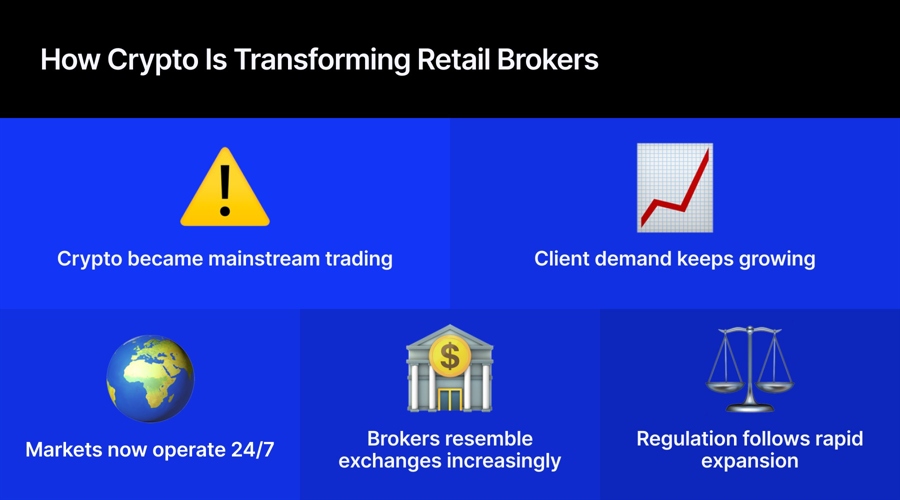
Consider the operational demands. Brokers handling
significant crypto activity must source specialist liquidity, monitor markets
24/7, maintain custody where applicable, manage settlement exposure and keep
pricing competitive despite volatility. These responsibilities increasingly
mirror those of digital asset venues.
The distinction between broker and exchange is becoming
increasingly blurred. However, operational similarities do not change a firm’s
legal or regulatory classification, which depends on its activities and
licensing framework.
Historically, retail brokers acted as market gateways,
connecting clients to liquidity, facilitating execution and managing exposure. Crypto has changed that.
Clients now expect round-the-clock access to numerous digital assets, seamless
execution, advanced charting, staking, wallets and tokenised products.
In short, clients increasingly expect an exchange experience
within an over-the-counter environment.
The Client is Always Right
This expectation has created a strategic dilemma. Without a
comprehensive crypto offering, clients may move to specialist exchanges. Yet
expanding crypto services pushes brokers further into exchange territory.
Ironically, many firms reached this point gradually rather
than deliberately.
Few executives planned to become crypto infrastructure
providers. Most simply responded to client demand by adding Bitcoin, Ethereum,
more tokens, weekend trading, stronger liquidity and expanded risk systems.
Before long, dedicated digital asset divisions emerged.
The result is a gradual but undeniable convergence.
Revenue composition provides the clearest evidence. Crypto
has evolved from an auxiliary product into a meaningful
contributor to trading volumes. During periods of strong market activity,
digital assets account for a substantial share of client trading, requiring
dedicated operational, risk and compliance oversight.
Naturally, this evolution attracts regulators.
As brokers expand into digital assets, supervisory
expectations increase. Regulators are applying greater scrutiny to market
integrity, client protection, custody, operational resilience and financial
crime controls.
This creates another parallel with crypto exchanges.
Many regulatory issues now facing brokers are the same ones
exchanges have dealt with for years. The difference is that brokers often rely
on legacy FX, CFD and
equities infrastructure, making adaptation to digital assets both complex
and costly.
Yet the industry appears committed to the journey.
Surrendering the Lion’s Share
The implications of tokenised real-world assets extend far
beyond new investment opportunities. Tokenisation challenges the traditional
brokerage model by embedding market access, settlement and record-keeping
directly into blockchain infrastructure.
Ownership can be recorded on distributed ledgers,
settlements completed in seconds through smart contracts, and corporate actions
automated, reducing the need for multiple financial intermediaries.
Retail is quietly coming back to crypto.
Not like 2021. This time it looks different.
• 500M+ people globally already own crypto
• APAC crypto activity grew 69% YoY, reaching $2.36T in transaction volume
• Stablecoin market cap has surpassed $300B
• Bitcoin ETFs have… https://t.co/wzXxV7Sf8S— AetheriumX (@aetheriumX_fun) August 2, 2026
More importantly, tokenisation
democratises market access. Investors may increasingly use digital wallets
and regulated blockchain platforms instead of brokerage accounts, while issuers
could distribute tokenised securities directly. Brokers risk being cut out of
the loop.
However, brokers will not become obsolete. Institutions will
still need research, financing, portfolio management and regulatory expertise.
As tokenised finance develops, execution and custody alone will become less
sustainable competitive advantages.
Economic Pragmatism Rules the Roost
There is strong commercial logic behind this transformation.
New generations of investors expect mobile-first technology, instant access and
digital-native products. To many, the distinction between a broker and a crypto
exchange is largely irrelevant.
Firms that meet these expectations are likely to gain market
share. Those that do not risk becoming obsolete.
Looking ahead, tokenisation could accelerate convergence
further. As real-world assets move onto blockchain networks, the boundaries
between traditional and digital finance may weaken significantly.
If that happens, the evolution of retail brokers into
exchange-like businesses may become inevitable rather than gradual.
Serving to Survive and Prosper
The financial savannah rewards adaptation. Brokers once
focused on FX and CFDs now operate in digital asset markets that never close,
evolve rapidly and rarely forgive complacency.
Whether they realise it or not, many retail brokers are
already moving towards exchange functionality by building the infrastructure,
expertise and capabilities traditionally associated with crypto venues.
The process may be gradual and unplanned, but it is
happening.
Brokers initially offered crypto to satisfy client demand.
They are now discovering that crypto is not just another asset class but one
with its own market structure, operational requirements and competitive
pressures.
As that architecture becomes embedded within brokerage
businesses, brokers are increasingly adopting exchange-like capabilities while
remaining subject to their own regulatory frameworks. Applicable obligations
still depend on each firm’s business model, licences and jurisdiction.
The crucible of financial services has always catered for
risk-takers, first and foremost. Yes, marketplaces are used by all sorts of
participants, including risk mitigators and the like, but the ones who seek the
grandest rewards often take the greatest risks. It is a deeply ingrained brute
fact that will never change.
Digital assets, commonly referred to as crypto, have evolved
from a niche asset class into a significant component of modern financial
markets. As adoption has grown across both retail and institutional investors,
their influence on brokerage business models, market infrastructure and
regulatory expectations has expanded considerably.
Gazing across the lush savannah of financial services today,
the sector with the most “risk”, arguably, is crypto. Having arrived only in
the space of the last decade, at least in a tradeable, convertible, smooth
fashion that’s available for all levels of the market pyramid, not just the
elite few.
Cryptocurrencies, as a concept, have enabled everyone, ranging from
the average Joe to top-tier prop trading desks on Wall Street, to take
inordinate risks – with a view to raking in inordinate rewards.
Catering for all the understandable demand in crypto,
brokers have stepped into the fold to assist. And why wouldn’t they? Where an
asset can be lawfully traded, regulated intermediaries often facilitate market
access, subject to applicable licensing requirements.
However, what retail
brokers probably didn’t expect is the pace at which crypto adoption would
filter through to the retail trading community, which has pounced on the
high-risk, highly volatile asset class offered by the likes of Bitcoin , Ethereum
and XRP.
In response to the gushing torrent of speculators with
varied trading strategies and approaches to capturing returns, retail brokers
have taken on yet another ledger of orders, flow and liquidity. Not only must
they risk-manage stocks, foreign exchange (FX), and commodities, but there is
now a far thornier commodity being traded across the financial savannah.
Retail
brokers believed they were adding another asset class when they embraced
cryptocurrency. In reality, they were beginning a transformation into
something entirely different. The industry’s response to crypto has quietly
pushed brokers towards the operating model of digital asset exchanges—and
tokenisation may accelerate that shift even further.
For retail brokers, this creates both opportunity and risk.
What began as offering crypto products has become far more challenging. In many
respects, brokers
are starting to resemble crypto exchanges.
Consider the operational demands. Brokers handling
significant crypto activity must source specialist liquidity, monitor markets
24/7, maintain custody where applicable, manage settlement exposure and keep
pricing competitive despite volatility. These responsibilities increasingly
mirror those of digital asset venues.
The distinction between broker and exchange is becoming
increasingly blurred. However, operational similarities do not change a firm’s
legal or regulatory classification, which depends on its activities and
licensing framework.
Historically, retail brokers acted as market gateways,
connecting clients to liquidity, facilitating execution and managing exposure. Crypto has changed that.
Clients now expect round-the-clock access to numerous digital assets, seamless
execution, advanced charting, staking, wallets and tokenised products.
In short, clients increasingly expect an exchange experience
within an over-the-counter environment.
The Client is Always Right
This expectation has created a strategic dilemma. Without a
comprehensive crypto offering, clients may move to specialist exchanges. Yet
expanding crypto services pushes brokers further into exchange territory.
Ironically, many firms reached this point gradually rather
than deliberately.
Few executives planned to become crypto infrastructure
providers. Most simply responded to client demand by adding Bitcoin, Ethereum,
more tokens, weekend trading, stronger liquidity and expanded risk systems.
Before long, dedicated digital asset divisions emerged.
The result is a gradual but undeniable convergence.
Revenue composition provides the clearest evidence. Crypto
has evolved from an auxiliary product into a meaningful
contributor to trading volumes. During periods of strong market activity,
digital assets account for a substantial share of client trading, requiring
dedicated operational, risk and compliance oversight.
Naturally, this evolution attracts regulators.
As brokers expand into digital assets, supervisory
expectations increase. Regulators are applying greater scrutiny to market
integrity, client protection, custody, operational resilience and financial
crime controls.
This creates another parallel with crypto exchanges.
Many regulatory issues now facing brokers are the same ones
exchanges have dealt with for years. The difference is that brokers often rely
on legacy FX, CFD and
equities infrastructure, making adaptation to digital assets both complex
and costly.
Yet the industry appears committed to the journey.
Surrendering the Lion’s Share
The implications of tokenised real-world assets extend far
beyond new investment opportunities. Tokenisation challenges the traditional
brokerage model by embedding market access, settlement and record-keeping
directly into blockchain infrastructure.
Ownership can be recorded on distributed ledgers,
settlements completed in seconds through smart contracts, and corporate actions
automated, reducing the need for multiple financial intermediaries.
Retail is quietly coming back to crypto.
Not like 2021. This time it looks different.
• 500M+ people globally already own crypto
• APAC crypto activity grew 69% YoY, reaching $2.36T in transaction volume
• Stablecoin market cap has surpassed $300B
• Bitcoin ETFs have… https://t.co/wzXxV7Sf8S— AetheriumX (@aetheriumX_fun) August 2, 2026
More importantly, tokenisation
democratises market access. Investors may increasingly use digital wallets
and regulated blockchain platforms instead of brokerage accounts, while issuers
could distribute tokenised securities directly. Brokers risk being cut out of
the loop.
However, brokers will not become obsolete. Institutions will
still need research, financing, portfolio management and regulatory expertise.
As tokenised finance develops, execution and custody alone will become less
sustainable competitive advantages.
Economic Pragmatism Rules the Roost
There is strong commercial logic behind this transformation.
New generations of investors expect mobile-first technology, instant access and
digital-native products. To many, the distinction between a broker and a crypto
exchange is largely irrelevant.
Firms that meet these expectations are likely to gain market
share. Those that do not risk becoming obsolete.
Looking ahead, tokenisation could accelerate convergence
further. As real-world assets move onto blockchain networks, the boundaries
between traditional and digital finance may weaken significantly.
If that happens, the evolution of retail brokers into
exchange-like businesses may become inevitable rather than gradual.
Serving to Survive and Prosper
The financial savannah rewards adaptation. Brokers once
focused on FX and CFDs now operate in digital asset markets that never close,
evolve rapidly and rarely forgive complacency.
Whether they realise it or not, many retail brokers are
already moving towards exchange functionality by building the infrastructure,
expertise and capabilities traditionally associated with crypto venues.
The process may be gradual and unplanned, but it is
happening.
Brokers initially offered crypto to satisfy client demand.
They are now discovering that crypto is not just another asset class but one
with its own market structure, operational requirements and competitive
pressures.
As that architecture becomes embedded within brokerage
businesses, brokers are increasingly adopting exchange-like capabilities while
remaining subject to their own regulatory frameworks. Applicable obligations
still depend on each firm’s business model, licences and jurisdiction.


