

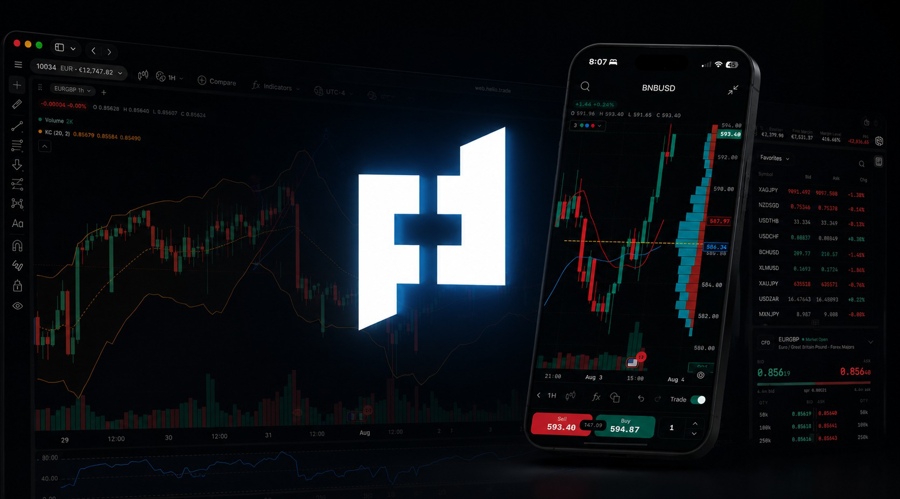
Helio has completed a trading platform designed to disappear behind the broker selling it. Unveiled today (Wednesday), its web terminal and browser-based mobile interface can carry the broker’s name, colors and domain from the first login.
The proposition combines a two-click route to a first trade with configurable workspaces for more experienced users. Brokers can run the interfaces on Helio’s backend or place them over existing infrastructure, with the full package starting at $2,950 a month plus a $6,500 implementation fee.
Ahmad Said, Founder & CEO of Fintake
“Their brand is the one clients see, not ours,” Ahmad Said, Founder & CEO of Fintake, told FinanceMagnates.com.
This is the customer-facing part of the roadmap that Fintake outlined when it launched Helio in March. The earlier release focused on cloud infrastructure, live updates and removing a single point of failure. Brokers can now see what their traders would use.
A Simple First Trade Opens Into a Professional Workspace
The web demo reviewed by FinanceMagnates.com starts with a familiar trading screen, but most parts of it can be moved or expanded. Charts, positions, orders, market depth and the order ticket can share one screen or run in separate workspaces.
The initial order flow is aimed at beginners. A trader selects a market, enters the size and reaches the order button without navigating through a series of separate screens. Take-profit and stop-loss controls remain optional.
Before an order is submitted, the ticket shows leverage, required margin, estimated cost, tick value and the market movement needed to break even. The demo also displayed margin usage against available funds.
More experienced users can open multiple chart panels, add indicators, compare instruments and work with a depth-of-market ladder. The position table includes controls for adding protective orders, reversing a position or increasing its size.
That combination puts Helio into a category already occupied by MT5, cTrader, DXtrade and Match-Trader. Each offers broker administration, multi-asset trading and access across more than one device, though their pricing and integration models differ.
Helio currently lists FX, stock CFDs, crypto derivatives and perpetual futures as supported markets. The demo included perpetual-futures funding rates, contract specifications, trading sessions and leverage tiers. Prediction markets and spot crypto remain in development.
The Broker Brand Comes First
Helio is sold as white-label infrastructure. Traders can use a broker’s domain, colors and visual identity without seeing the technology provider behind the service.
That structure is also why Helio cannot yet name its first production client. A multi-asset broker group regulated across several jurisdictions is routing live customer flow through the Helio backend under its own brand and front ends.
A second broker relationship remains in pilot. Helio said the confidentiality around the live deployment was requested by the client, and the two sides are discussing a joint announcement. An answer is expected by mid-September.
The March profile described Helio as an API-first, front-end-agnostic system. The new release adds Helio’s own interface without removing the option for a broker to build or retain another one.
Mobile Is Meant to Be a Trading Surface, Not a Companion
Helio’s mobile product is a progressive web application (PWA). Traders can open it through a browser, add it to a phone and receive updates without downloading a new version from an app store.
The PWA is designed to include charting, market depth, order entry and position management. Helio also says layouts can synchronize between a desk and phone, and brokers can embed the interface inside an existing application.
FinanceMagnates.com reviewed the desktop terminal but did not test the mobile version. No broker has deployed the new Helio web or mobile interfaces to end clients, and both products remain in evaluation.
“I expect first client trades in Q4,” Said told FinanceMagnates.com. Helio will not set a date before a broker fixes its launch window.
Browser-based mobile access is not new to the sector. Devexperts released a mobile web interface for DXtrade in July 2025, alongside its standalone apps. The webview approach lets brokers place the trading screen inside their own mobile products.
Spotware updated cTrader Mobile to version 5.4 in June 2025, adding time navigation, chart themes and automatic time-zone adjustments. DXtrade and cTrader had released another pair of mobile updates one day apart in March.
The TradingView Connection Is Built, but There Is No Badge
Helio has also clarified the unnamed integration discussed in March. Said confirmed that the connection was built and tested with TradingView for a broker served by both businesses.
TradingView did not operate a certification program for infrastructure providers when the work took place, according to Helio. The connection is onboarded through the client, so Helio does not hold a separate vendor approval badge.
The integration is ready to carry client flow when the common broker launches it, Said said. Helio has not disclosed that launch date or the name of the client.
In March, Said told FinanceMagnates.com that the unnamed partner would be disclosed within weeks. “I was wrong on the timing,” he said in the latest exchange.
Other technology providers use a similar broker-led route. Blueberry added direct TradingView access through DXtrade in June 2025, including access for smaller firms operating as its sub-brokers.
MT5 Alternatives Are Competing on the Whole Stack
The market Helio is entering is no longer a contest between trading screens alone. Vendors increasingly bundle liquidity connections, risk tools, broker administration, mobile access and third-party integrations around the execution engine.
MetaTrader 5 still ran on roughly 68% of global brokerages when FinanceMagnates.com profiled Helio in March. MT5 had also overtaken MT4 by trading volume on MetaQuotes platforms, according to FM Intelligence data cited in that article.
Match-Trader has been expanding from a smaller base. Its developer reported a 290% rise in server clients between January 2024 and August 2025, although it did not provide the absolute number in that announcement.
Spotware moved in the other direction, from a trading platform into standalone infrastructure. It launched cBridge in March 2026 with fixed pricing based on servers and connections instead of trading volume.
Helio combines its own trading server, administration console, web and mobile interfaces and direct liquidity routing. Brokers can take the complete package, use only the front ends or retain another interface over the backend.
What the Full Stack Costs
The published pricing follows active accounts rather than trading volume. Helio’s Launch plan costs $2,950 a month and includes 750 active accounts, one brand and two liquidity connections. Implementation costs $6,500.
The Growth tier costs $6,950 for 3,000 active accounts and four liquidity connections. Scale costs $14,950 for 10,000 accounts, three brands and unlimited liquidity connections.
An account counts as active if it executes a trade, makes a balance transaction or holds an open position during the month. Demo and inactive accounts are free, and Helio says it does not charge volume-based fees.
Native market-data sourcing and direct routing allow a new brokerage to connect to a prime broker, prime-of-prime or liquidity provider without first buying a separate bridge. Established firms can keep their current bridge and venue relationships.
“It is a design decision rather than a claim that we replace bridges,” Said explained.
Price competition has already moved in the same direction. Leverate introduced a free entry tier in February 2026, while its paid plans also use live account counts instead of revenue or volume thresholds.
FinanceMagnates.com reported at the time that cTrader white-label packages started with a $5,000 setup fee and $2,000 monthly charge. Match-Trader started at $2,000 a month, while Soft-FX used separate implementation and subscription fees.
Helio’s standard service-level commitments are 99.95% for Launch and Growth and 99.99% for Scale. According to Said, a 99.999% SLA is also available for enterprise deployments running active-active across multiple regions.
Annual payment reduces the subscription by 10%, and Helio says annual price increases are capped at inflation plus 3%.
Said told FinanceMagnates.com that Helio will demonstrate the web and mobile interfaces at Forex Expo Dubai in September. Helio also expects to present them at iFX EXPO Hong Kong in October, although that appearance has not yet been confirmed.
The commercial test comes next. Brokers are evaluating the interfaces, and Helio expects the first end-client trades through its own screens in Q4.
Helio has completed a trading platform designed to disappear behind the broker selling it. Unveiled today (Wednesday), its web terminal and browser-based mobile interface can carry the broker’s name, colors and domain from the first login.
The proposition combines a two-click route to a first trade with configurable workspaces for more experienced users. Brokers can run the interfaces on Helio’s backend or place them over existing infrastructure, with the full package starting at $2,950 a month plus a $6,500 implementation fee.
Ahmad Said, Founder & CEO of Fintake
“Their brand is the one clients see, not ours,” Ahmad Said, Founder & CEO of Fintake, told FinanceMagnates.com.
This is the customer-facing part of the roadmap that Fintake outlined when it launched Helio in March. The earlier release focused on cloud infrastructure, live updates and removing a single point of failure. Brokers can now see what their traders would use.
A Simple First Trade Opens Into a Professional Workspace
The web demo reviewed by FinanceMagnates.com starts with a familiar trading screen, but most parts of it can be moved or expanded. Charts, positions, orders, market depth and the order ticket can share one screen or run in separate workspaces.
The initial order flow is aimed at beginners. A trader selects a market, enters the size and reaches the order button without navigating through a series of separate screens. Take-profit and stop-loss controls remain optional.
Before an order is submitted, the ticket shows leverage, required margin, estimated cost, tick value and the market movement needed to break even. The demo also displayed margin usage against available funds.
More experienced users can open multiple chart panels, add indicators, compare instruments and work with a depth-of-market ladder. The position table includes controls for adding protective orders, reversing a position or increasing its size.
That combination puts Helio into a category already occupied by MT5, cTrader, DXtrade and Match-Trader. Each offers broker administration, multi-asset trading and access across more than one device, though their pricing and integration models differ.
Helio currently lists FX, stock CFDs, crypto derivatives and perpetual futures as supported markets. The demo included perpetual-futures funding rates, contract specifications, trading sessions and leverage tiers. Prediction markets and spot crypto remain in development.
The Broker Brand Comes First
Helio is sold as white-label infrastructure. Traders can use a broker’s domain, colors and visual identity without seeing the technology provider behind the service.
That structure is also why Helio cannot yet name its first production client. A multi-asset broker group regulated across several jurisdictions is routing live customer flow through the Helio backend under its own brand and front ends.
A second broker relationship remains in pilot. Helio said the confidentiality around the live deployment was requested by the client, and the two sides are discussing a joint announcement. An answer is expected by mid-September.
The March profile described Helio as an API-first, front-end-agnostic system. The new release adds Helio’s own interface without removing the option for a broker to build or retain another one.
Mobile Is Meant to Be a Trading Surface, Not a Companion
Helio’s mobile product is a progressive web application (PWA). Traders can open it through a browser, add it to a phone and receive updates without downloading a new version from an app store.
The PWA is designed to include charting, market depth, order entry and position management. Helio also says layouts can synchronize between a desk and phone, and brokers can embed the interface inside an existing application.
FinanceMagnates.com reviewed the desktop terminal but did not test the mobile version. No broker has deployed the new Helio web or mobile interfaces to end clients, and both products remain in evaluation.
“I expect first client trades in Q4,” Said told FinanceMagnates.com. Helio will not set a date before a broker fixes its launch window.
Browser-based mobile access is not new to the sector. Devexperts released a mobile web interface for DXtrade in July 2025, alongside its standalone apps. The webview approach lets brokers place the trading screen inside their own mobile products.
Spotware updated cTrader Mobile to version 5.4 in June 2025, adding time navigation, chart themes and automatic time-zone adjustments. DXtrade and cTrader had released another pair of mobile updates one day apart in March.
The TradingView Connection Is Built, but There Is No Badge
Helio has also clarified the unnamed integration discussed in March. Said confirmed that the connection was built and tested with TradingView for a broker served by both businesses.
TradingView did not operate a certification program for infrastructure providers when the work took place, according to Helio. The connection is onboarded through the client, so Helio does not hold a separate vendor approval badge.
The integration is ready to carry client flow when the common broker launches it, Said said. Helio has not disclosed that launch date or the name of the client.
In March, Said told FinanceMagnates.com that the unnamed partner would be disclosed within weeks. “I was wrong on the timing,” he said in the latest exchange.
Other technology providers use a similar broker-led route. Blueberry added direct TradingView access through DXtrade in June 2025, including access for smaller firms operating as its sub-brokers.
MT5 Alternatives Are Competing on the Whole Stack
The market Helio is entering is no longer a contest between trading screens alone. Vendors increasingly bundle liquidity connections, risk tools, broker administration, mobile access and third-party integrations around the execution engine.
MetaTrader 5 still ran on roughly 68% of global brokerages when FinanceMagnates.com profiled Helio in March. MT5 had also overtaken MT4 by trading volume on MetaQuotes platforms, according to FM Intelligence data cited in that article.
Match-Trader has been expanding from a smaller base. Its developer reported a 290% rise in server clients between January 2024 and August 2025, although it did not provide the absolute number in that announcement.
Spotware moved in the other direction, from a trading platform into standalone infrastructure. It launched cBridge in March 2026 with fixed pricing based on servers and connections instead of trading volume.
Helio combines its own trading server, administration console, web and mobile interfaces and direct liquidity routing. Brokers can take the complete package, use only the front ends or retain another interface over the backend.
What the Full Stack Costs
The published pricing follows active accounts rather than trading volume. Helio’s Launch plan costs $2,950 a month and includes 750 active accounts, one brand and two liquidity connections. Implementation costs $6,500.
The Growth tier costs $6,950 for 3,000 active accounts and four liquidity connections. Scale costs $14,950 for 10,000 accounts, three brands and unlimited liquidity connections.
An account counts as active if it executes a trade, makes a balance transaction or holds an open position during the month. Demo and inactive accounts are free, and Helio says it does not charge volume-based fees.
Native market-data sourcing and direct routing allow a new brokerage to connect to a prime broker, prime-of-prime or liquidity provider without first buying a separate bridge. Established firms can keep their current bridge and venue relationships.
“It is a design decision rather than a claim that we replace bridges,” Said explained.
Price competition has already moved in the same direction. Leverate introduced a free entry tier in February 2026, while its paid plans also use live account counts instead of revenue or volume thresholds.
FinanceMagnates.com reported at the time that cTrader white-label packages started with a $5,000 setup fee and $2,000 monthly charge. Match-Trader started at $2,000 a month, while Soft-FX used separate implementation and subscription fees.
Helio’s standard service-level commitments are 99.95% for Launch and Growth and 99.99% for Scale. According to Said, a 99.999% SLA is also available for enterprise deployments running active-active across multiple regions.
Annual payment reduces the subscription by 10%, and Helio says annual price increases are capped at inflation plus 3%.
Said told FinanceMagnates.com that Helio will demonstrate the web and mobile interfaces at Forex Expo Dubai in September. Helio also expects to present them at iFX EXPO Hong Kong in October, although that appearance has not yet been confirmed.
The commercial test comes next. Brokers are evaluating the interfaces, and Helio expects the first end-client trades through its own screens in Q4.


