

For online merchants, payment processing can have a direct impact on revenue.
A customer who cannot complete a deposit or purchase because a payment fails may not try again. For businesses operating across multiple countries, the issue can become even more complex as payment performance can vary between markets, providers and payment methods.
This is driving more businesses to look beyond a single payment service provider (PSP) and consider multi-PSP routing as part of their payment strategy.
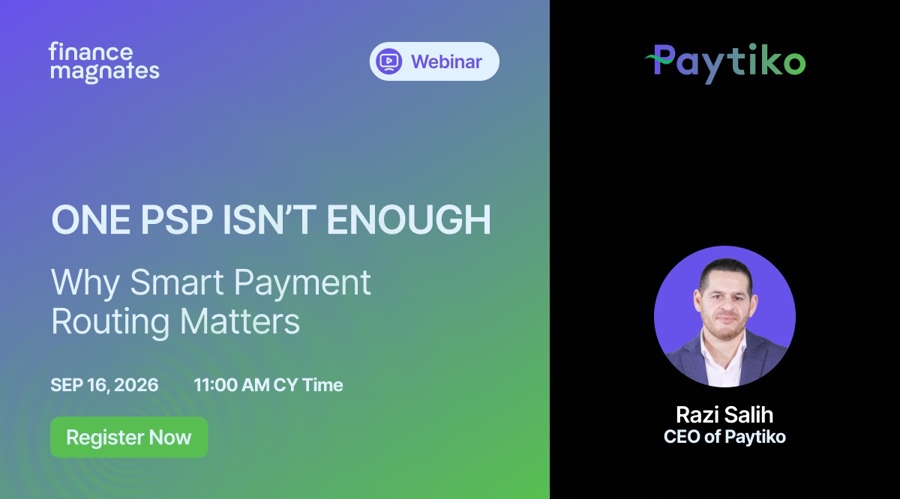
Finance Magnates will explore this topic in an upcoming webinar with Paytiko, “Beyond the Single Processor: Why Multi-PSP Routing Is Becoming Non-Negotiable,” taking place on September 16, 2026, at 11:00 AM Cyprus time.
The session will feature Razi Saleh, CEO of Paytiko, who will explain how smart payment routing works and why payment orchestration is becoming an important part of the payment stack for online businesses.
Why Is a Single PSP No Longer Enough?
Using one payment provider can make a payment setup easier to manage. But as merchants grow, that simplicity can also create risk.
If the provider experiences an outage, has lower approval rates in a particular market or struggles with a specific payment method, the merchant may have limited alternatives.
This can lead to failed transactions and lost revenue.
The issue is especially relevant for businesses operating across several markets. A PSP that performs well in one region may not provide the same results elsewhere.
Payment orchestration platforms aim to address this by connecting merchants to multiple PSPs through a central technology layer.
Paytiko currently describes its platform as a payment orchestration solution that connects businesses with more than 500 payment partners across 170 countries.
What Is Multi-PSP Routing?
Multi-PSP routing allows merchants to work with several payment service providers instead of sending every transaction through a single provider.
A payment orchestration platform can use predefined rules and performance data to determine where a transaction should be processed.
Routing decisions can take factors such as these into account:
-
Approval rates
-
Geography
-
Payment method
-
Currency
-
Processing costs
-
PSP availability
-
Transaction performance
-
Decline rates
The aim is to give merchants more control over how payments are processed while reducing their reliance on any single provider.
Paytiko’s smart routing system, for example, is designed to redirect declined card payments to fallback providers without disrupting the customer experience.
How Does Smart Payment Routing Work?
The process can be relatively simple from the customer’s point of view.
A customer starts a payment on a merchant’s website or platform. The transaction enters the payment orchestration layer, which determines which PSP should process it based on the merchant’s routing rules.
The transaction is then sent to the selected provider.
If the payment cannot be processed through that route, a fallback provider may be used, depending on the rules and the reason for the failure.
This means the customer does not necessarily need to start the payment process again or manually select another payment provider.
For merchants, this can create a more flexible payment setup.
What Happens When a PSP Goes Down?
One of the main benefits of having multiple PSPs is payment failover.
Consider a merchant that relies entirely on one provider. If that provider experiences a technical issue, transactions may fail until the problem is resolved.
With several providers connected to a payment orchestration platform, merchants can have alternative routes available.
If the primary route becomes unavailable, the transaction can potentially be redirected to another provider.
Paytiko says its smart routing technology can redirect card payment declines to fallback providers for another approval attempt.
The key issue for merchants is not simply having several PSPs.
It is having a clear strategy for deciding which provider should handle which transaction and when a transaction should move to another route.
How Should Merchants Audit Their Payment Stack?
Before adding more PSPs, merchants should understand how their current payment setup performs.
A payment audit should ask:
Which PSP has the highest approval rate?
Review payment performance by provider rather than looking only at the overall business approval rate.
Which markets perform best?
Compare payment success rates by country and region.
Why are transactions failing?
Declines can have different causes. Understanding the reason behind failed transactions can help merchants decide whether routing changes are needed.
What happens during an outage?
A business should know exactly what happens if its primary PSP becomes unavailable.
Is there a fallback route?
Having a second PSP is only useful if the payment flow can actually use it when needed.
How much does each route cost?
Payment costs should be considered alongside approval rates when reviewing provider performance.
Can the data be viewed in one place?
A central view of transactions, providers, declines and payment performance can make it easier to identify weak points.
These checks can help merchants find potential single points of failure before they become a bigger business issue.
Finance Magnates Webinar: Beyond the Single Processor
To explore these questions in more detail, Finance Magnates & Paytiko will host “Beyond the Single Processor: Why Multi-PSP Routing Is Becoming Non-Negotiable” on September 16, 2026, at 11:00 AM Nicosia time.
The webinar will feature Razi Saleh, CEO of Paytiko.
Saleh’s background includes online marketing, banking, media buying and the trading and brokerage industry. He brings experience from working with businesses that face payment challenges across different markets and transaction flows.
What Will Attendees Learn?
The webinar will provide a practical look at multi-PSP routing, payment orchestration and payment failover.
Topics will include:
-
Why relying on one PSP can create business risk
-
How smart payment routing works
-
How transactions are routed between PSPs
-
What happens when a PSP goes down
-
How payment failover works
-
How approval rates can differ across providers and markets
-
How merchants can benchmark their payment performance
-
How geography and cost can influence routing
-
How to identify single points of failure
-
How to audit an existing payment stack
The goal is to give attendees practical ideas they can apply when reviewing their own payment infrastructure.
Meet Razi Saleh, CEO of Paytiko
Razi Saleh is the CEO of Paytiko, a payment orchestration platform focused on fintech, trading and online businesses.
Paytiko’s platform connects payment providers and offers tools for managing pay-ins, pay-outs, reconciliation, reporting and payment routing. The company says its platform currently connects merchants with more than 500 payment partners across 170 countries.
Paytiko has also continued to develop its payment orchestration capabilities in 2026, with the company highlighting dynamic routing based on factors including success rates, processing costs and geographic coverage.
Register for the Webinar
Join Razi Saleh, CEO of Paytiko, and Finance Magnates on September 16, 2026, at 11:00 AM Nicosia time to learn how smart payment routing works, how failover can reduce payment disruption and how merchants can assess their own payment performance.
[REGISTER FOR THE WEBINAR]
Webinar: Beyond the Single Processor: Why Multi-PSP Routing Is Becoming Non-Negotiable
Date: September 16, 2026
Time: 11:00 AM Nicosia time
Speaker: Razi Saleh, CEO of Paytiko
For online merchants, payment processing can have a direct impact on revenue.
A customer who cannot complete a deposit or purchase because a payment fails may not try again. For businesses operating across multiple countries, the issue can become even more complex as payment performance can vary between markets, providers and payment methods.
This is driving more businesses to look beyond a single payment service provider (PSP) and consider multi-PSP routing as part of their payment strategy.
Finance Magnates will explore this topic in an upcoming webinar with Paytiko, “Beyond the Single Processor: Why Multi-PSP Routing Is Becoming Non-Negotiable,” taking place on September 16, 2026, at 11:00 AM Cyprus time.
The session will feature Razi Saleh, CEO of Paytiko, who will explain how smart payment routing works and why payment orchestration is becoming an important part of the payment stack for online businesses.
Why Is a Single PSP No Longer Enough?
Using one payment provider can make a payment setup easier to manage. But as merchants grow, that simplicity can also create risk.
If the provider experiences an outage, has lower approval rates in a particular market or struggles with a specific payment method, the merchant may have limited alternatives.
This can lead to failed transactions and lost revenue.
The issue is especially relevant for businesses operating across several markets. A PSP that performs well in one region may not provide the same results elsewhere.
Payment orchestration platforms aim to address this by connecting merchants to multiple PSPs through a central technology layer.
Paytiko currently describes its platform as a payment orchestration solution that connects businesses with more than 500 payment partners across 170 countries.
What Is Multi-PSP Routing?
Multi-PSP routing allows merchants to work with several payment service providers instead of sending every transaction through a single provider.
A payment orchestration platform can use predefined rules and performance data to determine where a transaction should be processed.
Routing decisions can take factors such as these into account:
-
Approval rates
-
Geography
-
Payment method
-
Currency
-
Processing costs
-
PSP availability
-
Transaction performance
-
Decline rates
The aim is to give merchants more control over how payments are processed while reducing their reliance on any single provider.
Paytiko’s smart routing system, for example, is designed to redirect declined card payments to fallback providers without disrupting the customer experience.
How Does Smart Payment Routing Work?
The process can be relatively simple from the customer’s point of view.
A customer starts a payment on a merchant’s website or platform. The transaction enters the payment orchestration layer, which determines which PSP should process it based on the merchant’s routing rules.
The transaction is then sent to the selected provider.
If the payment cannot be processed through that route, a fallback provider may be used, depending on the rules and the reason for the failure.
This means the customer does not necessarily need to start the payment process again or manually select another payment provider.
For merchants, this can create a more flexible payment setup.
What Happens When a PSP Goes Down?
One of the main benefits of having multiple PSPs is payment failover.
Consider a merchant that relies entirely on one provider. If that provider experiences a technical issue, transactions may fail until the problem is resolved.
With several providers connected to a payment orchestration platform, merchants can have alternative routes available.
If the primary route becomes unavailable, the transaction can potentially be redirected to another provider.
Paytiko says its smart routing technology can redirect card payment declines to fallback providers for another approval attempt.
The key issue for merchants is not simply having several PSPs.
It is having a clear strategy for deciding which provider should handle which transaction and when a transaction should move to another route.
How Should Merchants Audit Their Payment Stack?
Before adding more PSPs, merchants should understand how their current payment setup performs.
A payment audit should ask:
Which PSP has the highest approval rate?
Review payment performance by provider rather than looking only at the overall business approval rate.
Which markets perform best?
Compare payment success rates by country and region.
Why are transactions failing?
Declines can have different causes. Understanding the reason behind failed transactions can help merchants decide whether routing changes are needed.
What happens during an outage?
A business should know exactly what happens if its primary PSP becomes unavailable.
Is there a fallback route?
Having a second PSP is only useful if the payment flow can actually use it when needed.
How much does each route cost?
Payment costs should be considered alongside approval rates when reviewing provider performance.
Can the data be viewed in one place?
A central view of transactions, providers, declines and payment performance can make it easier to identify weak points.
These checks can help merchants find potential single points of failure before they become a bigger business issue.
Finance Magnates Webinar: Beyond the Single Processor
To explore these questions in more detail, Finance Magnates & Paytiko will host “Beyond the Single Processor: Why Multi-PSP Routing Is Becoming Non-Negotiable” on September 16, 2026, at 11:00 AM Nicosia time.
The webinar will feature Razi Saleh, CEO of Paytiko.
Saleh’s background includes online marketing, banking, media buying and the trading and brokerage industry. He brings experience from working with businesses that face payment challenges across different markets and transaction flows.
What Will Attendees Learn?
The webinar will provide a practical look at multi-PSP routing, payment orchestration and payment failover.
Topics will include:
-
Why relying on one PSP can create business risk
-
How smart payment routing works
-
How transactions are routed between PSPs
-
What happens when a PSP goes down
-
How payment failover works
-
How approval rates can differ across providers and markets
-
How merchants can benchmark their payment performance
-
How geography and cost can influence routing
-
How to identify single points of failure
-
How to audit an existing payment stack
The goal is to give attendees practical ideas they can apply when reviewing their own payment infrastructure.
Meet Razi Saleh, CEO of Paytiko
Razi Saleh is the CEO of Paytiko, a payment orchestration platform focused on fintech, trading and online businesses.
Paytiko’s platform connects payment providers and offers tools for managing pay-ins, pay-outs, reconciliation, reporting and payment routing. The company says its platform currently connects merchants with more than 500 payment partners across 170 countries.
Paytiko has also continued to develop its payment orchestration capabilities in 2026, with the company highlighting dynamic routing based on factors including success rates, processing costs and geographic coverage.
Register for the Webinar
Join Razi Saleh, CEO of Paytiko, and Finance Magnates on September 16, 2026, at 11:00 AM Nicosia time to learn how smart payment routing works, how failover can reduce payment disruption and how merchants can assess their own payment performance.
[REGISTER FOR THE WEBINAR]
Webinar: Beyond the Single Processor: Why Multi-PSP Routing Is Becoming Non-Negotiable
Date: September 16, 2026
Time: 11:00 AM Nicosia time
Speaker: Razi Saleh, CEO of Paytiko


