

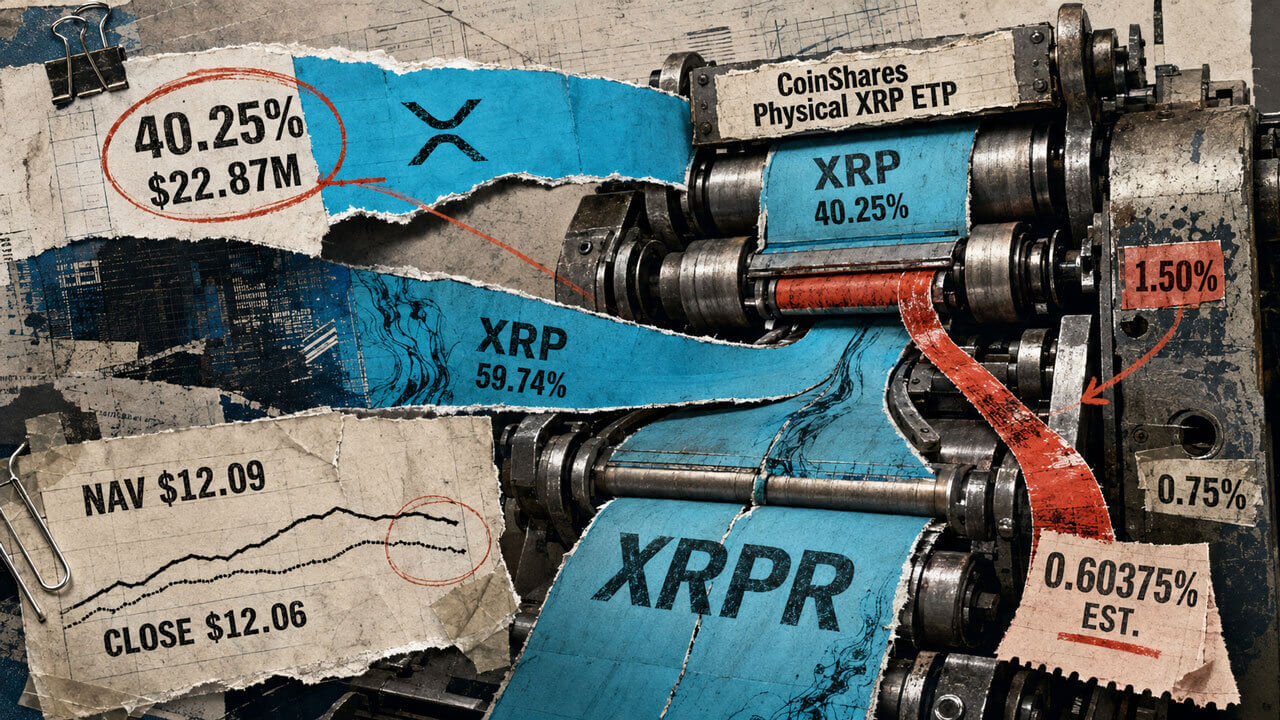
REX-Osprey’s XRP ETF held 40.25% of its assets in the CoinShares Physical XRP ETP on Aug. 24, routing $22.87 million of a $56.68 million portfolio through another listed product. That structure means XRP ETF fees and trading costs can stack up across two listed products. The same holdings snapshot reported 59.74% as XRP, with 4.7 million XRPR shares outstanding, a $12.09 net asset value and a $12.06 closing price.
That split is not evidence that the CoinShares position lacks XRP backing. CoinShares says its product is 100% physically backed. Nor should XRPR’s XRP line be read as proof that the parent fund directly owns every token: its February shareholder report consolidates a Cayman subsidiary used for XRP exposure.
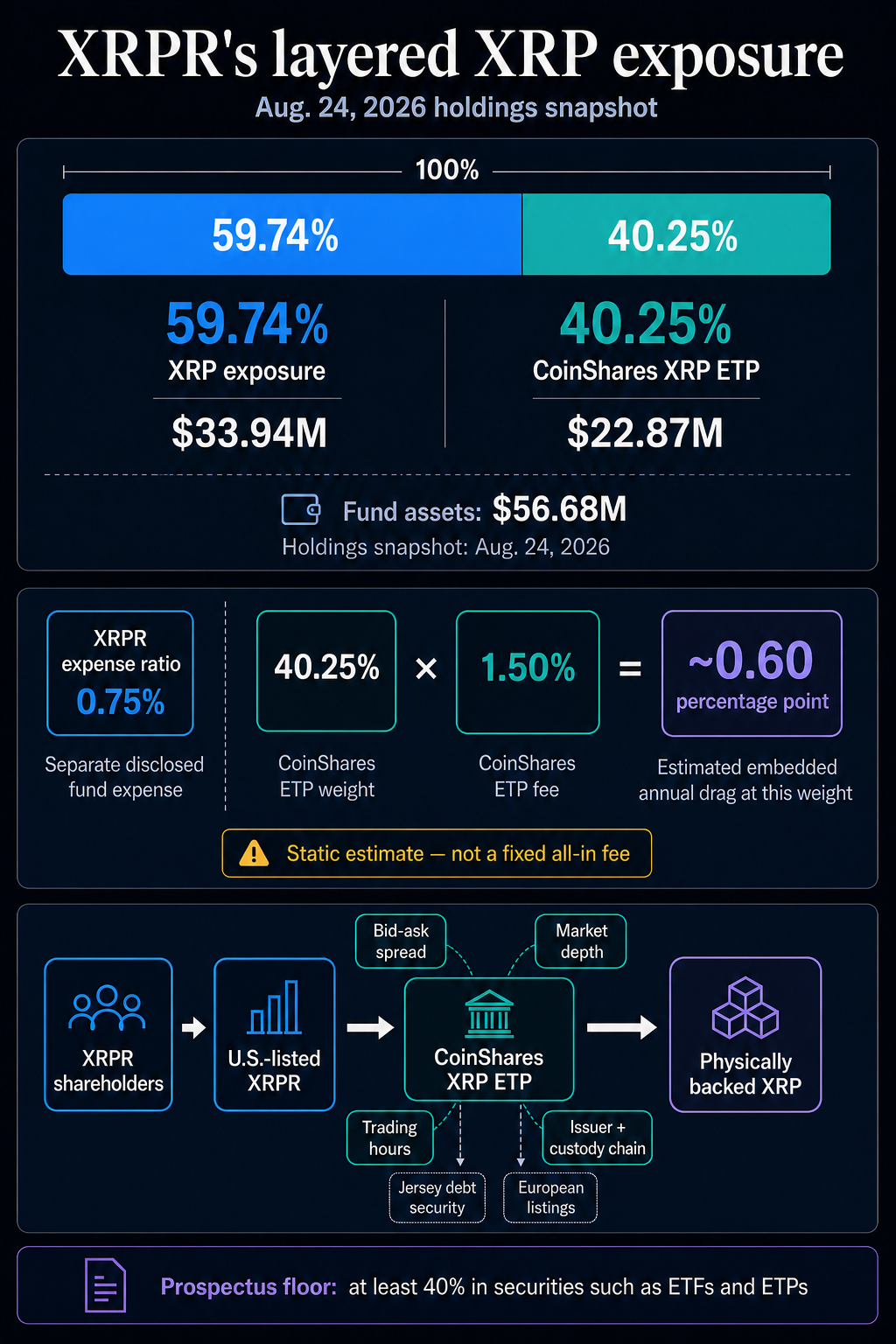
The allocation is consistent with XRPR’s disclosed mandate. Its June 30 prospectus says the fund seeks to keep at least 80% of assets in XRP and instruments providing XRP exposure, while investing at least 40% in securities such as ETFs and non-U.S. exchange-traded products. At 40.25%, the CoinShares sleeve sits just above that floor.
How XRP ETF fees stack up in the second layer
XRPR discloses a 0.75% total annual operating expense ratio. CoinShares lists a 1.50% annual fee for its XRP ETP. Applying that fee to the Aug. 24 weight produces an estimated 0.60375 percentage-point annual drag inside XRPR before changes in allocation, prices or expenses.
That estimate is not a fixed all-in XRPR fee. The underlying product’s charge is reflected in its own value, while XRPR’s 0.75% is the fund’s disclosed operating expense figure. REX-Osprey’s statement of additional information says shareholders indirectly bear acquired-vehicle fees in addition to the fund’s own expenses, but the weight can change daily and accounting treatment can affect how the cost appears.
The sleeve can also create tracking differences beyond the stated fee. XRPR investors trade a U.S.-listed ETF, while part of its exposure comes through a Jersey-domiciled debt security listed on European exchanges. CoinShares reported $168.75 million of product assets on Aug. 21, but the XRPR holdings snapshot does not show the position’s current bid-ask spread, market depth or execution price.
Those market frictions matter when XRPR has to rebalance, create or redeem shares, or trade while the underlying venue is less liquid or operating on different hours. The extra security also adds an issuer, custody and trading-venue chain between XRPR and the XRP backing. CoinShares’ physical-backing disclosure addresses the asset backing; it does not eliminate the legal and execution differences between holding XRP exposure through an ETP and obtaining it elsewhere.
For shareholders, the practical impact of XRP ETF fees is return divergence: how closely XRPR’s net asset value follows XRP after its own expenses, the weighted CoinShares fee, and the trading costs of maintaining the required securities sleeve.


