

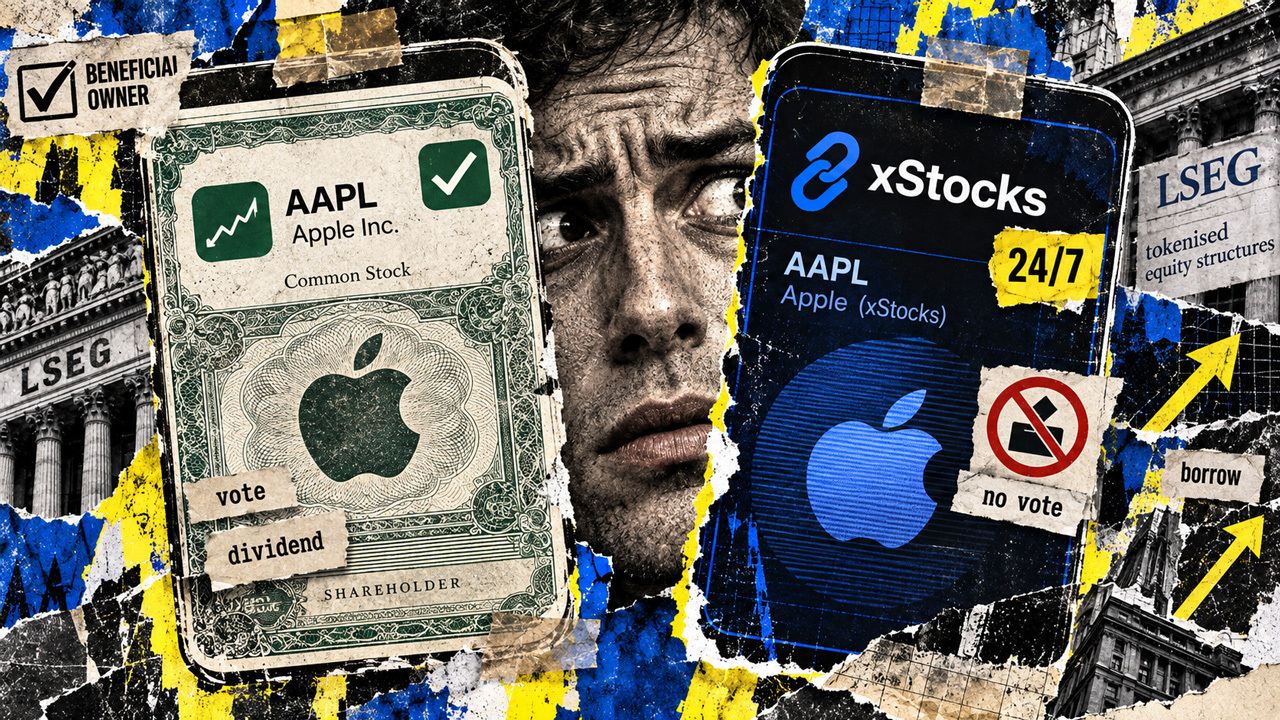
Tokenized stocks promise cheaper trading and wider access, while some products make speculation easier without passing shareholder rights to the buyer.
Two people can open their investment apps, see the same company name beside a similar price, and still own different things. One holds shares in the company, and the other holds a token designed to follow those shares. Both benefit if the price goes up, but that doesn’t settle what either person is entitled to receive or control.
You can easily lose that distinction when you look at an attractive interface. Familiar tickers and buy buttons make the transaction look and feel like buying stocks, even when the contract underneath it is different.
The London Stock Exchange is now exploring how to bring shares onto blockchain networks while preserving shareholder rights. Its Sep. 1 announcement with Payward describes a structure still under assessment and subject to regulatory approval. Separately, it plans to list xStocks on its LSE 24 venue in 2027, also subject to approval.
Those projects pursue different versions of access. One aims to preserve the relationship between investors and the companies they own, while the other wants to give a separate stock-linked product another place to trade.
The effects this could have reach beyond paperwork to what kind of market tokenization is helping build, and whether its expanding audience gets more ownership or just more ways to bet on prices.
What owning stocks actually gives you
Shares represent ownership interests in companies. Their exact rights depend on the share class and applicable rules, but common shareholders typically participate in the business’s financial fortunes and can vote on certain corporate decisions.
If the company distributes a dividend, every eligible shareholder receives it. If the business fails, shareholders have a residual claim, which means they get whatever is left once claims ranking above theirs have been paid. More often than not, that’s nothing, and shareholders bear that business risk as part of owning the company.
Most people don’t appear personally on every record used to administer those rights. Brokers usually hold shares through nominees and keep their own records of the customers entitled to them. Those investors are called beneficial owners. The SEC distinguishes that arrangement from direct registration, where the owner holds shares in their own name with the company.
Ordinary brokerage accounts already rely on several organizations to maintain records and pass entitlements along. Shareholders can exercise rights through that chain, with voting instructions and dividend payments traveling through intermediaries.
Tokenization introduces another way to maintain and transfer a record. Tokens are digital units that move between accounts on a blockchain. The network records control of those units; the legal arrangement determines what their owners are entitled to receive.
Companies could use that technology for their own shares. Where ownership records recognize the transfer, sending tokens can transfer the shares themselves. The SEC staff’s January taxonomy describes issuer-sponsored structures as well as products created by unrelated third parties. But this is a staff explanation of different arrangements, not blanket approval of every token carrying a company name.
Recording shares this way can preserve their existing rights while making transfers easier to administer. The technology leaves room for that choice.
However, a much more confusing arrangement starts when someone other than the company creates a new product linked to its shares.
Your token comes with its own fine print
Imagine a business buying shares and keeping them with a custodian. It then issues tokens intended to track the value of those holdings, so customers buying those tokens receive that business’s product. That means that the original company hasn’t necessarily issued anything new or entered into a relationship with the token buyer.
There are now two investments to keep track of: the underlying shares and the instrument representing exposure to them. Backing the second with the first can help it track the price, but it doesn’t automatically pass every shareholder right through the arrangement.
Kraken makes that distinction in its xStocks documentation. It describes tokens backed by underlying equities but says holders don’t receive the underlying shareholder voting rights. The economic benefit of dividends is reflected through an adjustment to their effective holdings rather than a separate cash payment. The tokens also can’t be transferred into an ordinary brokerage account as the underlying shares.
The dividend treatment is easier to understand with a small example. Suppose an investment represents $100 of share exposure and receives a $2 net dividend that is reinvested at $100 per share. Ignoring fees and price movement for this illustration, that buys another 0.02 shares of exposure. The holding now represents 1.02 shares rather than one.
The owner now has more share exposure, with the $2 reinvested rather than available to spend. Different products apply their own tax treatment and adjustment methods. In xStocks, the displayed effective balance can increase through a multiplier even while the underlying on-chain token count stays the same.
The dividend benefit belongs to the token’s financial design. Shareholder status depends on a separate legal relationship with the company whose shares support it.
| Arrangement | What the investor holds | Voting in the underlying company | How dividends reach the investor |
|---|---|---|---|
| Ordinary shares through a broker | Beneficial ownership of the shares | Usually through the broker, subject to share class and account terms | Normally credited through the account; reinvestment may be available |
| Company-sponsored tokenized shares | The share itself, if the legal records and token transfer are integrated that way | Determined by the share class and the issuer’s arrangements | Determined by the share’s rights and payment arrangements |
| xStocks | Separate tokens providing exposure to the underlying investment | No underlying shareholder vote under the published terms | Economic benefit reflected in adjusted holdings rather than separate cash |
The middle row describes a possible legal structure, not an already approved LSEG product. Product terms and jurisdiction determine the details.
Those relationships become especially important when something goes wrong. Shareholders’ claims against a company can differ from token holders’ claims involving an issuer. If that issuer fails, recovery depends on the custody and collateral arrangements and how insolvency law treats them.
Proof of backing only establishes that assets exist; it’s the contract that determines how holders can reach them. Keeping tokens in your own wallet gives you control over their transfer, while the underlying shares continue to depend on the businesses holding and administering them. CryptoSlate’s coverage of the companies holding tokenized equity reserves traces that dependence behind the promise of easier transfers.
For people who struggle to access foreign stocks, easier entry can be a real improvement. Small purchases and transfers between compatible apps can make investing more convenient, especially across time zones, and a significant number of buyers will knowingly value that flexibility more than a shareholder vote. Fractional investing already exists through conventional brokers, though, and any advantage depends on the services a person can actually use.
Access also has legal boundaries. Kraken excludes several jurisdictions, including the US, from its xStocks offering. Globally transferable software still operates within distribution rules, and holding tokens in a wallet provides no universal entitlement to buy every product.
All of the other promises tokenized stock products make also deserve the same kind of scrutiny.
Blockchain records make token transfers visible, but leave custody agreements and competing legal claims elsewhere. Businesses can automate parts of that settlement, but the bill may still include conversion charges and the gap between buying and selling prices. Kraken’s fee documentation, for example, distinguishes between purchase methods and notes that some transactions can include a spread. Lower costs have to survive the entire transaction to benefit the investor.
Adding trading hours also doesn’t automatically produce liquidity. Weekend token markets can operate while the underlying stock exchange is closed. During those hours, traders have fewer ways to buy the shares or offset their exposure, so token prices can stray from the stock’s last quoted price. Splitting activity across incompatible venues can also leave each with fewer willing counterparties.
However, the commercial attraction is easy to understand. Platforms that earn fees or part of a trading spread benefit when customers transact more often. They can charge less per trade and still do well if activity expands enough. Investors benefit when access improves the investments available to them or reduces their costs; the number of trades they make is a poor substitute for either outcome.
But all of this comes at a price. Extending the hours and adding more entrances can turn stock exposure into something available for continuous speculation. That becomes especially consequential when these tokens get big and popular enough to be pledged to borrow money, and the borrowed funds can buy more tokens.
Consider a hypothetical investor with $100 in tokens who borrows $50 against them and buys another $50 of exposure. They now have $150 exposed to the stock price and owe $50. If the tokens fall 20%, their holdings are worth $120, leaving $70 once the debt is subtracted. Their own $100 has lost 30%, before interest and fees. Depending on the lending terms, forced sales could occur before they choose to exit.
Borrowing against securities is already possible in conventional markets. Tokenization can make that activity accessible through more applications and connect it to automated sales when collateral falls below a required threshold. Several borrowers hitting those thresholds together can add selling into a falling market.
The Financial Stability Board’s 2024 assessment examined this potential for easier collateral use to expand borrowing and transmit losses. It also recognized possible efficiency gains. At the time, it judged tokenization’s scale too small to pose a material financial-stability risk. Its warning concerned what broader adoption and more interconnected arrangements could produce, rather than a finding that stock tokens had already destabilized markets.
The claim that tokenization props up stocks also needs to be addressed. Issuers buying backing shares for newly created tokens can add demand in the underlying market. Investors switching from ordinary shares into tokens, however, may largely relocate existing exposure, while redemptions can put the process into reverse. Faster distribution creates another route for buying and selling; its effect on prices depends on the balance of those decisions.
There’s also a difference between funding companies and trading their existing shares. Most secondary-market purchases pay an existing owner. They can help companies indirectly if a more accessible market makes future fundraising easier, but a token trade supplies no automatic addition to the business’s cash or productive capacity.
The biggest danger here is treating a larger market for stock exposure as sufficient evidence of progress. Easier access can broaden participation while leaving newcomers with fewer rights and more opportunities to borrow against an investment they barely understand. Public transaction records offer only partial protection when the decisive obligations are in contracts elsewhere.
LSEG’s proposals show that stronger ownership and wider distribution are distinct design choices.
Tokenization deserves credit where it lowers the full cost of investing or makes enforceable ownership easier to hold and transfer.
Where it mostly adds trading hours and borrowing opportunities to products with weaker claims, the businesses selling access may gain more than the people buying it. The rights and protections delivered with that access should determine how much enthusiasm the product deserves.


