


President Donald Trump has reportedly agreed to proposed ethics restrictions tied to sweeping US cryptocurrency legislation, addressing one of the biggest obstacles in months of negotiations and shifting the next decision to Senate Democrats who have demanded limits on how public officials can profit from digital assets.
The agreement came after Trump met last week with Republican Sens. Bernie Moreno of Ohio and Cynthia Lummis of Wyoming and White House crypto adviser Patrick Witt to discuss ethics provisions for the Digital Asset Market Clarity Act, or CLARITY Act.
No agreement emerged from the July 16 meeting, but Trump subsequently approved proposed language on Monday, according to reports.
Moreno told CNBC’s Emily Wilkins that Trump had accepted what he described as “the most aggressive ethics language” in US history and said Republicans and Democrats were expected to continue talks.
The development does not guarantee Democratic support because lawmakers involved in the negotiations had not yet reviewed the newly approved text when Trump’s position was reported.
That makes the president’s decision less an end to the ethics fight than a change in who must act next.
Democrats now face the compromise
The CLARITY Act would establish a federal framework for digital-asset markets, expanding Commodity Futures Trading Commission (CFTC) oversight of digital commodities while preserving Securities and Exchange Commission (SEC) authority over securities. It would also impose registration and customer-protection requirements on crypto intermediaries.
But Trump’s concession alone does not provide the votes needed to pass it.
The House passed an earlier version of H.R. 3633 by a 294-134 vote in July 2025. The Senate Banking Committee advanced its version 15-9 on May 14, with Democratic Sens. Ruben Gallego of Arizona and Angela Alsobrooks of Maryland joining Republicans.
Both Democratic senators, however, made clear that their committee votes did not guarantee support when the legislation reached the Senate floor.
Alsobrooks said after the committee vote that lawmakers still needed an ethics agreement covering not only the president and vice president but members of Congress. She also identified financial-crime provisions as unfinished business.
Republicans would need Democratic support to overcome a filibuster, which requires 60 votes. The committee bill received support from only two Democrats, leaving its sponsors needing several more votes if the measure encounters procedural opposition on the floor.
Senators are also working through other disputes, including decentralized finance and illicit-finance provisions. An agreement on ethics would therefore eliminate a major source of disagreement without resolving every remaining issue.
Before last week’s White House meeting, Democrats involved in the talks had objected to Republican ethics proposals they considered insufficient.
Gallego, one of the Democratic lawmakers most closely involved in negotiations, had previously criticized Republican language as too weak.
Democrats were not represented at the July 16 White House meeting where Republican lawmakers presented their approach to Trump.
The next test is whether the language Trump accepted closes enough of that gap.
Trump’s crypto income raised stakes of ethics fight
The dispute has taken on greater significance because Trump is not merely overseeing an administration developing crypto policy. His family has substantial financial interests in the industry.
Trump’s annual financial disclosure for 2025 showed more than $1.4 billion in income connected to family cryptocurrency ventures, including World Liberty Financial and businesses associated with the TRUMP memecoin. Companies linked to Trump received almost $800 million from World Liberty alone, including proceeds from token sales and the sale of interests in the company.
Those figures strengthened Democratic demands for rules governing crypto holdings and business relationships involving presidents, vice presidents, lawmakers and other senior federal officials.
Sen. Elizabeth Warren of Massachusetts, one of the bill’s most persistent critics, has argued that approving market-structure legislation without stronger ethics protections could allow Trump to continue benefiting financially from an industry affected by decisions made by his administration.
The issue had already surfaced during the Senate Banking Committee’s May markup. An amendment proposed by Democratic Sen. Chris Van Hollen of Maryland that sought restrictions on crypto business ties involving senior government officials failed 11-13. Ethics negotiations continued after the committee advanced the overall bill.
Trump’s willingness to accept new restrictions was therefore viewed by negotiators as an important condition for a broader agreement.
The president had repeatedly called for Congress to pass crypto market-structure legislation, but until the latest negotiations it was uncertain how far he would go in supporting provisions that could affect his own family’s business interests.
Senate clock adds another obstacle
Even if Democrats and Republicans reach an ethics compromise, lawmakers have little room left for delay.
The Senate’s scheduled August state work period begins Aug. 10, meaning supporters effectively have only the remainder of July and the first week of August to assemble the necessary votes under the current calendar. The approaching midterm elections could make reviving the legislation later in the year more difficult.
The Banking Committee’s May vote moved CLARITY substantially closer to the Senate floor, but passage there would still not send the legislation directly to Trump.
The Senate version contains changes from the bill approved by the House, and lawmakers must also deal with provisions falling under the jurisdiction of the Senate Agriculture Committee, which oversees the CFTC.
Any final Senate package that differs from the House-approved measure would need to be reconciled before the legislation could reach the president.
Lummis has said she expects the Senate to move ahead with CLARITY and has pushed for action before lawmakers leave Washington.
Therefore, the compressed timetable means even an ethics agreement would only reopen a path to passage rather than guarantee one. Lawmakers would still need to settle remaining policy disputes, secure enough Democratic votes and complete the legislative process before the August break.
Crypto industry increases pressure for a deal
Industry groups and executives have meanwhile intensified pressure on lawmakers to prevent the ethics disagreement from derailing the broader regulatory package.
Kristin Smith, president of the Solana Policy Institute, said the legislation had changed substantially since its House passage, including additions covering illicit finance, consumer protection and oversight of trading platforms.
She described ethics as the largest remaining issue and argued that restrictions should apply across government rather than solely to Trump.
Prediction-market traders also became more optimistic after reports that Trump had accepted the proposed restrictions.
A Polymarket contract asking whether CLARITY will become law in 2026 priced the probability at about 42%, up from roughly 32% last week. The contract has generated more than $2 million in trading volume.
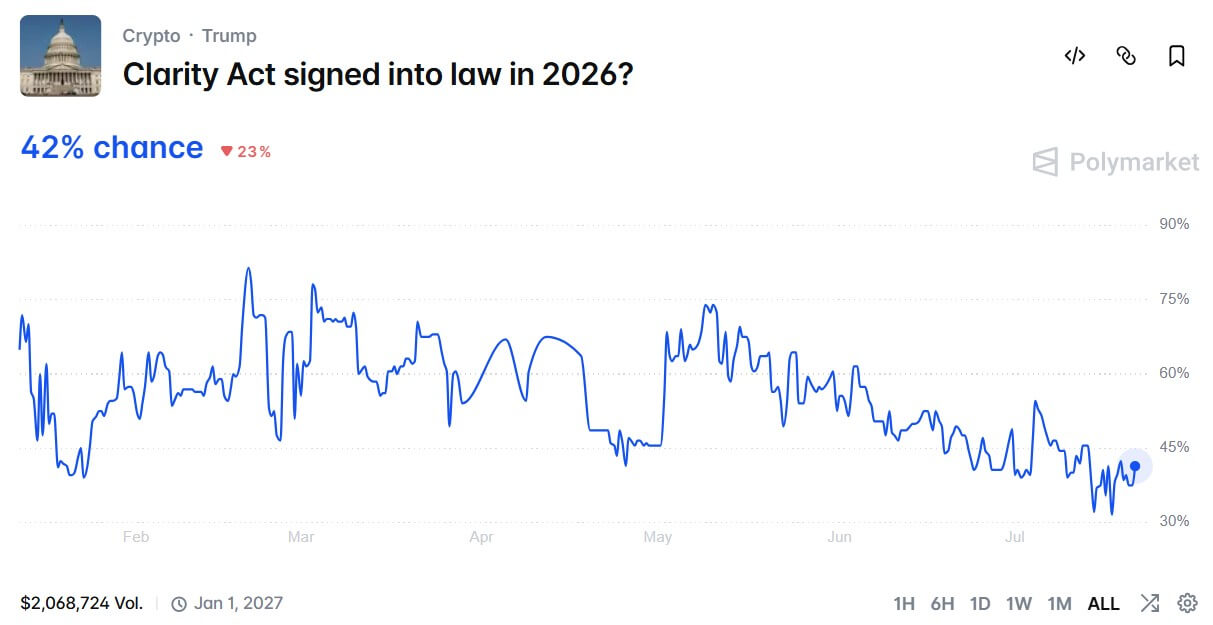
The move suggests traders see Trump’s concession as improving the bill’s prospects, though pricing remains below even odds and reflects continued uncertainty over whether negotiators can convert the proposal into a bipartisan agreement.
The remaining question is no longer whether Trump will accept an ethics restriction.
It is whether Democrats consider the restrictions he accepted strong enough to provide the votes CLARITY still needs before the Senate leaves Washington.


