

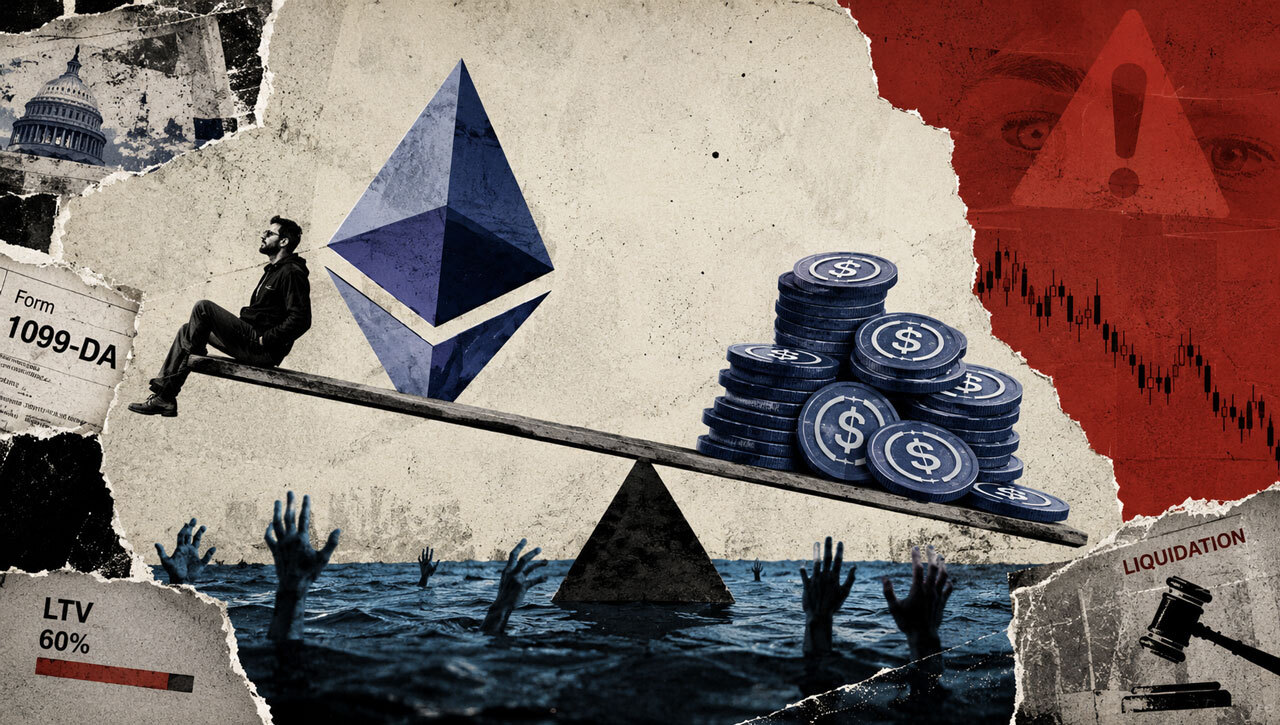
Imagine someone who bought ETH for $1,000, watched it climb to $4,000, and now wants to cash out $1,000. Selling one-quarter of the ETH would provide the cash, but it would also realize a $750 gain under US tax treatment of digital assets held for investment.
However, DeFi offers another way. The owner can deposit the full ETH into a lending protocol, use it as collateral, and borrow $1,000 in a stablecoin designed to track the dollar.
The loan doesn’t count as taxable income, the ETH keeps its exposure to any future price increase, and the owner now has something they can spend or convert into dollars without selling the original asset.
| Decision | Cash received | Tax impact | ETH exposure | New risk created |
|---|---|---|---|---|
| Sell 25% of ETH | $1,000 | $750 realized gain | Reduced by 25% | No liquidation risk |
| Borrow stablecoin against ETH | $1,000 | No immediate taxable sale | Full ETH exposure retained | Debt, interest, liquidation risk |
While it saves the owner a lot of money in taxes, it also creates a fragile math problem. The $1,000 debt begins at 25% of collateral worth $4,000, but a fall in ETH to $2,000 doubles that loan-to-value ratio to 50%, and interest accumulating on the debt pushes it higher.
If the ratio crosses the protocol’s limit, the code opens the collateral to liquidation, allowing an outside trader to repay part of the loan and claim some of the ETH at a discount.
The borrower might have deferred a taxable sale, but the lending pool has taken on the risk created by the collateral price, the size of the debt, and the borrower’s willingness to act before liquidation.
One person’s tax decision essentially became part of a shared credit market funded by other users, most of whom know the wallet only as a string of letters and numbers.
Lisa De Simone of the University of Texas at Austin, Peiyi Jin of the National University of Singapore, and Daniel Rabetti of NUS examined that connection in a working paper on tax planning and DeFi credit risk.
They studied Venus, a DeFi lending protocol on BNB Smart Chain that allowed users to pledge crypto and borrow other tokens through rules enforced by smart contracts.
Their sample runs from Nov. 12, 2020, through July 31, 2022, and covers the 15 largest tokens on Venus. Roughly 13 million transactions became 1.36 million daily borrower observations, which means the same wallet can appear once on every active day, and about 3% of traders experienced what the paper defines as a default.
That definition needs some translation because a DeFi default looks different from a missed mortgage payment.
The paper classified a borrower as defaulted when the loan remained above Venus’s 60% loan-to-value limit for at least seven days without later borrowing or depositing, and its $133.34 million total adds outstanding defaulted debt across each day it persisted.
A single troubled loan can therefore contribute to several dates, making the total a measure of accumulated daily exposure rather than unique principal lost in one event.
| ETH collateral value | Stablecoin debt | Loan-to-value ratio | Borrower position |
|---|---|---|---|
| $4,000 | $1,000 | 25% | Comfortable cushion |
| $3,000 | $1,000 | 33% | Risk rising |
| $2,000 | $1,000 | 50% | Close to danger |
| $1,667 | $1,000 | 60% | Liquidation threshold |
| Below $1,667 | $1,000+ interest | Above 60% | Liquidation risk active |
The billionaire trade gets a wallet
The traditional version of this strategy is known as “buy, borrow, die.” Investors buy an asset, let it appreciate, and borrow against it to live without realizing the gain through a sale.
Continued borrowing can defer capital-gains tax for years, and US estate rules may reset the asset’s tax basis when heirs inherit it, reducing the gain accumulated during the original owner’s lifetime.
This has usually been a rich person’s trade because a private bank wants a client with valuable collateral and enough wealth to survive a downturn. The bank can examine the client’s broader finances, decide how much it will lend, and negotiate terms for the relationship, giving both sides room to deal with trouble before collateral has to be sold.
DeFi compresses that very human-centric relationship into code. Software doesn’t need any of its elements because it just looks at the assets inside a wallet and applies the same collateral rules to everyone.
Access to this kind of service then widens, and the price of that openness is a system built around overcollateralization, where a borrower must pledge more value than the loan is worth from the start.
Under the Venus configuration described in the paper, approved collateral worth $10,000 could support up to $6,000 of debt. Borrowing the full amount left almost no room for a fall, while someone borrowing $2,000 had a much thicker cushion, and both accounts were monitored continuously by code using market prices supplied to the protocol.
When collateral weakened enough to break the limit, a liquidator could repay part of the debt and take collateral at a discount, earning a reward for restoring the account. This process is meant to protect the pool before the collateral falls below the debt, even though a fast selloff or thin market can make the sale less effective, and blockchain congestion can prevent liquidators from acting soon enough.
The tax incentive complicates the borrower’s side of this system because reducing risk requires trading, repaying debt, or selling part of an appreciated holding.
Borrowers who took out the loan to defer a taxable sale will likely wait longer to unwind it, especially when the token has produced a large paper gain or the account has moved most of the way toward the lower long-term capital-gains rate.
What makes this trade especially attractive are stablecoins. Dollar-pegged coins turn otherwise volatile collateral into dollar spending power. So traders can keep ETH or another token pledged, borrow USDT or USDC, and use them elsewhere.
Large holders are borrowing stablecoins against crypto collateral to fund activity while preserving exposure to the underlying asset.
The protocol sees a healthy collateral ratio when the loan opens. But it can’t see that the borrower bought ETH for a fraction of its current price, has a large gain waiting behind a sale, or sees another few months of holding as financially valuable, even though all of those facts can affect how the borrower behaves once the loan becomes dangerous.
The IRS turns Venus into an experiment
The researchers needed a way to separate tax-motivated behavior from the normal chaos of crypto markets, and they found one in the Infrastructure Investment and Jobs Act enacted on Nov. 15, 2021.
Section 80603 of the 2021 infrastructure law expanded information-reporting requirements for brokers handling digital assets, giving traders reason to expect that more of their activity would eventually be reported to the IRS.
The law changed the level of third-party reporting traders expected, giving the authors an external event that could affect the behavior of likely US taxpayers while international users saw no changes.
The reporting system took a long time to build. Custodial brokers began reporting gross proceeds from covered sales and exchanges completed from Jan. 1, 2025, on Form 1099-DA, and IRS broker rules added basis reporting for certain transactions completed from Jan. 1, 2026.
Those regulations cover firms that take possession of customers’ assets, while noncustodial DeFi services fall outside their current scope.
For the paper, the research value comes from what people believed in November 2021, when the new law made future reporting feel more concrete.
The authors compare behavior around that enactment date, years before the final rules took effect, allowing the study to capture a reaction to expected visibility instead of an automatic response to a tax form already being issued.
Because the blockchain doesn’t reveal anyone’s nationality or tax residence, the researchers had to infer which wallets might belong to US users. They looked for activity concentrated during US business hours and unusual behavior on holidays observed only in the US, then added holdings of dollar stablecoins under US oversight as another clue.
Each measure can misclassify people, so the paper reports several versions and a stricter definition that combines them.
The basic comparison is like watching two groups use the same financial machine on either side of one legal event. Both groups faced the same token prices and the same Venus rules, while the probable US group had a stronger reason to care about the reporting provision, helping the authors isolate the tax channel from a broad market move.
Across their main designs, the authors report that US-linked borrowers became 24.5% less likely to trade assets relative to international users once the law was enacted.
Borrowers using stablecoin debt recorded an additional 23% decline, which fits the paper’s argument because stablecoins offered immediate spending power while appreciated collateral stayed pledged.
The paper uses “liquidity” in a narrow, wallet-level sense: the daily probability that a borrower traded any asset. While most people associate the word with exchange depth, bid-ask spreads, or the cost of selling a large holding, this study is measuring how active the borrower’s portfolio was and whether appreciated assets stayed locked in place.
The same pattern became stronger among borrowers with larger gains and higher loan-to-value ratios. Activity fell during December, especially in its final week, when investors often defer gains into a new tax year, then increased once holdings passed the one-year point associated with lower US long-term capital-gains rates.
Those behavioral checks give the tax interpretation support beyond the November 2021 comparison.
The authors estimate that US borrowers in the sample deferred an average of $3,357.42 in capital-gains tax per year, equal to about 17% of their trading portfolios during the period.
That estimate assumes the inferred wallets belong to US taxpayers, reconstructs their portfolios from blockchain activity, and applies the relevant tax brackets, so it is best read as a rough estimate of scale across the sample.
The bill comes due inside the pool
The final part of the paper follows the reduced trading into loan performance. Borrowers who rarely trade may leave a risky account open longer, miss chances to repay debt, or fail to add enough collateral before the ratio breaks its limit, allowing a tax preference that began outside Venus to influence the amount of unresolved debt inside it.
From that angle, it’s obvious it’s a major problem because causality can run the other way too: a default may cause someone to abandon a wallet and stop trading.
The researchers use the law-induced reduction in activity among US-linked borrowers to isolate a drop in trading that came from outside the protocol, a statistical method known as an instrumental-variable design.
Using that design, they estimate that a 1% increase in tax-induced illiquidity was associated with an 11.2% increase in defaulted accounts and a 39.6% increase in defaulted loan value. A one-standard-deviation increase corresponded to roughly $350 more defaulted debt per borrower, equal to 2.7 times the baseline value in the model.
Those percentages sound enormous because they describe the borrowers whose activity reacted to the reporting event, a group economists call compliers. Their proper scope is the tax-sensitive portion of the Venus sample, and the estimates help explain how behavior can affect credit outcomes rather than serving as a universal multiplier for every DeFi loan.
| Stage | Borrower incentive | Protocol sees | Hidden risk |
|---|---|---|---|
| Asset appreciates | Avoid selling and realizing gain | Healthy collateral value | Tax lock-in begins |
| Stablecoin loan opens | Access cash without sale | Acceptable LTV | Borrower may resist de-risking |
| Collateral falls | Delay repayment or sale | LTV deteriorates | Trading inactivity rises |
| Threshold breached | Preserve appreciated asset or abandon wallet | Liquidation condition triggered | Liquidators must act quickly |
| Liquidation fails or lags | Borrower loss becomes pool risk | Bad debt/defaulted exposure | Losses may hit reserves, token holders, or suppliers |
It exposes a blind spot in automated lending. Smart contracts know the collateral price, debt balance, interest owed, and liquidation threshold, but the borrower’s purchase price and tax incentive never enter its calculation.
Two wallets with identical ETH collateral and identical loans can therefore look the same to Venus, even when one owner is comfortable selling, and the other is working hard to avoid it.
That difference is what becomes a borrower-selection problem. Overcollateralization protects the pool against ordinary price moves, but borrowers most attached to appreciated assets may keep debt open longer and trade less as their cushion narrows, concentrating risk among people whose motives the protocol cannot measure.
When liquidation works, an outside participant repays debt and removes collateral before lenders suffer a shortfall. When it fails, the cost can pass through protocol reserves, token holders, or the users who supplied assets to the pool, depending on how losses are allocated, which turns what was a personal tax preference into a financial outcome the entire pool shares.
The paper also found a much wider set of risks associated with this tax channel.
It studied one protocol during the boom and crash of 2020 through 2022, inferred US residence from behavior, and used a specialized definition of default based on unresolved high-LTV accounts. The researchers separately found that volatile collateral and liquidation flaws contributed to troubled Venus loans, giving tax sensitivity one role in a system that could fail for several reasons.
Another protocol with deeper liquidity or different collateral limits could produce a different result, and a later market with more professional liquidators may behave differently from Venus during the sample.
Nonetheless, the paper still offers something traditional lending data rarely provides: a public view of collateral, debt, borrower activity, liquidation, and abandonment at the individual-wallet level.
DeFi brought a private-bank borrowing strategy onto a public blockchain and opened it to people far outside private banking. In doing so, it also showed that automating the loan officer doesn’t remove the human motives behind a loan, because tax bills, attachment to appreciated assets, and reluctance to sell continue through the code and eventually reach everyone funding the pool.


