

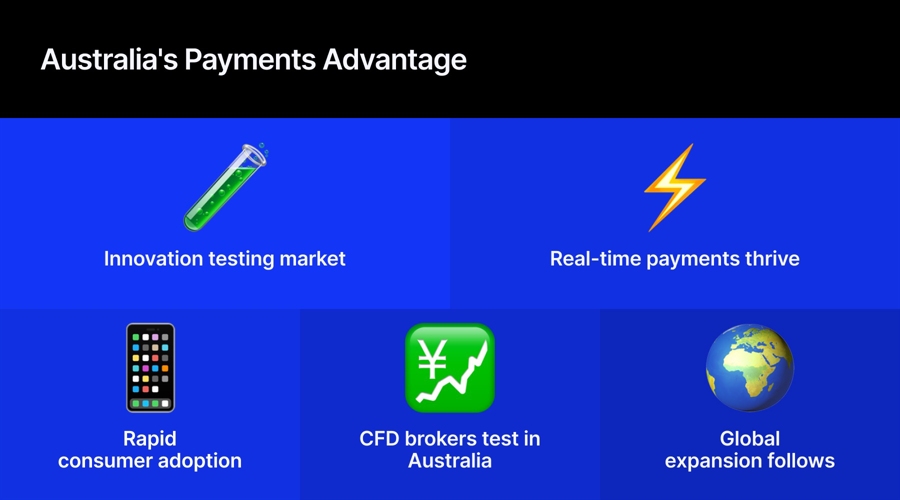
Australia has long been feted as an
innovation hub. While homegrown success stories such as Atlassian, Canva, and
Airwallex have demonstrated the country’s ability to build world-class
technology businesses, the country is also earning a different reputation: as
the place where global financial services firms test new payment experiences
before taking them to much larger markets.
The reason is surprisingly simple, but
impactful. Australia’s demographics are comparable to those of many major Western
economies, but on a much smaller scale. That makes it large enough to generate
meaningful commercial insights, yet small enough to experiment, refine
products, and reduce risk before expanding internationally.
It’s an approach increasingly being
adopted by global CFD and online
trading platforms. Firms such as
Pepperstone and Trade Nation are using Australia’s payments ecosystem to
validate new customer experiences before rolling them out more broadly.
Why Is Australia Proving So Attractive?
For a population of approximately 28
million, Aussies
certainly punch above their weight
when it comes to payments adoption. In its most recent Consumer Payment Survey,
the Reserve Bank of Australia (RBA) found that contactless payments are used for
almost all in-person transactions, rendering cash all but obsolete.
According
to the Australian Banking Association, Australians are making more than 500
million mobile wallet transactions every month, totalling over $20 billion in
value.
Yet it’s the speed of adoption that
stands out.
Australians embraced contactless
payments remarkably quickly. Following initial trails in 2011, the nation
reached widespread adoption by 2018. A coordinated rollout of ‘tap-and-go’
infrastructure by major financial institutions, coupled with enthusiastic
merchant participation, led consumers to move away from physical currency at a pace that outpaced many comparable markets globally.
It’s this consumer behaviour that makes
Australia so valuable. Australians mirror many of the payment habits seen in
larger markets such as Europe and the US, while also embracing new technology
quickly. Combine that with modern payments infrastructure, and you have a
market that offers meaningful insights before launching into much larger
geographies.
It is little wonder, then, that
real-time Account-to-Account payments such as PayID are showing many of the
same signals. PayID allows customers to make payments using a mobile number or
email address instead of traditional bank account details, making account
funding faster and simpler.
According to the same RBA survey, PayID
usage increased by 18% in 2025, with around half of respondents reporting they
had used the service at least once during the previous year.
Why Global Trading Platforms Are Paying Attention
For CFD and online trading platforms,
the payment experience is every bit as important as the trading experience.
Traders expect to move funds the moment opportunities arise, regardless of
whether it’s during business hours or on a Sunday evening.
Increasingly, that’s exactly what
they’re doing. Volt’s data shows that nearly 73% of CFD account top-ups made
via Australia’s New Payments Platform such as PayID and PayTo occur outside
standard 9-to-5 banking hours, with more than one in five (21%) taking place on
weekends.
The figures suggest traders value the ability to fund their accounts
whenever opportunities arise, rather than being constrained by traditional
banking hours.
This is why global trading platforms
such as Trade Nation and Pepperstone have introduced real-time payments through
Volt for their Australian customers.
For Trade Nation, Australia wasn’t simply
another market to launch in. As Payments Manager Siona Spooner has observed,
Australian consumers adopt new payment methods more quickly than those in many
comparable markets, making the country an ideal place to introduce new payment
capabilities, understand how clients actually use them, and refine the
experience before rolling it out globally.
The early data reinforces that strategy.
Nearly 47% of CFD traders who
fund via the NPP are repeat payers.
Two-thirds return within a week, and more than a quarter top up again within 24
hours.
Rather than simply making deposits faster, real-time payments appear to
encourage more habitual engagement, allowing traders to respond to market
movements immediately instead of waiting for funds to clear.
That’s exactly why Australia has become
such an important proving ground. It offers firms the opportunity to validate
not just the technology itself, but how customers behave when funding is
instant, available around the clock, and seamlessly integrated into the trading
experience.
The way payment innovation is brought to
market is changing. Rather than building a capability and rolling it out
everywhere at once, businesses are increasingly looking to understand how
customers interact with it in a live environment before making larger
investments.
Payments have
become much more than the movement of money.
They’re part of the overall customer experience, and small improvements can
have a meaningful impact on adoption. Australia continues to show what’s
possible when strong infrastructure meets customers who are willing to embrace
new ways to pay, and that’s exactly why it has become such an important market
for global payments innovation.
Australia has long been feted as an
innovation hub. While homegrown success stories such as Atlassian, Canva, and
Airwallex have demonstrated the country’s ability to build world-class
technology businesses, the country is also earning a different reputation: as
the place where global financial services firms test new payment experiences
before taking them to much larger markets.
The reason is surprisingly simple, but
impactful. Australia’s demographics are comparable to those of many major Western
economies, but on a much smaller scale. That makes it large enough to generate
meaningful commercial insights, yet small enough to experiment, refine
products, and reduce risk before expanding internationally.
It’s an approach increasingly being
adopted by global CFD and online
trading platforms. Firms such as
Pepperstone and Trade Nation are using Australia’s payments ecosystem to
validate new customer experiences before rolling them out more broadly.
Why Is Australia Proving So Attractive?
For a population of approximately 28
million, Aussies
certainly punch above their weight
when it comes to payments adoption. In its most recent Consumer Payment Survey,
the Reserve Bank of Australia (RBA) found that contactless payments are used for
almost all in-person transactions, rendering cash all but obsolete.
According
to the Australian Banking Association, Australians are making more than 500
million mobile wallet transactions every month, totalling over $20 billion in
value.
Yet it’s the speed of adoption that
stands out.
Australians embraced contactless
payments remarkably quickly. Following initial trails in 2011, the nation
reached widespread adoption by 2018. A coordinated rollout of ‘tap-and-go’
infrastructure by major financial institutions, coupled with enthusiastic
merchant participation, led consumers to move away from physical currency at a pace that outpaced many comparable markets globally.
It’s this consumer behaviour that makes
Australia so valuable. Australians mirror many of the payment habits seen in
larger markets such as Europe and the US, while also embracing new technology
quickly. Combine that with modern payments infrastructure, and you have a
market that offers meaningful insights before launching into much larger
geographies.
It is little wonder, then, that
real-time Account-to-Account payments such as PayID are showing many of the
same signals. PayID allows customers to make payments using a mobile number or
email address instead of traditional bank account details, making account
funding faster and simpler.
According to the same RBA survey, PayID
usage increased by 18% in 2025, with around half of respondents reporting they
had used the service at least once during the previous year.
Why Global Trading Platforms Are Paying Attention
For CFD and online trading platforms,
the payment experience is every bit as important as the trading experience.
Traders expect to move funds the moment opportunities arise, regardless of
whether it’s during business hours or on a Sunday evening.
Increasingly, that’s exactly what
they’re doing. Volt’s data shows that nearly 73% of CFD account top-ups made
via Australia’s New Payments Platform such as PayID and PayTo occur outside
standard 9-to-5 banking hours, with more than one in five (21%) taking place on
weekends.
The figures suggest traders value the ability to fund their accounts
whenever opportunities arise, rather than being constrained by traditional
banking hours.
This is why global trading platforms
such as Trade Nation and Pepperstone have introduced real-time payments through
Volt for their Australian customers.
For Trade Nation, Australia wasn’t simply
another market to launch in. As Payments Manager Siona Spooner has observed,
Australian consumers adopt new payment methods more quickly than those in many
comparable markets, making the country an ideal place to introduce new payment
capabilities, understand how clients actually use them, and refine the
experience before rolling it out globally.
The early data reinforces that strategy.
Nearly 47% of CFD traders who
fund via the NPP are repeat payers.
Two-thirds return within a week, and more than a quarter top up again within 24
hours.
Rather than simply making deposits faster, real-time payments appear to
encourage more habitual engagement, allowing traders to respond to market
movements immediately instead of waiting for funds to clear.
That’s exactly why Australia has become
such an important proving ground. It offers firms the opportunity to validate
not just the technology itself, but how customers behave when funding is
instant, available around the clock, and seamlessly integrated into the trading
experience.
The way payment innovation is brought to
market is changing. Rather than building a capability and rolling it out
everywhere at once, businesses are increasingly looking to understand how
customers interact with it in a live environment before making larger
investments.
Payments have
become much more than the movement of money.
They’re part of the overall customer experience, and small improvements can
have a meaningful impact on adoption. Australia continues to show what’s
possible when strong infrastructure meets customers who are willing to embrace
new ways to pay, and that’s exactly why it has become such an important market
for global payments innovation.


