

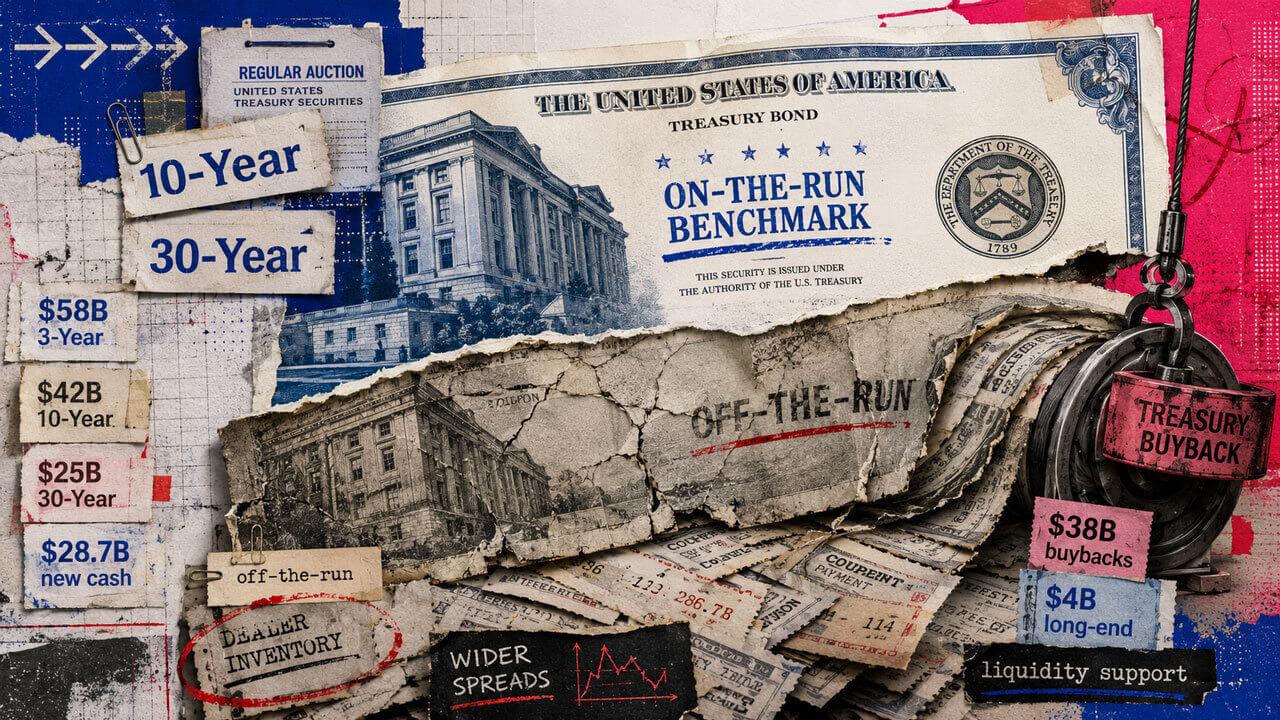
The US Treasury expects to borrow $739 billion from July through September while paying investors to hand back some of its older bonds. The pairing looks self-defeating because both transactions involve the same issuer. However, they are on separate ledgers and solve separate problems: auctions finance the government and create liquid benchmarks, while buybacks retire selected old issues or help Treasury manage its cash balance.
Treasury’s Aug. 3 borrowing estimate assumes a $950 billion cash balance at the end of September, then projects another $628 billion of borrowing from October through December. Its August refunding statement authorized as much as $38 billion of liquidity-support purchases and $25 billion of short-dated cash-management purchases during the current quarter.
Treasury widened the program on Aug. 19, lifting the maximum size of each buyback in the 10-to-20-year and 20-to-30-year sectors from $2 billion to at least $4 billion for operations from Sept. 9 through Nov. 4.
The announcement kept the regular auction schedule intact and confirmed that purchased debt will generally be replaced through new issuance, giving the government room to sell and buy bonds during the same financing cycle. Because the expansion came later, the earlier $38 billion quarterly figure isn’t a final ceiling for long-end purchases.
New bonds get the benchmark treatment
Treasury sells bills, notes, bonds, floating-rate notes, and inflation-protected securities to fund the gap between federal receipts and spending, refinance maturing debt, and maintain its cash balance. Bills mature within a year and are generally sold at a discount, while notes and bonds usually pay interest every six months across maturities from two to 30 years. “Coupon” is the old name for that periodic interest payment, inherited from the paper certificates whose interest slips investors once clipped by hand.
An auction can introduce a new security or reopen an existing one, with competitive bids establishing the market-clearing yield and price. A new 10-year note receives a fresh CUSIP and becomes the current benchmark, while a reopening adds supply to that same security at a later auction. The August refunding, for example, comprised a $58 billion three-year note, a $42 billion 10-year note and a $25 billion 30-year bond, producing $28.7 billion of new cash once maturing securities were accounted for.
The newest security in a maturity bucket becomes the on-the-run issue, usually trading more frequently and at tighter bid-ask spreads than comparable older bonds. Traders and institutions use it for hedging and price discovery, giving Treasury a reason to keep benchmark auctions large and predictable even when its cash balance can support buybacks.
Once a new security replaces it, the previous benchmark becomes off-the-run while retaining the same federal guarantee and scheduled payments. Trading migrates toward the fresh issue and the pool of natural buyers narrows, leaving dealers to use more balance-sheet capacity when they warehouse the older bond. Investors can then face a wider selling spread, and small price gaps can open between securities with nearly identical interest-rate exposure.
Across a debt market measured in tens of trillions of dollars, small trading frictions become expensive when volatility consumes dealer capacity, and investors crowd into the newest issues. An old Treasury can retain the same credit quality and cash flows while becoming inconvenient to sell, which is why a liquidity-support buyback gives dealers and other holders a regular outlet for selected off-the-run supply.
Treasury buys the bonds the market leaves behind
Treasury announces an eligible maturity bucket and a maximum purchase amount before each operation, then approved counterparties submit competitive offers through FedTrade, with the New York Fed acting as Treasury’s fiscal agent. Sellers specify the security and price, and Treasury evaluates those offers using market prices and relative value across eligible issues, according to its buyback guidance.
It can accept less than the published maximum when prices look unattractive, preserving the discipline of an auction rather than guaranteeing every seller an exit.
Liquidity-support operations focus on older coupons whose trading can benefit from a regular buyer, with Treasury retiring accepted securities as scheduled auctions keep building the current benchmarks. Josh Frost, then Treasury’s assistant secretary for financial markets, described the program as a tool for ordinary market functioning that can reduce fragmented supply and free dealer capacity between operations.
Cash-management buybacks address a different problem because tax receipts, spending, maturities, and auction settlements arrive in uneven waves.
Treasury can buy securities that are close to maturity when its cash balance would otherwise run higher than desired, smoothing upcoming redemptions and giving debt managers more control over near-term cash needs. That flexibility also reduces the need for abrupt bill-auction adjustments around large payment dates.
Treasury’s own borrowing estimates exclude a large net effect from the program because every repurchased dollar has to be financed somewhere else, all else equal. If Treasury sells $100 billion of new securities to private investors and buys back $4 billion held by private investors, privately held debt has increased by $96 billion. Reaching a $100 billion net borrowing target alongside that purchase would require roughly $104 billion of gross issuance.
That also lets sales and purchases expand together because the Treasury can deepen a current benchmark, remove a slice of older supply and still raise the net cash in its financing plan. The federal deficit determines the net financing need, while buybacks alter the age, composition, and maturity profile of debt held by the public.
The TGA carries the cash through the system
Auction proceeds and buyback payments pass through the Treasury General Account, the federal government’s operating account at the Fed. When private buyers settle a Treasury auction, money moves toward the TGA and reserve balances in the banking system generally decline, all else equal. Federal spending and Treasury buybacks send funds back toward private accounts, generally adding reserves along the way.
The Fed’s Aug. 27 H.4.1 release showed the TGA averaging $950.7 billion during the week ended Aug. 26 and standing at $959.4 billion on Wednesday, while reserve balances averaged $2.92 trillion. Treasury expects the account to finish September near $950 billion, reach roughly $1.05 trillion, plus or minus $50 billion, in late October and settle near $850 billion at year-end.
A $4 billion buyback can therefore put cash into sellers’ hands on settlement day, and a larger auction can pull cash toward the TGA on another day. Taxes and federal outlays add more movements, so the reserve path depends on the full calendar rather than the headline maximum attached to one operation. Timing can loosen or tighten dollar availability for several days even when the quarter’s net borrowing estimate barely moves.
The source of the money separates Treasury buybacks from quantitative easing because the Fed creates reserve balances when it purchases securities for its own portfolio, adding reserves to its liabilities and bonds to its assets. Treasury spends an existing TGA balance and replenishes that balance through taxes or debt sales, while repurchased securities are retired instead of joining a monetary-policy portfolio.
Those balance sheets give the two programs different effects because removing off-the-run duration can free dealer capacity, narrow relative-value gaps, and make long bonds easier to transact, while surrounding Treasury issuance can absorb cash and add duration elsewhere. Accepted offers, auction demand, settlement dates and maturity buckets determine the combined result.
Treasury preserves that two-sided structure because shrinking benchmark auctions whenever cash-management needs fluctuate would make issuance less predictable, fragment current securities, and risk higher financing costs over time. Regular auctions give investors dependable supply, while selective purchases let debt managers address older pockets of inventory without rebuilding the entire calendar around temporary cash swings.
Long-dated bonds are the most price-sensitive securities in the regular auction schedule, and warehousing them consumes more dealer risk capacity when yields move sharply. Older 20- and 30-year issues can linger once demand concentrates in a fresh benchmark, so doubling the per-operation ceiling gives Treasury more room to buy attractive offers while retaining the option to stop below the cap.
Treasury’s formal objective is ordinary market functioning, and the agency hasn’t announced a target for long-term yields. Purchases can still affect relative prices at the margin because they remove duration from selected issues and give dealers another buyer, which makes intent and market effect separate parts of the analysis. A $4 billion operation can ease a local pocket of illiquidity, while its scale stays small beside a Treasury market measured in tens of trillions of dollars.
For Bitcoin, the connection runs through reserve availability, long-term yields, collateral markets, and dealer capacity, all of which influence the cost of carrying risk across asset classes. CryptoSlate has tracked how Treasury yields can transmit stress into Bitcoin, and buybacks enter that channel by easing selected bond inventories while auctions move cash toward the TGA.
A well-received long-bond buyback could ease a local dislocation and lower one source of cross-market strain, while a heavy auction week or a rapid TGA build could absorb cash at the same time. Bitcoin can benefit when yields settle and dollar availability improves, though the size and timing of those effects have to be measured across the whole financing schedule. Treating every purchase ceiling as an equal injection assigns the program a power its funding mechanics don’t provide.
The larger long-end operations begin Sept. 9, and the next quarterly refunding announcement arrives Nov. 4. Accepted purchase amounts, offered prices, demand for the new benchmarks, and the TGA path around settlement will show how much Treasury has improved trading in old bonds while continuing to finance the government through new ones.


