


Fidelity’s FETH and FSOL staking plans give its Ethereum and Solana exchange-traded products authority to stake up to 100% of their crypto under normal conditions, while pairing that ceiling with a layered plan for meeting redemptions when network exits take too long.
The matching framework appears in Aug. 21 prospectuses for the Fidelity Ethereum Fund, or FETH, and Fidelity Solana Fund, or FSOL. Neither fund has a minimum staking requirement, and sponsor FD Funds Management can keep ether or SOL unstaked for foreseeable redemptions, expenses, asset protection and its liquidity program.
The 100% figure is an authority ceiling, not evidence that both funds are fully staked. FSOL reported 1,675,797 SOL staked out of 1,687,589 SOL held at June 30, with a fair value of $126.3 million. Its quarterly report put net assets at $127.079 million and its trailing 30-day staked percentage at 99.64%.
FETH was at a different point. Its June 30 report listed 476,311 ether and $758.609 million in net assets without a staked-ether line. Fidelity amended the trust and custody arrangements in August, and the new prospectus said staking was expected to begin as soon as practicable after Aug. 21. It did not disclose a current staked amount.
How the redemption ladder works
Reserves are the first buffer. If they are insufficient and unstaking cannot finish within the standard settlement window, the sponsor may extend settlement temporarily. If an exit still is not practicable within a reasonable extended period, it may deliver cash in place of some or all of the crypto owed in an in-kind redemption. The filings describe these as discretionary options, not automatic protections or tools that have already been used.
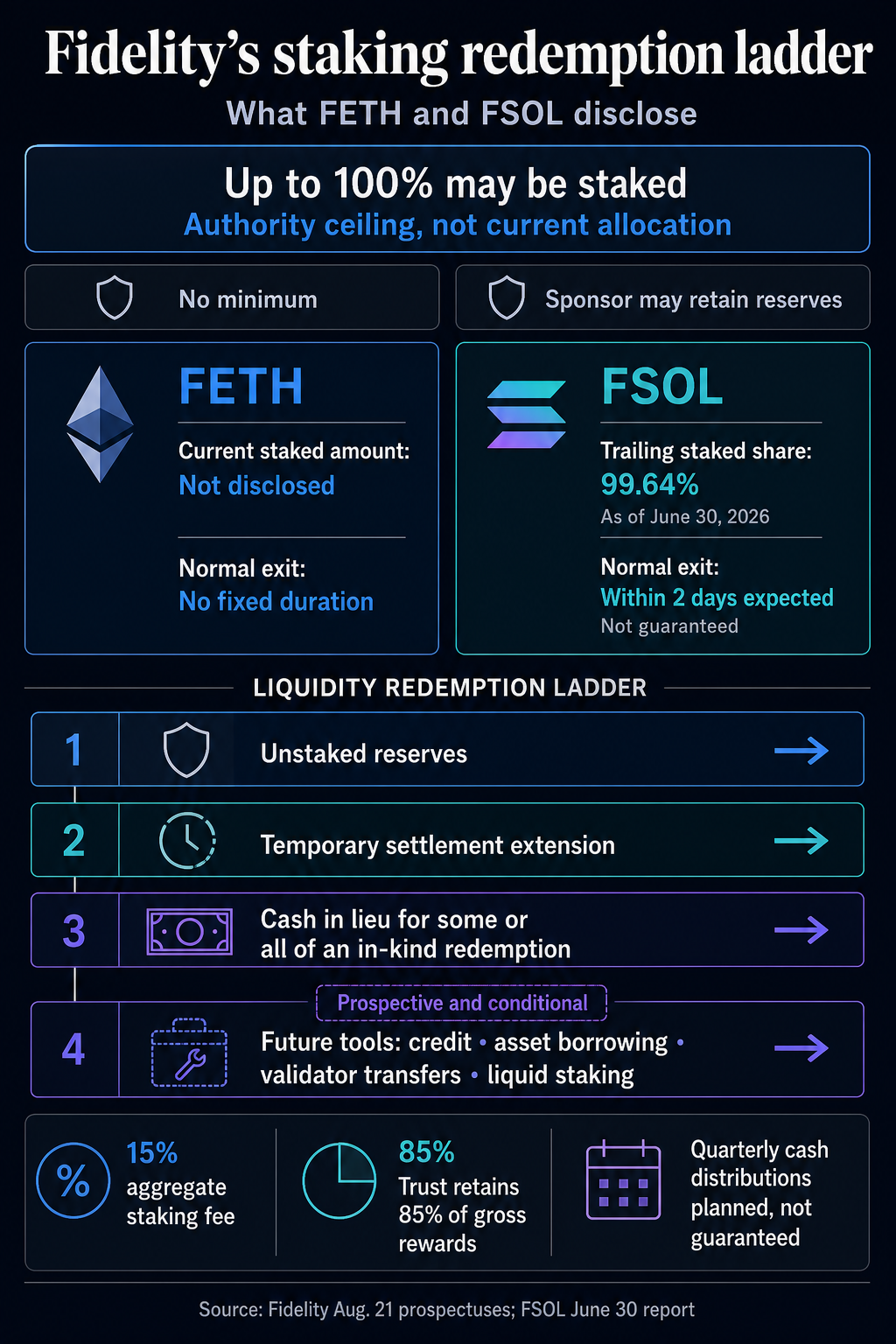
The timing risk for FETH and FSOL staking differs by network. FSOL expects to regain complete control of its staked SOL within two days under normal conditions, without guaranteeing that result. FETH gives no fixed duration: Ethereum validators must leave the active set and pass a mandatory wait before the network’s withdrawal sweep processes them. Heavy exit demand or network disruption can lengthen either timeline.
Fidelity also lists possible future backstops, including a credit facility involving the sponsor or an affiliate, direct borrowing of digital assets, sales or transfers of validator positions, and structures involving liquid staking tokens or tradable rights to staked assets. Neither trust had a line of credit as of Aug. 21, and several mechanisms depend on legal, tax or exchange-rule changes.
Each trust pays aggregate staking fees equal to 15% of gross rewards and retains the remaining 85%. The retained share can fund trust expenses, quarterly cash distributions, redemptions and additional staking, in that stated priority order, though the sponsor can change the order. The trusts would pay quarterly distributions in cash after selling rewards, but their amount and timing are not guaranteed.


