

Fear
of Loss is an overlooked factor that prevents many traders from trading
consistently. Yet brokers often try to overcome this behavioral barrier with
standard marketing and retention tools — tools designed to stimulate activity
rather than address the psychological reason behind inactivity.
If
a trader is afraid to lose, another trading opportunity may not be what they
need.
Once
a trader opens an account and makes a First Time Deposit, an important
transition takes place inside most brokerage organizations: Acquisition and
conversion have done their job and the funded client now moves into the
retention department.
From
this point onward, the challenge is often framed as one of engagement: How can
we encourage the trader to remain active, trade more frequently and stay with
the broker for longer?
The
industry has developed increasingly sophisticated technology to address this
challenge. Brokers can identify relevant market events, personalize
communications, offer promotions and bonuses, and reach clients through
multiple channels at precisely the right moment.
These
technologies can certainly be effective, but after years of observing traders’
behavior across different brokers and geographical markets, I believe there is
a more fundamental behavioral issue that deserves greater attention.
Trading
begins with an uncomfortable reality: losses are inevitable. An experienced
trader understands that a trade can lose money even when the decision behind it
was reasonable because trading is a probabilistic activity, and no strategy
eliminates uncertainty.
For
a new trader, however, this distinction is much harder to internalize. Fear of loss is an innate psychological response. A loss can easily trigger a chain of
thoughts and emotions: Maybe I’m not good at this. Maybe I shouldn’t have made
that trade. Maybe I should wait until I’m more certain.
The
natural fear of another loss can then produce hesitation that reduces activity.
With
less activity comes less experience, less learning and fewer opportunities to
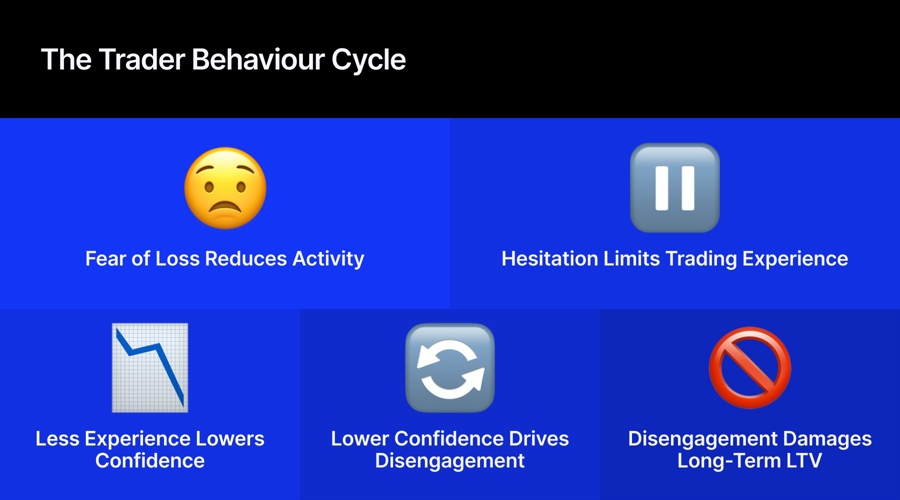
develop confidence and skill. Eventually, some traders simply stop. This
creates a behavioral cycle:
Loss
→ Fear → Hesitation → Less Experience → Lower Confidence → Disengagement
At
this point, another market alert or promotion may have limited power. The
broker may be presenting an excellent opportunity to trade, but the trader’s
problem is no longer a lack of opportunity—he may be struggling with doubts,
negative feelings and low motivation.
Trading
Is a Skill
This
leads to a second observation that I believe is important for the industry.
Trading is not simply an activity—it is a skill that develops over time.
Like
other skills involving uncertainty and decision-making, its
development requires experience, trial and error, discipline and resilience.
Losses are part of that learning process, and the challenge is that many
inexperienced traders do not necessarily perceive losses that way. A loss can
be interpreted as evidence of failure rather than part of the cost of learning.
This
creates an interesting contradiction: To become more experienced, traders need
to be more active, but the emotional impact of their early experiences can
prevent them from accumulating enough of it. That makes the early stages of the
trader’s journey particularly important.
For
brokers, trader development should therefore not be confused with creating more
profitable traders. A more resilient and disciplined trader is not necessarily
a more successful trader financially. The markets remain difficult to beat, and
behavioral development does not change that. It may, however, help traders
remain engaged, learn from experience and avoid abandoning trading simply
because losses trigger fear or loss of confidence.
The
Hidden Cost to Brokers
This
psychological issue is also an economic one. According to CPattern’s analysis
of traders’ behavior across multiple brokers, monthly trader churn
(discontinuation from one month to the next) can reach approximately 50%.
Brokers
invest substantial resources in acquiring each funded client: advertising,
affiliates, sales, onboarding, KYC, payments and conversion. If that client
funds an account but trades very little before disengaging, the broker has
technically achieved conversion, but may never generate sufficient client value
to justify the acquisition cost.
Aggregate
results can also be misleading. A relatively small number of large depositors
may compensate for many funded clients who generate very little activity,
potentially masking the economics of the broader client base.
When this happens
at scale, the natural response may be to acquire more clients, more leads , more
registrations, more FTDs. But increasing acquisition does not necessarily solve
what happens after FTD. This is why I believe brokers should think about LTV
differently.
LTV
Is Built Over Time
Lifetime
Value is often discussed as a commercial outcome, but underneath the financial
metric is a human process: A trader who gradually develops greater discipline,
confidence, emotional stability and resilience is more likely to continue
engaging with trading than someone who never progresses beyond the uncertainty
of their earliest experiences.
This means LTV is not something a broker simply
“extracts” from an existing client—it is something that develops over
time.
The
objective should not necessarily be to stimulate the maximum possible activity
at every moment, but rather to help traders develop a sustainable relationship
with trading over time through engagement, education and even helping traders
understand their own behavior. And sometimes the most valuable intervention may
not contain a Call to Action at all.
Can
this developmental process actually be influenced? Our data suggests that it
can. In implementations where this issue had been addressed, we observed an
increase of over 50% in trading activity, trading volume, and
survivability compared with benchmark traders. We also observed a
significant increase in re-deposit behavior.
These
results don’t mean that traders became more profitable. They indicate something
different: when traders receive support around their own behavior, more of them
remain engaged and continue accumulating trading experience.
From
Marketing Personalization to Behavioral Personalization
The
brokerage industry has made enormous progress in personalization. It is
possible to personalize content according to geography, deposit history,
instruments traded, market activity, previous responses and dozens of other
variables. AI makes this increasingly sophisticated.
But
there is an important distinction between personalizing what we want to
communicate and understanding what the trader needs at that particular point in
their development. A trader who has become hesitant after several losses may
need something very different from a trader who has become overconfident after
several wins.
A trader who is progressing steadily may need something different
again. All three can receive perfectly personalized marketing messages, but
their needs are fundamentally different, and this is where I believe the next
evolution in trader engagement will occur: from personalized marketing to
personalized trader development.
A
Different Way to Think About Retention
This
doesn’t mean brokers should stop using promotions, market alerts, CRM
automation or other retention tools. These tools remain important, but they
address only part of the challenge.
If
we accept that trading is a skill that develops through experience, then
understanding what helps or prevents that development should become part of the
retention strategy.
For
brokers, this adds a different question to the traditional one. Instead
of asking only: “How
can we get this trader to trade again?” Perhaps
we should also ask: “What
does this trader need in order to keep developing?”
The
economic distinction could be significant.
Acquisition
creates a funded account. Marketing can stimulate activity. But long-term LTV
depends on whether the person behind that account develops into a resilient,
loyal and engaged trader.
Fear
of Loss is an overlooked factor that prevents many traders from trading
consistently. Yet brokers often try to overcome this behavioral barrier with
standard marketing and retention tools — tools designed to stimulate activity
rather than address the psychological reason behind inactivity.
If
a trader is afraid to lose, another trading opportunity may not be what they
need.
Once
a trader opens an account and makes a First Time Deposit, an important
transition takes place inside most brokerage organizations: Acquisition and
conversion have done their job and the funded client now moves into the
retention department.
From
this point onward, the challenge is often framed as one of engagement: How can
we encourage the trader to remain active, trade more frequently and stay with
the broker for longer?
The
industry has developed increasingly sophisticated technology to address this
challenge. Brokers can identify relevant market events, personalize
communications, offer promotions and bonuses, and reach clients through
multiple channels at precisely the right moment.
These
technologies can certainly be effective, but after years of observing traders’
behavior across different brokers and geographical markets, I believe there is
a more fundamental behavioral issue that deserves greater attention.
Trading
begins with an uncomfortable reality: losses are inevitable. An experienced
trader understands that a trade can lose money even when the decision behind it
was reasonable because trading is a probabilistic activity, and no strategy
eliminates uncertainty.
For
a new trader, however, this distinction is much harder to internalize. Fear of loss is an innate psychological response. A loss can easily trigger a chain of
thoughts and emotions: Maybe I’m not good at this. Maybe I shouldn’t have made
that trade. Maybe I should wait until I’m more certain.
The
natural fear of another loss can then produce hesitation that reduces activity.
With
less activity comes less experience, less learning and fewer opportunities to
develop confidence and skill. Eventually, some traders simply stop. This
creates a behavioral cycle:
Loss
→ Fear → Hesitation → Less Experience → Lower Confidence → Disengagement
At
this point, another market alert or promotion may have limited power. The
broker may be presenting an excellent opportunity to trade, but the trader’s
problem is no longer a lack of opportunity—he may be struggling with doubts,
negative feelings and low motivation.
Trading
Is a Skill
This
leads to a second observation that I believe is important for the industry.
Trading is not simply an activity—it is a skill that develops over time.
Like
other skills involving uncertainty and decision-making, its
development requires experience, trial and error, discipline and resilience.
Losses are part of that learning process, and the challenge is that many
inexperienced traders do not necessarily perceive losses that way. A loss can
be interpreted as evidence of failure rather than part of the cost of learning.
This
creates an interesting contradiction: To become more experienced, traders need
to be more active, but the emotional impact of their early experiences can
prevent them from accumulating enough of it. That makes the early stages of the
trader’s journey particularly important.
For
brokers, trader development should therefore not be confused with creating more
profitable traders. A more resilient and disciplined trader is not necessarily
a more successful trader financially. The markets remain difficult to beat, and
behavioral development does not change that. It may, however, help traders
remain engaged, learn from experience and avoid abandoning trading simply
because losses trigger fear or loss of confidence.
The
Hidden Cost to Brokers
This
psychological issue is also an economic one. According to CPattern’s analysis
of traders’ behavior across multiple brokers, monthly trader churn
(discontinuation from one month to the next) can reach approximately 50%.
Brokers
invest substantial resources in acquiring each funded client: advertising,
affiliates, sales, onboarding, KYC, payments and conversion. If that client
funds an account but trades very little before disengaging, the broker has
technically achieved conversion, but may never generate sufficient client value
to justify the acquisition cost.
Aggregate
results can also be misleading. A relatively small number of large depositors
may compensate for many funded clients who generate very little activity,
potentially masking the economics of the broader client base.
When this happens
at scale, the natural response may be to acquire more clients, more leads , more
registrations, more FTDs. But increasing acquisition does not necessarily solve
what happens after FTD. This is why I believe brokers should think about LTV
differently.
LTV
Is Built Over Time
Lifetime
Value is often discussed as a commercial outcome, but underneath the financial
metric is a human process: A trader who gradually develops greater discipline,
confidence, emotional stability and resilience is more likely to continue
engaging with trading than someone who never progresses beyond the uncertainty
of their earliest experiences.
This means LTV is not something a broker simply
“extracts” from an existing client—it is something that develops over
time.
The
objective should not necessarily be to stimulate the maximum possible activity
at every moment, but rather to help traders develop a sustainable relationship
with trading over time through engagement, education and even helping traders
understand their own behavior. And sometimes the most valuable intervention may
not contain a Call to Action at all.
Can
this developmental process actually be influenced? Our data suggests that it
can. In implementations where this issue had been addressed, we observed an
increase of over 50% in trading activity, trading volume, and
survivability compared with benchmark traders. We also observed a
significant increase in re-deposit behavior.
These
results don’t mean that traders became more profitable. They indicate something
different: when traders receive support around their own behavior, more of them
remain engaged and continue accumulating trading experience.
From
Marketing Personalization to Behavioral Personalization
The
brokerage industry has made enormous progress in personalization. It is
possible to personalize content according to geography, deposit history,
instruments traded, market activity, previous responses and dozens of other
variables. AI makes this increasingly sophisticated.
But
there is an important distinction between personalizing what we want to
communicate and understanding what the trader needs at that particular point in
their development. A trader who has become hesitant after several losses may
need something very different from a trader who has become overconfident after
several wins.
A trader who is progressing steadily may need something different
again. All three can receive perfectly personalized marketing messages, but
their needs are fundamentally different, and this is where I believe the next
evolution in trader engagement will occur: from personalized marketing to
personalized trader development.
A
Different Way to Think About Retention
This
doesn’t mean brokers should stop using promotions, market alerts, CRM
automation or other retention tools. These tools remain important, but they
address only part of the challenge.
If
we accept that trading is a skill that develops through experience, then
understanding what helps or prevents that development should become part of the
retention strategy.
For
brokers, this adds a different question to the traditional one. Instead
of asking only: “How
can we get this trader to trade again?” Perhaps
we should also ask: “What
does this trader need in order to keep developing?”
The
economic distinction could be significant.
Acquisition
creates a funded account. Marketing can stimulate activity. But long-term LTV
depends on whether the person behind that account develops into a resilient,
loyal and engaged trader.


