


During the three months ending June 30, CleanSpark put 9,400 Bitcoin-equivalent call contracts through Spot+, its strategy for selling options around ongoing sales from its corporate Bitcoin treasury. Because the figure is expressed in Bitcoin equivalents, it can resemble a balance-sheet position even though it measures a quarter’s trading flow.
In its Aug. 6 quarterly filing for the period ended June 30, CleanSpark reported $8.017 million in premium proceeds from those calls. Bitcoin averaged $68,766 when the contracts were entered, against an average strike price of $76,383.
The distinction exposes a blind spot in corporate Bitcoin treasury analysis. A headline holding tells investors how much Bitcoin a company reports, while options, collars and secured loans can assign rights over some coins or connect them to future settlement choices.
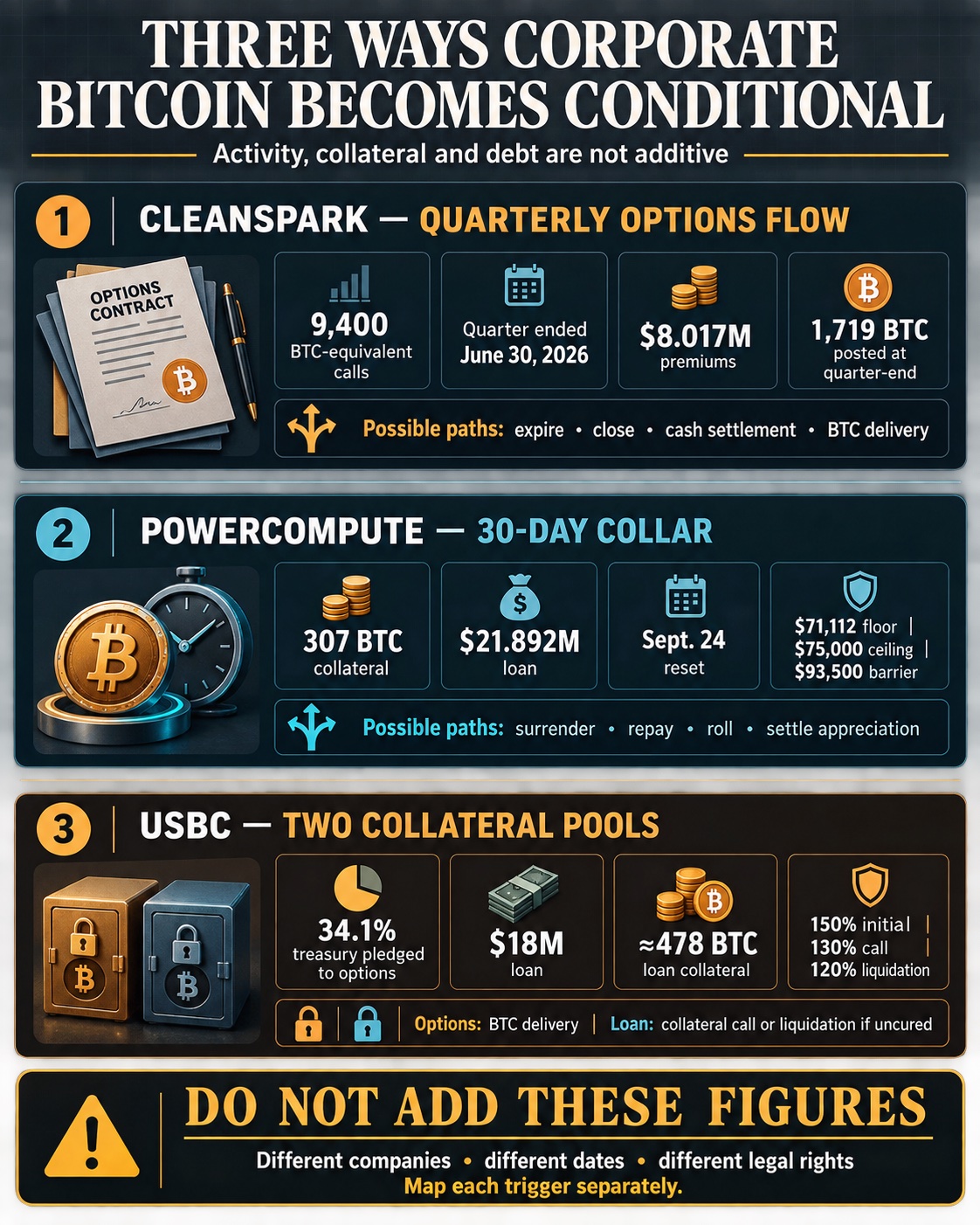
CleanSpark, PowerCompute and USBC illustrate three versions of that conditional supply. Their filings show pathways to delivered Bitcoin, cash costs, more debt, capped upside or lender-controlled collateral. The disclosed measures span different companies, dates and legal structures, so combining them would produce a false exposure total.
CleanSpark’s corporate Bitcoin treasury flow and inventory differ
CleanSpark’s 9,400 Bitcoin-equivalent figure sits in the period-activity column. Its point-in-time disclosure was different: the company reported 12,205 Bitcoin as held at June 30 and a separate receivable for 1,719 Bitcoin posted to derivative trading counterparties.
CleanSpark’s July 7 June operational update presented 13,924 Bitcoin in total, including the 1,719 posted as collateral or receivable. This reconciles the company’s operational total with the filing’s accounting boundary.
The settlement figures show where potential supply became actual delivery. During June, CleanSpark reported 250 Bitcoin sold through call exercises, 25 acquired through put exercises and 244 acquired through a delta-neutral basis trade. Its quarterly digital asset management reconciliation reported $8.595 million in proceeds from premiums and incremental Spot+ trading. The activity table also lists 7,850 Bitcoin-equivalent close-out transactions with negative $3.523 million in the premium-proceeds column, while the reconciliation included $2.982 million of fair value above strike on settled derivatives.
Those figures occupy four distinct categories: 9,400 Bitcoin-equivalent calls were period activity; 1,719 Bitcoin was posted at period end; 250 Bitcoin was sold through call exercises in June; and the dollar values record premiums, close-outs and settlement accounting.
| Company | Disclosure | What the Bitcoin measure means | What can happen |
|---|---|---|---|
| CleanSpark | Quarter ended June 30; holdings snapshot at June 30 | 9,400 BTC-equivalent Spot+ calls are period activity; 1,719 BTC was posted to derivative counterparties at period end | Calls may expire, close early, settle in cash or result in Bitcoin delivery |
| PowerCompute | 30-day collar running Aug. 25 through Sept. 24 | 307 BTC secures a $21.892 million non-recourse collar loan | Reset choices can return, retain, sell or deliver collateral; a high-price knock-in can create a settlement cost or added debt |
| USBC | Options and loan disclosures as of Aug. 24 | 34.1% of the treasury was pledged for options; about 478 BTC separately secured a credit facility | Options can require Bitcoin delivery; a falling collateral ratio can produce a call and, if uncured, lender liquidation rights |
PowerCompute’s ceiling is tested at reset
PowerCompute offers the clearest example of why contract terms matter more than a single strike price. On Aug. 25, the company entered a $21,892,131.88 collar loan secured by 307 Bitcoin at 6.5% annual interest. The new principal included a $3.765 million cost to unwind the prior collar, which the borrower elected to add to the loan balance.
The contract annex sets a $71,112 floor, a $75,000 ceiling and a $93,500 knock-in barrier for the rolling period scheduled to end Sept. 24.
Bitcoin traded near $78,767 on Aug. 31, above the ceiling and below the barrier. PowerCompute had not forfeited appreciation above $75,000 at that price. The contract tests the barrier at the reset time on Sept. 24 and disregards price moves before that moment. An early exit would move the same test forward to the exit date.
If the reference price is below $93,500 at the applicable test, the ceiling has no effect and PowerCompute keeps the appreciation, even when Bitcoin is above $75,000. At or above the barrier, the cap knocks in and appreciation above $75,000 becomes payable to the lender. PowerCompute can settle that amount with pledged Bitcoin or cash. On a rollover, it may instead add the amount to principal or absorb it into the next pricing terms.
Below the $71,112 floor, PowerCompute may surrender the pledged Bitcoin in full satisfaction of the non-recourse debt, repay and recover the collateral, or roll after curing the shortfall. Without an election, the loan matures automatically and the annex’s collateral retention or sale provisions apply.
The result is conditional supply governed by a reset structure rather than continuous intraday liquidation. PowerCompute’s 307 Bitcoin is tied to a defined decision point and a menu of settlement routes. Its latest reset has already been examined in CryptoSlate’s PowerCompute coverage; the wider lesson is that an encumbered treasury coin need not be immediately for sale.
USBC separates option control from loan liquidation
USBC’s Aug. 27 filing disclosed two constraints on its Bitcoin as of Aug. 24.
First, 34.1% of the treasury was pledged for options trading. The Bitcoin sat in cold-storage wallets with custodial partners designated by the trading counterparties, which controlled the private keys. The program can create a right to receive or an obligation to deliver a fixed amount of Bitcoin, with exposure capped by the treasury’s holdings.
The 34.1% figure therefore describes collateral under counterparty control, rather than a forecast of imminent sales. Its outcome depends on the options positions and their settlement.
Second, USBC reported a separate $18 million Bitcoin-backed borrowing from Payward Interactive, with approximately 478 Bitcoin pledged under an account-control agreement and held by Payward Financial. The loan required a 150% initial margin. A decline to 130% permits a collateral call, while a fall to 120% can give the lender liquidation rights if the deficiency is not cured.
That pathway resembles conventional secured lending: lower Bitcoin prices weaken collateral coverage, potentially requiring more coins or repayment before liquidation becomes available. It differs from CleanSpark’s rolling option activity and PowerCompute’s reset-tested non-recourse collar. Prior USBC collateral coverage and broader corporate treasury loan analysis provide the lending context, while USBC’s options pledge adds a separate layer of counterparty control.
Together, the filings leave no defensible combined total for economically unencumbered corporate Bitcoin. CleanSpark distinguishes 12,205 Bitcoin held from 1,719 posted to derivative counterparties. PowerCompute identifies 307 coins tied to one live collar. USBC reports an options-collateral percentage and a separate credit-facility collateral balance. The companies, dates, units and legal effects differ.
CleanSpark’s earlier liquidity analysis showed why a treasury’s funding demands matter. The newer filings sharpen the measurement problem: every corporate Bitcoin figure needs labels for activity versus inventory, control of the coins, the price and time that activate the contract, and whether settlement means delivery, cash, more debt or lost upside.
A corporate Bitcoin treasury holding can look permanent even when part of its economics already belongs to a contract.


