


Australian crypto firms that need financial-services authorization have until Sept. 30 to enter a compliance pathway or risk enforcement.
This week, the Australian Securities and Investments Commission (ASIC) said qualifying digital-asset businesses must apply for or vary a license, become an authorized representative, notify the regulator of an intended market-license application or begin winding down before the deadline.
From Oct. 1, firms that require authorization but have not met the applicable conditions will lose the benefit of ASIC’s temporary no-action position. The regulator warned that breaches of financial-services law can carry civil and criminal penalties, including fines of up to 10% of annual turnover.
However, this deadline does not apply uniformly across the crypto sector.
Whether a business falls inside the regime depends on whether the digital asset or arrangement it offers qualifies as a financial product and what service the company provides. ASIC said that assessment turns on the rights, benefits, expectations and product features attached to each offering.
That makes Sept. 30 less a blanket licensing cutoff and more a deadline for firms to establish where they sit within the regulatory framework.
Firms must choose a path or step away
Businesses providing financial services involving digital assets that qualify as financial products can apply for an Australian Financial Services License, vary an existing license or operate through specified authorized-representative and related-company arrangements.
Market operators and clearing and settlement providers face a different route. They must notify ASIC in writing that they intend to apply and attend a pre-application meeting by Sept. 30, with a formal application due within 12 months.
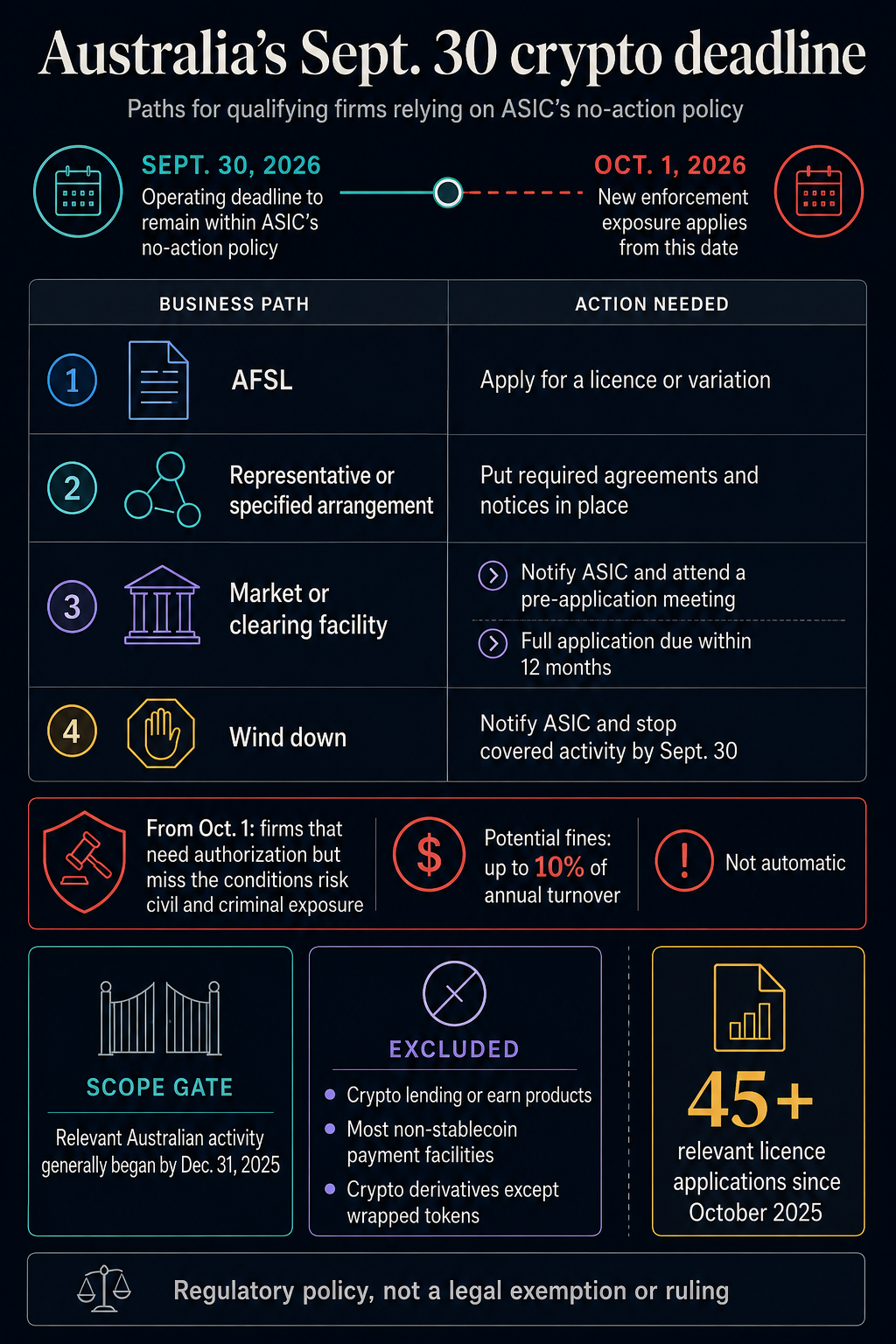
Companies that do not want to enter the licensing system can wind down instead, but they must notify ASIC by the same deadline and stop the covered activity within the permitted period.
The no-action policy also excludes several products, including crypto lending and earn offerings, most digital-asset derivatives and certain non-cash payment facilities.
ASIC has already recorded more than 45 applications for relevant digital-asset financial-services authorizations since updating its guidance in October 2025.
The regulator originally set a June 30 deadline, then extended the transition by three months and broadened the available compliance routes.
That extension now appears to be the final buffer.
ASIC’s no-action letter does not declare the covered activity lawful or prevent courts and third parties from acting. It simply sets out when the regulator presently intends not to pursue enforcement.
The practical choice for qualifying firms is therefore narrowing quickly: enter the licensing system, restructure how they operate or leave the regulated activity behind before the reprieve expires.


