

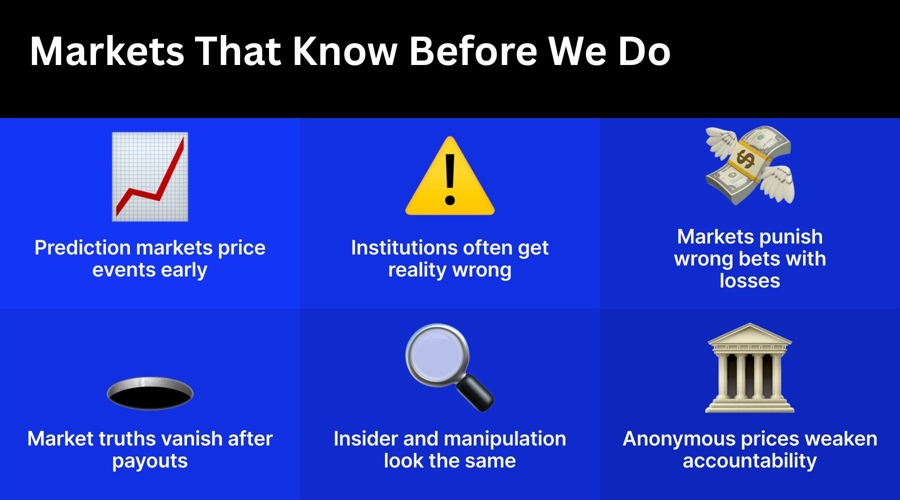
On election night in November 2024, before a single swing
state had been called, a number was already moving. Not a poll, not a network
projection — a probability on Polymarket, drifting with quiet certainty toward
Donald Trump while cable anchors hedged and statisticians shrugged.
By the time
Pennsylvania was called, Polymarket had already priced the outcome for hours.
It did not predict the result. It preceded it.
Six weeks into 2026, the machinery spoke again. A Polymarket
account called “Burdensome-Mix” placed $32,537 on Nicolás Maduro’s removal from power at odds of 5.5 percent. Hours later, Trump announced on Truth Social that
Delta Force commandos had seized Maduro from his Caracas home. The account
collected $436,759. Congress opened an inquiry.
Then, on the night of February 27, as U.S. and Israeli
aircraft prepared for strikes on Tehran, a trader named “Magamyman” placed $32,000
on the strikes occurring the following morning. Polymarket’s own odds sat at 17
percent. By dawn, Khamenei was dead. Magamyman collected $553,000.
Each time, a betting exchange knew before the governments,
the press, or families. And each time, when the outrage came, the platforms
offered the same quiet defense: the market was right.
Our truth-telling institutions have failed us in ways now
beyond dispute: the CIA’s unanimous WMD consensus, the Fed’s eleven months of
‘transitory’ inflation, three straight elections that the polling industry lost to a
betting exchange. The question is not why they failed, but why prediction
markets keep getting it right.
🚨FOR IMMEDIATE RELEASE
March 3rd, 2026
Kalshi “Khamenei Out” Investigation
Premier Plaintiff Law Firm, Lieff Cabraser has been retained to investigate Kalshi for unfair and improper practices connected to its “Ali Khamenei out as Supreme Leader” markets where consumers…
— RealBenGeller (@RealBenGeller) March 3, 2026
Friedrich Hayek’s answer, offered in 1945, is that markets
impose a cost for falsehood that no briefing room or press conference ever
reliably does. You lose money for being wrong. The penalty is immediate,
personal, and unappealable.
The Challenger disaster is the cleanest proof. On January
28, 1986, the shuttle disintegrated 73 seconds after launch. Within 21 minutes,
Morton Thiokol’s stock was halted while all three other component manufacturers
recovered. The Rogers Commission spent five months reaching the same conclusion
the market had reached before lunch: Morton Thiokol’s O-rings had failed.
But here is what the Challenger story is almost never used
to illustrate: the market knew, and nothing happened. The knowledge evaporated
into a payout and disappeared.
JUST IN: @Kalshi surpasses $10B in Weekly Notional Volume for the first time ever pic.twitter.com/TvBV6lPGJ1
— KalshiData (@kalshidata) June 28, 2026
This is the distinction the prediction market debate almost
never reaches: the difference between truth that is accurate and truth that is
owned. When Bob Woodward and Carl Bernstein published their Watergate
reporting, the truth arrived with someone attached to it — names on a byline,
an editor who judged the story worth the risk, a newspaper staking its
reputation.
It was owned: by people who had decided to tell it, who bore
consequences, who stayed accountable for what they set in motion. It built — into
testimony, impeachment, a resignation, a body of law. ‘Magamyman’ knew what was
coming in Iran.
He was right, and bore no obligation to tell anyone. His
knowledge was extracted, priced, and closed out. Price signals do not
accumulate. They correct, they resolve, they leave no record a society can act
on.
How Much Is the First Second of Truth Worth?
The prediction market’s accuracy derives from a mechanism
that rewards whoever is closest to the truth and asks no questions about how
they got there. Hayek understood this as pure gain: the surgeon who knows the
outcome before the family possesses knowledge markets can harvest without it
ever being explained.
But Hayek’s framework depends on a distinction it cannot
enforce: the difference between knowing something and controlling it. The
surgeon’s advantage is passive — she is present, and presence is knowledge. The
official who authorized the operation she is performing is different. The
mechanism that harvests the surgeon’s passive knowledge cannot distinguish it
from the official’s active one. It sees only a position and a payout.
Whether these were insider trades or extraordinary
inference, current law has no clean answer — because prediction markets were
built to reward exactly what insider trading law was built to prohibit: acting
on information others don’t have, regardless of how you came to have it.
.@CFTC Sues Kentucky to Prevent Violation of CFTC’s Exclusive Jurisdiction: https://t.co/7XZ57xPil2
— CFTC (@CFTC) June 23, 2026
At Super Bowl 55, Yuri Andrade found a prop bet at +750 odds
on whether a fan would run onto the field. He pooled $50,000 across friends’
accounts, put on a pink leotard, and sprinted onto the field. Bovada declined
to pay.
But Andrade’s logic was identical to “Magamyman”: he did not predict an
outcome, he manufactured one. The prediction market could not tell the
difference. A system that rewards knowing, without asking how you know, will
always be gamed by whoever can close the distance between knowing and doing.
The Probability Surface
Every other information system runs through hierarchies —
career preservation, source protection, narrative consistency — that don’t make
people dishonest, but careful in ways that compound into distortion. A
prediction market has only money, which flows toward accuracy with a directness
that no other system matches.
In the weeks before Russia’s invasion of Ukraine in February
2022, prediction market probabilities rose above 60 percent weeks ahead of
official government assessments. For anyone trying to understand what was
actually about to happen, the market was the most reliable instrument
available.
Finally, The US has sanctioned Iskander Makhmudov and Andrei Bokarev, the owners of the odious armaments company Transmashholding and Ural Mining and Metallurgical Company.
Hight time, but now they are sanctioned.
Now go for Rosatom!https://t.co/skSlQ5pE2s— Anders Åslund (@anders_aslund) September 14, 2023
Thomas Schelling spent his career studying how conflict
outcomes cluster around visible, salient signals — focal points. A prediction
market probability is the most salient signal: one number, universally visible,
updated in real time, backed by real money. A market pricing invasion at 67
percent does not observe the situation from outside.
It enters it — becoming
the coordinate around which every party calculates its response. Their accuracy
depends on independence from the events they price. Their scale destroys that
independence.
A small prediction market on a geopolitical outcome is a
forecast. A large one — $500 million wagered on the timing of the Iran strikes
— is a participant. When Kalshi CEO Tarek Mansour announced his platform’s
“death carveout” after Khamenei was killed, he acknowledged what the platforms
had long denied: that the market had become entangled with the event itself.
You cannot take half a billion dollars in bets on when a head of state will die
and remain a neutral forecaster.
The Simulation We Are Choosing
“Burdensome-Mix.” “Magamyman.” A man in a pink leotard at the Super Bowl. None conspired. None were irrational. Each saw a market, read
an incentive, and acted. The mechanism converted their private knowledge — or
their proximity to power, or their willingness to manufacture an outcome — into
a price, a payout, a resolved contract. The market did not know which of them
it was rewarding or why. It only knew the outcome had been produced.
Accuracy is not the only thing a truth-telling institution
provides, and it is not the thing we are giving up. When we replace
institutions that lied to us occasionally with a mechanism that is honest about
everything, we lose the social weight of being told the truth by someone who
decided to tell it — who had other options, who bore consequences, who stayed
accountable.
We lose the difference between the Washington Post on June 17,
1972, and “Magamyman” on February 28, 2026. Both knew something. Only one of
them had to decide what to do with what they knew.
That decision — to tell the
truth, under your own name, bearing the weight of what you are setting in
motion — is the act by which a society holds itself accountable. When that act
is replaced by a price signal, accountability does not become more efficient.
It disappears.
On election night in November 2024, before a single swing
state had been called, a number was already moving. Not a poll, not a network
projection — a probability on Polymarket, drifting with quiet certainty toward
Donald Trump while cable anchors hedged and statisticians shrugged.
By the time
Pennsylvania was called, Polymarket had already priced the outcome for hours.
It did not predict the result. It preceded it.
Six weeks into 2026, the machinery spoke again. A Polymarket
account called “Burdensome-Mix” placed $32,537 on Nicolás Maduro’s removal from power at odds of 5.5 percent. Hours later, Trump announced on Truth Social that
Delta Force commandos had seized Maduro from his Caracas home. The account
collected $436,759. Congress opened an inquiry.
Then, on the night of February 27, as U.S. and Israeli
aircraft prepared for strikes on Tehran, a trader named “Magamyman” placed $32,000
on the strikes occurring the following morning. Polymarket’s own odds sat at 17
percent. By dawn, Khamenei was dead. Magamyman collected $553,000.
Each time, a betting exchange knew before the governments,
the press, or families. And each time, when the outrage came, the platforms
offered the same quiet defense: the market was right.
Our truth-telling institutions have failed us in ways now
beyond dispute: the CIA’s unanimous WMD consensus, the Fed’s eleven months of
‘transitory’ inflation, three straight elections that the polling industry lost to a
betting exchange. The question is not why they failed, but why prediction
markets keep getting it right.
🚨FOR IMMEDIATE RELEASE
March 3rd, 2026
Kalshi “Khamenei Out” Investigation
Premier Plaintiff Law Firm, Lieff Cabraser has been retained to investigate Kalshi for unfair and improper practices connected to its “Ali Khamenei out as Supreme Leader” markets where consumers…
— RealBenGeller (@RealBenGeller) March 3, 2026
Friedrich Hayek’s answer, offered in 1945, is that markets
impose a cost for falsehood that no briefing room or press conference ever
reliably does. You lose money for being wrong. The penalty is immediate,
personal, and unappealable.
The Challenger disaster is the cleanest proof. On January
28, 1986, the shuttle disintegrated 73 seconds after launch. Within 21 minutes,
Morton Thiokol’s stock was halted while all three other component manufacturers
recovered. The Rogers Commission spent five months reaching the same conclusion
the market had reached before lunch: Morton Thiokol’s O-rings had failed.
But here is what the Challenger story is almost never used
to illustrate: the market knew, and nothing happened. The knowledge evaporated
into a payout and disappeared.
JUST IN: @Kalshi surpasses $10B in Weekly Notional Volume for the first time ever pic.twitter.com/TvBV6lPGJ1
— KalshiData (@kalshidata) June 28, 2026
This is the distinction the prediction market debate almost
never reaches: the difference between truth that is accurate and truth that is
owned. When Bob Woodward and Carl Bernstein published their Watergate
reporting, the truth arrived with someone attached to it — names on a byline,
an editor who judged the story worth the risk, a newspaper staking its
reputation.
It was owned: by people who had decided to tell it, who bore
consequences, who stayed accountable for what they set in motion. It built — into
testimony, impeachment, a resignation, a body of law. ‘Magamyman’ knew what was
coming in Iran.
He was right, and bore no obligation to tell anyone. His
knowledge was extracted, priced, and closed out. Price signals do not
accumulate. They correct, they resolve, they leave no record a society can act
on.
How Much Is the First Second of Truth Worth?
The prediction market’s accuracy derives from a mechanism
that rewards whoever is closest to the truth and asks no questions about how
they got there. Hayek understood this as pure gain: the surgeon who knows the
outcome before the family possesses knowledge markets can harvest without it
ever being explained.
But Hayek’s framework depends on a distinction it cannot
enforce: the difference between knowing something and controlling it. The
surgeon’s advantage is passive — she is present, and presence is knowledge. The
official who authorized the operation she is performing is different. The
mechanism that harvests the surgeon’s passive knowledge cannot distinguish it
from the official’s active one. It sees only a position and a payout.
Whether these were insider trades or extraordinary
inference, current law has no clean answer — because prediction markets were
built to reward exactly what insider trading law was built to prohibit: acting
on information others don’t have, regardless of how you came to have it.
.@CFTC Sues Kentucky to Prevent Violation of CFTC’s Exclusive Jurisdiction: https://t.co/7XZ57xPil2
— CFTC (@CFTC) June 23, 2026
At Super Bowl 55, Yuri Andrade found a prop bet at +750 odds
on whether a fan would run onto the field. He pooled $50,000 across friends’
accounts, put on a pink leotard, and sprinted onto the field. Bovada declined
to pay.
But Andrade’s logic was identical to “Magamyman”: he did not predict an
outcome, he manufactured one. The prediction market could not tell the
difference. A system that rewards knowing, without asking how you know, will
always be gamed by whoever can close the distance between knowing and doing.
The Probability Surface
Every other information system runs through hierarchies —
career preservation, source protection, narrative consistency — that don’t make
people dishonest, but careful in ways that compound into distortion. A
prediction market has only money, which flows toward accuracy with a directness
that no other system matches.
In the weeks before Russia’s invasion of Ukraine in February
2022, prediction market probabilities rose above 60 percent weeks ahead of
official government assessments. For anyone trying to understand what was
actually about to happen, the market was the most reliable instrument
available.
Finally, The US has sanctioned Iskander Makhmudov and Andrei Bokarev, the owners of the odious armaments company Transmashholding and Ural Mining and Metallurgical Company.
Hight time, but now they are sanctioned.
Now go for Rosatom!https://t.co/skSlQ5pE2s— Anders Åslund (@anders_aslund) September 14, 2023
Thomas Schelling spent his career studying how conflict
outcomes cluster around visible, salient signals — focal points. A prediction
market probability is the most salient signal: one number, universally visible,
updated in real time, backed by real money. A market pricing invasion at 67
percent does not observe the situation from outside.
It enters it — becoming
the coordinate around which every party calculates its response. Their accuracy
depends on independence from the events they price. Their scale destroys that
independence.
A small prediction market on a geopolitical outcome is a
forecast. A large one — $500 million wagered on the timing of the Iran strikes
— is a participant. When Kalshi CEO Tarek Mansour announced his platform’s
“death carveout” after Khamenei was killed, he acknowledged what the platforms
had long denied: that the market had become entangled with the event itself.
You cannot take half a billion dollars in bets on when a head of state will die
and remain a neutral forecaster.
The Simulation We Are Choosing
“Burdensome-Mix.” “Magamyman.” A man in a pink leotard at the Super Bowl. None conspired. None were irrational. Each saw a market, read
an incentive, and acted. The mechanism converted their private knowledge — or
their proximity to power, or their willingness to manufacture an outcome — into
a price, a payout, a resolved contract. The market did not know which of them
it was rewarding or why. It only knew the outcome had been produced.
Accuracy is not the only thing a truth-telling institution
provides, and it is not the thing we are giving up. When we replace
institutions that lied to us occasionally with a mechanism that is honest about
everything, we lose the social weight of being told the truth by someone who
decided to tell it — who had other options, who bore consequences, who stayed
accountable.
We lose the difference between the Washington Post on June 17,
1972, and “Magamyman” on February 28, 2026. Both knew something. Only one of
them had to decide what to do with what they knew.
That decision — to tell the
truth, under your own name, bearing the weight of what you are setting in
motion — is the act by which a society holds itself accountable. When that act
is replaced by a price signal, accountability does not become more efficient.
It disappears.


