

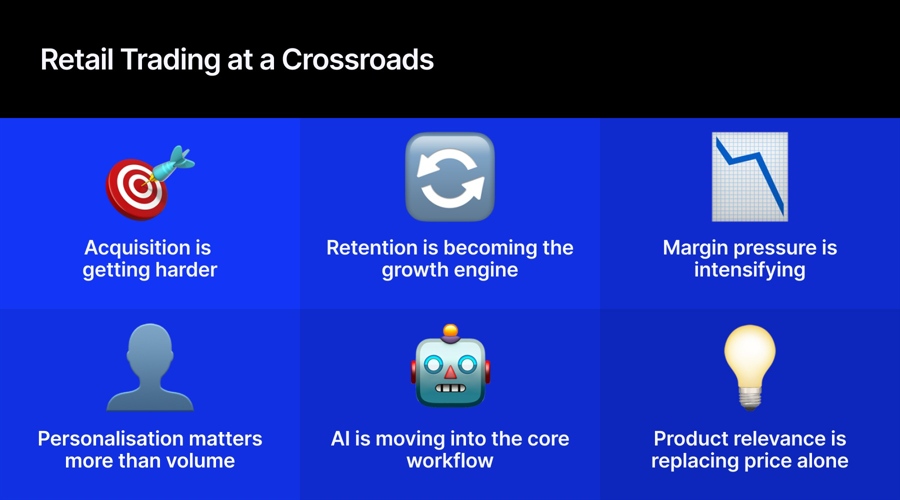
For years, brokers relied heavily on rapid client acquisition, fuelled by aggressive marketing and enticing bonuses. This approach drove impressive growth but was always vulnerable to shifting regulations and market dynamics. Today, that landscape has changed forever. Stricter regulations, heightened scrutiny, and relentless margin pressure have restructured the playing field, forcing brokers to abandon many of their traditional growth levers.
At the same time, acquiring new clients has become a far more complex and costly endeavour. Regulatory constraints and advertising restrictions imposed by major online platforms have raised barriers that brokers must now navigate carefully.
In this new environment, success depends less on quick wins and more on building lasting relationships. Brokers are being compelled to rethink how they engage with clients, shifting from a focus on acquisition to one centred on retention, relevance, and long-term value.
While the environment is undoubtedly more challenging, it is
also forcing the industry to mature, with brokers developing more sustainable
and insightful engagement models.
One of the clearest shifts across the industry is the move
from prioritising acquisition to focusing on retention. Bringing in new clients
today is far more challenging than it was just a few years ago. MiFID II and product intervention rules in Europe have imposed advertising restrictions, and
limitations imposed by platforms such as Google and Meta have raised the bar
for acquisition efforts.
This makes nurturing existing client relationships more critical than ever. Reducing churn by enhancing the overall platform experience, client engagement and interaction, as well as client satisfaction, is no longer just a support function – it has become central to sustainable growth.
Read more: iForex “Increased Marketing for the IPO, but Results Didn’t Follow Due to Listing Delay”
A Different Engagement Model
Client engagement has evolved beyond simple, generic email
blasts. Today, brokers have access to a wide array of communication channels,
including push notifications, SMS, and messaging apps. But having more channels
is not enough; relevance is key.
Clients expect communication that reflects their interests and trading behaviour. We see that engagement improves significantly when communications reflect a client’s actual trading behaviour and interests. For example, a trader focused on commodities is far more likely to engage with targeted updates on geopolitical developments affecting the prices of oil or gold than with broader market commentary.
This is why understanding the client in terms of what they trade, how they behave, and what they are interested in has become essential. Engagement needs to be as personalised and data-driven as possible.
The Impact of Margin Pressure
Margin compression is now one of the most pressing
challenges for brokers. Competition has driven spreads lower across many core
products, sometimes turning pricing into a race to the bottom. Meanwhile,
operational costs, especially manpower, remain high, squeezing profitability.
However, this also presents an opportunity for innovation,
pushing firms to become leaner, more efficient, and more focused on where value
is truly created.
To stay competitive, brokers are turning to technology and AI
to automate routine processes and support client engagement. This approach
helps control costs without sacrificing service quality. The goal is not to
eliminate the human touch, but to deploy it where it adds the most value.
Competing Through Product Relevance
As pricing becomes less of a differentiator, product
strategy is becoming more important. The industry has expanded beyond pure FX
focus to include a much broader range of assets, including equities ,
commodities, and cryptocurrencies.
We have seen multiple product cycles over
the past decade, with brokers adapting accordingly to meet clients’
expectations. Staying relevant means offering products that clients want,
precisely when they want them.
This is often driven by market events. When a major IPO attracts global attention, brokers who can quickly provide access are better positioned to capitalise. There is also a growing interest in less commoditised products, where competition is lighter and spreads are healthier.
Elon Musk just became the world’s first trillionaire.
With SpaceX opening on the Nasdaq at $150 a share Friday, his stake in the company is worth more than $766 billion. Combined with his Tesla stake, which is worth $280 billion, Musk’s net worth from both companies as of Friday… pic.twitter.com/a4jq3SWYE1
— CNBC (@CNBC) June 12, 2026
Looking ahead, emerging areas such as prediction markets are
gaining traction and may become important components of the retail trading
system.
Competing Through Product Relevance
Regulation has played a major role in shaping today’s
market. There is no question that improvements in transparency, client
protection, and risk disclosure are important and positive developments.
However, there is ongoing debate about whether regulatory measures have become
overly restrictive, limiting not just what clients are informed about but what
they can do.
In my view, regulation should empower clients with the
information they need to make informed decisions – not restrict their choices.
For brokers, the challenge is to remain engaging and competitive while fully
complying with these evolving rules.
The Role of AI in Engagement
AI is increasingly integral to broker-client relationships.
For brokers, it streamlines onboarding, communication, and customer service,
freeing teams to focus on higher-value interactions. For clients, AI tools are
becoming part of their decision-making process, from platform selection to
market analysis.
This is especially true in today’s abundance of information
sources. clients are not lacking information, they are often lacking clarity at
the critical decision point. AI agents’ ability to provide timely, relevant
guidance and analysis is becoming one of the most important drivers of
engagement.
This dynamic raises the stakes for brokers’ reputations. As
external AI tools influence client choices, brokers must ensure they are seen
as credible and trustworthy.
Looking ahead, engagement models will likely adopt a hybrid
approach. AI and automation will handle a large part of the interaction,
providing real-time information, guidance, and support, while human interaction
remains vital for experienced or high-value clients who expect personal
attention.
Innovative brokers are using AI to analyse client conversations and interactions. This helps identify frequently asked questions, better understand client needs and expectations, and continuously improve the quality of communications. AI is increasingly becoming a tool that supports teams and helps deliver a more personalised client experience.
The brokers who succeed will be those who can blend technology and human insight effectively – scaling engagement without losing the personal touch.
A Structural Shift
This is not a temporary phase. Regulation, margin pressure, and evolving client expectations have fundamentally changed the industry’s operating model. The focus is moving away from short-term acquisition and towards long-term engagement and retention.
The future for brokers lies in creating meaningful, long-term relationships with clients. Those who succeed will not be the loudest or the fastest to acquire, but those who invest in personalisation, product relevance, and efficient engagement strategies.
For years, brokers relied heavily on rapid client acquisition, fuelled by aggressive marketing and enticing bonuses. This approach drove impressive growth but was always vulnerable to shifting regulations and market dynamics. Today, that landscape has changed forever. Stricter regulations, heightened scrutiny, and relentless margin pressure have restructured the playing field, forcing brokers to abandon many of their traditional growth levers.
At the same time, acquiring new clients has become a far more complex and costly endeavour. Regulatory constraints and advertising restrictions imposed by major online platforms have raised barriers that brokers must now navigate carefully.
In this new environment, success depends less on quick wins and more on building lasting relationships. Brokers are being compelled to rethink how they engage with clients, shifting from a focus on acquisition to one centred on retention, relevance, and long-term value.
While the environment is undoubtedly more challenging, it is
also forcing the industry to mature, with brokers developing more sustainable
and insightful engagement models.
One of the clearest shifts across the industry is the move
from prioritising acquisition to focusing on retention. Bringing in new clients
today is far more challenging than it was just a few years ago. MiFID II and product intervention rules in Europe have imposed advertising restrictions, and
limitations imposed by platforms such as Google and Meta have raised the bar
for acquisition efforts.
This makes nurturing existing client relationships more critical than ever. Reducing churn by enhancing the overall platform experience, client engagement and interaction, as well as client satisfaction, is no longer just a support function – it has become central to sustainable growth.
Read more: iForex “Increased Marketing for the IPO, but Results Didn’t Follow Due to Listing Delay”
A Different Engagement Model
Client engagement has evolved beyond simple, generic email
blasts. Today, brokers have access to a wide array of communication channels,
including push notifications, SMS, and messaging apps. But having more channels
is not enough; relevance is key.
Clients expect communication that reflects their interests and trading behaviour. We see that engagement improves significantly when communications reflect a client’s actual trading behaviour and interests. For example, a trader focused on commodities is far more likely to engage with targeted updates on geopolitical developments affecting the prices of oil or gold than with broader market commentary.
This is why understanding the client in terms of what they trade, how they behave, and what they are interested in has become essential. Engagement needs to be as personalised and data-driven as possible.
The Impact of Margin Pressure
Margin compression is now one of the most pressing
challenges for brokers. Competition has driven spreads lower across many core
products, sometimes turning pricing into a race to the bottom. Meanwhile,
operational costs, especially manpower, remain high, squeezing profitability.
However, this also presents an opportunity for innovation,
pushing firms to become leaner, more efficient, and more focused on where value
is truly created.
To stay competitive, brokers are turning to technology and AI
to automate routine processes and support client engagement. This approach
helps control costs without sacrificing service quality. The goal is not to
eliminate the human touch, but to deploy it where it adds the most value.
Competing Through Product Relevance
As pricing becomes less of a differentiator, product
strategy is becoming more important. The industry has expanded beyond pure FX
focus to include a much broader range of assets, including equities ,
commodities, and cryptocurrencies.
We have seen multiple product cycles over
the past decade, with brokers adapting accordingly to meet clients’
expectations. Staying relevant means offering products that clients want,
precisely when they want them.
This is often driven by market events. When a major IPO attracts global attention, brokers who can quickly provide access are better positioned to capitalise. There is also a growing interest in less commoditised products, where competition is lighter and spreads are healthier.
Elon Musk just became the world’s first trillionaire.
With SpaceX opening on the Nasdaq at $150 a share Friday, his stake in the company is worth more than $766 billion. Combined with his Tesla stake, which is worth $280 billion, Musk’s net worth from both companies as of Friday… pic.twitter.com/a4jq3SWYE1
— CNBC (@CNBC) June 12, 2026
Looking ahead, emerging areas such as prediction markets are
gaining traction and may become important components of the retail trading
system.
Competing Through Product Relevance
Regulation has played a major role in shaping today’s
market. There is no question that improvements in transparency, client
protection, and risk disclosure are important and positive developments.
However, there is ongoing debate about whether regulatory measures have become
overly restrictive, limiting not just what clients are informed about but what
they can do.
In my view, regulation should empower clients with the
information they need to make informed decisions – not restrict their choices.
For brokers, the challenge is to remain engaging and competitive while fully
complying with these evolving rules.
The Role of AI in Engagement
AI is increasingly integral to broker-client relationships.
For brokers, it streamlines onboarding, communication, and customer service,
freeing teams to focus on higher-value interactions. For clients, AI tools are
becoming part of their decision-making process, from platform selection to
market analysis.
This is especially true in today’s abundance of information
sources. clients are not lacking information, they are often lacking clarity at
the critical decision point. AI agents’ ability to provide timely, relevant
guidance and analysis is becoming one of the most important drivers of
engagement.
This dynamic raises the stakes for brokers’ reputations. As
external AI tools influence client choices, brokers must ensure they are seen
as credible and trustworthy.
Looking ahead, engagement models will likely adopt a hybrid
approach. AI and automation will handle a large part of the interaction,
providing real-time information, guidance, and support, while human interaction
remains vital for experienced or high-value clients who expect personal
attention.
Innovative brokers are using AI to analyse client conversations and interactions. This helps identify frequently asked questions, better understand client needs and expectations, and continuously improve the quality of communications. AI is increasingly becoming a tool that supports teams and helps deliver a more personalised client experience.
The brokers who succeed will be those who can blend technology and human insight effectively – scaling engagement without losing the personal touch.
A Structural Shift
This is not a temporary phase. Regulation, margin pressure, and evolving client expectations have fundamentally changed the industry’s operating model. The focus is moving away from short-term acquisition and towards long-term engagement and retention.
The future for brokers lies in creating meaningful, long-term relationships with clients. Those who succeed will not be the loudest or the fastest to acquire, but those who invest in personalisation, product relevance, and efficient engagement strategies.


