


Vitalik Buterin has confirmed that AI-assisted analysis used by Co-Invest CEO Franklyn Wang correctly identified his anonymous contribution to an Ethereum proposal.
The identification comes two weeks after Buterin publicly challenged whether current AI tools could pierce online anonymity.
Wang’s winning submission identified an anonymous rewrite of EIP-7503 by analyzing the way it explained mathematical and technical concepts.
“The doc was an anonymous EIP-7503 rewrite he’d hidden by writing it in Chinese and machine-translating it,” Wang wrote in a Monday X post after Buterin confirmed the result. “The tell wasn’t his words, it was his reasoning.”
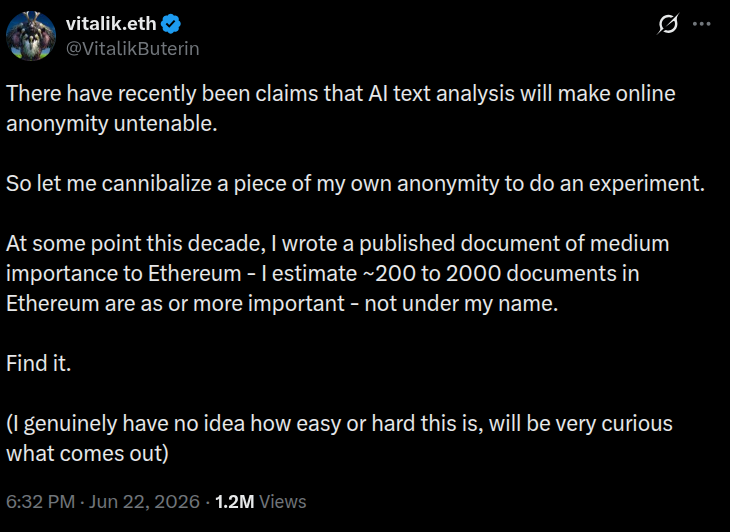
Vitalik Buterin’s June 22 post challenging viewers to discover his anonymous writing. Source: Vitalik Buterin
Some of the crypto industry’s most prominent contributors, including Bitcoin creator Satoshi Nakamoto, have relied on pseudonyms to conceal their identities. Some analysts believe that if AI can reliably identify authors from their reasoning patterns, that would make anonymous technical contributions harder to sustain across open-source blockchain communities.
Related: AI agent development hasn’t accelerated as expected, Zuckerberg says
Buterin tests AI deanonymization
In a February paper, researchers from ETH Zurich and Anthropic claimed large language models have made online deanonymization practical at scale.
The study found AI could identify pseudonymous online users by extracting identity-related information from unstructured text, searching for potential matches and reasoning over the most likely candidates, outperforming traditional deanonymization techniques.
“There have recently been claims that AI text analysis will make online anonymity untenable. So let me cannibalize a piece of my own anonymity to do an experiment,” Buterin said on June 22.
He confessed to publishing a document of “medium importance” to Ethereum at some point in the past decade under a different name.
“Find it,” he challenged.
Related: Yield Guild Games cuts 35 staff, shuts game publisher to focus on AI
Wang said that Co-Invest ranked Buterin as the most likely author of an anonymous December 2024 rewrite of EIP-7503, with roughly 20% confidence, which was about 10 times higher than the next candidate in its analysis of 27 documents.
Buterin later revealed he had written the anonymous rewrite in Chinese, translated it into English using Qwen 2.5 and manually corrected the translation in an attempt to disguise his prose.
“Notice that the stylistic hints that his AI picked up on were intellectual habits and style of math and algorithm explanation, which bypassed my obfuscation strategy (which only covered prose) completely,” Buterin wrote.
Lighter CEO Vladimir Novakovski said Monday he worked with Wang in a 2023 project using GPT-4 to try to identify Bitcoin creator Nakamoto by matching writing style in cryptography research, but said the effort failed to produce a high-confidence result.
According to Novakovski, Wang later applied a similar approach to Buterin’s anonymity challenge.
Magazine: Bitcoin slides to $58K, XRP hits $1 but onchain data promising: Market Moves


