


Bitcoin’s recovery above $60,000 is facing a fresh test from exchange-flow and derivatives data after large holders moved one of the year’s largest daily BTC inflows onto trading platforms during the latest selloff.
Data from CryptoSlate showed that the flagship digital asset was trading at $61,528 at press time, after dropping below $58,000 earlier in the week to a new bear-market low.
While the current price rebound has eased immediate pressure, the market data behind the move shows a less secure recovery than the price alone suggests.

Large Bitcoin deposits point to whale activity
Bitcoin’s June 30 exchange inflow has become one of the clearest warning signs behind the latest market rebound.
CryptoQuant data showed that about 49,000 BTC moved to trading platforms that day, one of the heaviest daily inflows recorded this year. Such spikes are closely watched because they can precede sharper volatility, especially when they occur during a fragile recovery.
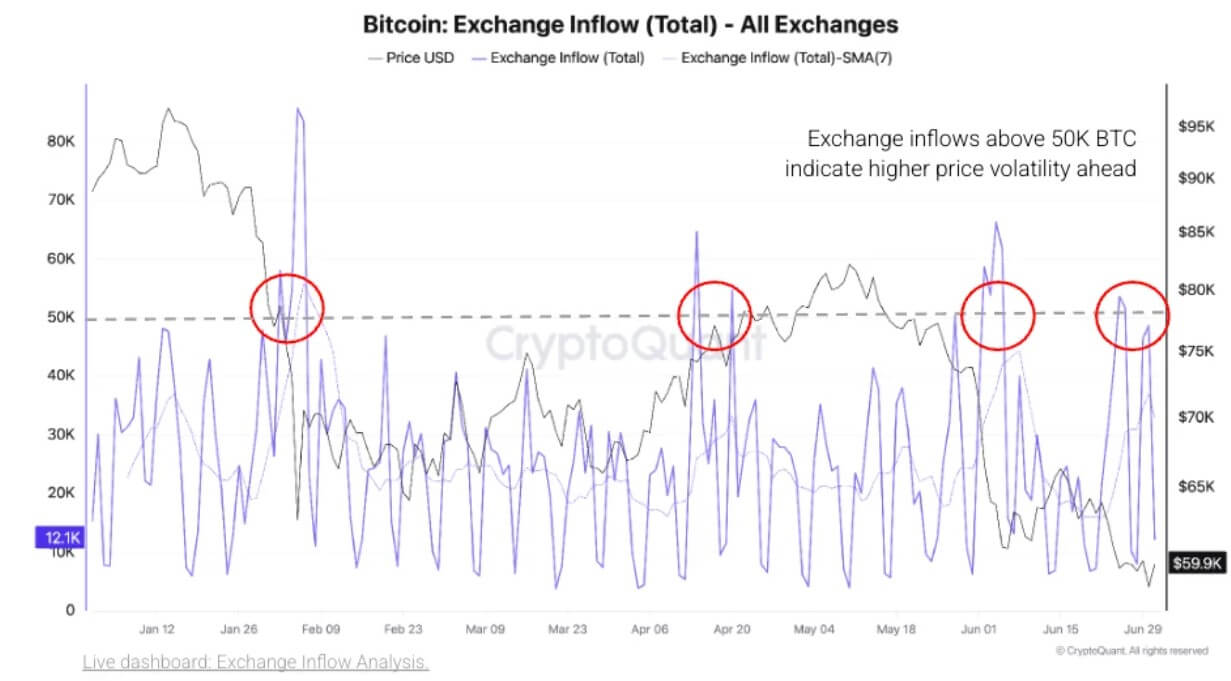
Exchange deposits do not always translate into immediate selling. Investors can move coins to trading venues to rebalance holdings, hedge exposure, post collateral, or prepare for derivatives activity.
Still, the transfers increase the amount of Bitcoin available on exchanges, leaving the market more exposed if sentiment weakens or buyers fail to absorb the added supply.
Meanwhile, the composition of the inflow added to the concern. CryptoQuant reported that the average Bitcoin deposit size doubled during the surge, rising from about 1 BTC to roughly 2 BTC.
That change suggests the movement was led by larger holders rather than a broad wave of smaller retail transfers.
That distinction is important for traders watching liquidity. A rise in many small deposits can reflect routine exchange activity.
However, a jump in average deposit size points to more deliberate repositioning by whales and institution-sized investors, whose transfers can carry greater weight when market depth is already thin.
BTC’s rebound has not repaired the chart
Beyond the flow of funds, Bitcoin’s price chart continues to present a precarious picture. The recent plunge below $58,000 inflicted significant technical damage that the current bounce has yet to repair.
CryptoQuant reported that the asset recently broke below the neckline of a prominent head-and-shoulders pattern on the daily time frame.
Traders often read this bearish formation as a sign that an uptrend may be giving way to a downtrend. Although prices have briefly reclaimed the $60,000 level, the breakdown remains valid unless Bitcoin mounts a sustained rally that invalidates the pattern.
Traders are now eyeing the $65,000 region as the next major battleground. However, former support zones often become formidable resistance levels during a broader market correction.
Consequently, any corrective bounce toward $65,000 may provide large holders with an attractive liquidity pocket to offload their recently deposited exchange balances, effectively capping further upside.
Futures buyers stepped in, but leverage fell
Moreover, a deeper dive into derivatives data reveals that the recent price recovery lacks the hallmarks of a sustainable bullish reversal.
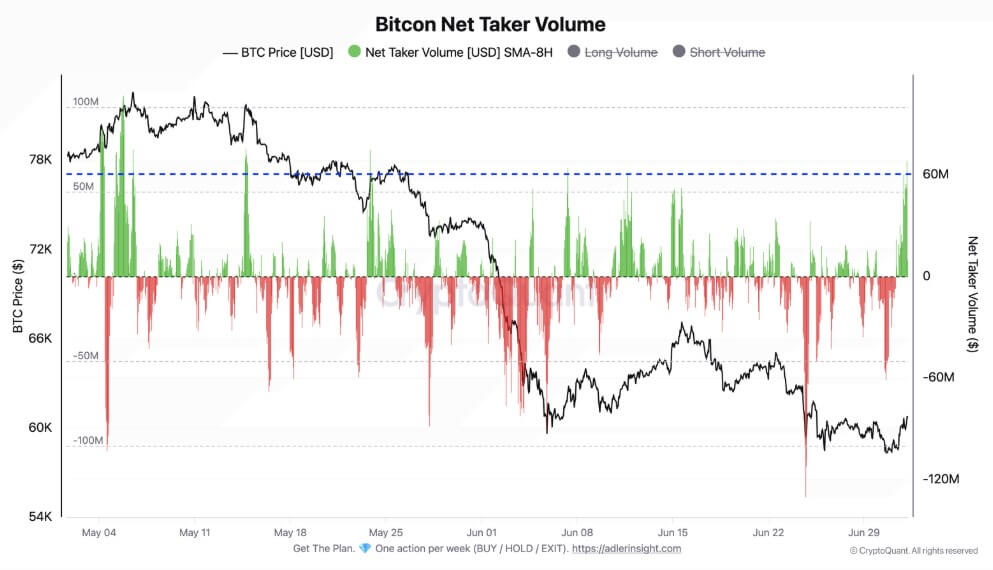
CryptoQuant analyst Axel Adler pointed out that BTC’s net taker volume, which tracks aggressive market buying minus selling and smooths the result with an eight-hour moving average, turned sharply higher after the June 30 sell-off.
The metric fell to about -$61 million as Bitcoin slid toward $58,300, then reversed the next day amid increased buying pressure.
By July 2, net taker volume reached about $68 million as Bitcoin rose from roughly $58,000 to a local high near $64,000. That showed real market buying during the rebound, not merely a passive drift higher.
However, BTC’s open interest moved in the opposite direction. The 24-hour change in Bitcoin open interest swung from a gain of about 26,000 BTC at the start of July 1 to a decline of about 23,000 BTC by the morning of July 2.
As a result, total open interest fell from about 368,000 BTC to the 342,000-346,000 BTC range.
This divergence is consistent with a short squeeze. A rising price coupled with falling open interest can indicate that underwater short-sellers are buying back positions to avoid forced liquidation.
Because that kind of move is driven more by deleveraging than by fresh long exposure, it may offer weaker support for an extended uptrend unless new demand follows.
Liquidity remains the weak point
Compounding the structural weakness of the bounce is a noticeable drought in stablecoin liquidity, which serves as a key source of dollar-denominated buying power across centralized exchanges and on-chain markets.
CryptoSlate previously reported that the stablecoin market recorded a rare contraction in the second quarter, adding to signs that crypto liquidity has weakened beyond spot prices.
Stablecoins are a key source of buying power on centralized exchanges and in on-chain markets, so a slowdown in fresh supply can make rebounds harder to sustain.
According to CryptoQuant, a Binance-linked USDT Refresh Rate Z-Score recently stood at -1.81, suggesting fresh stablecoin liquidity has not entered the world’s largest crypto exchange at a pace normally associated with stronger demand.
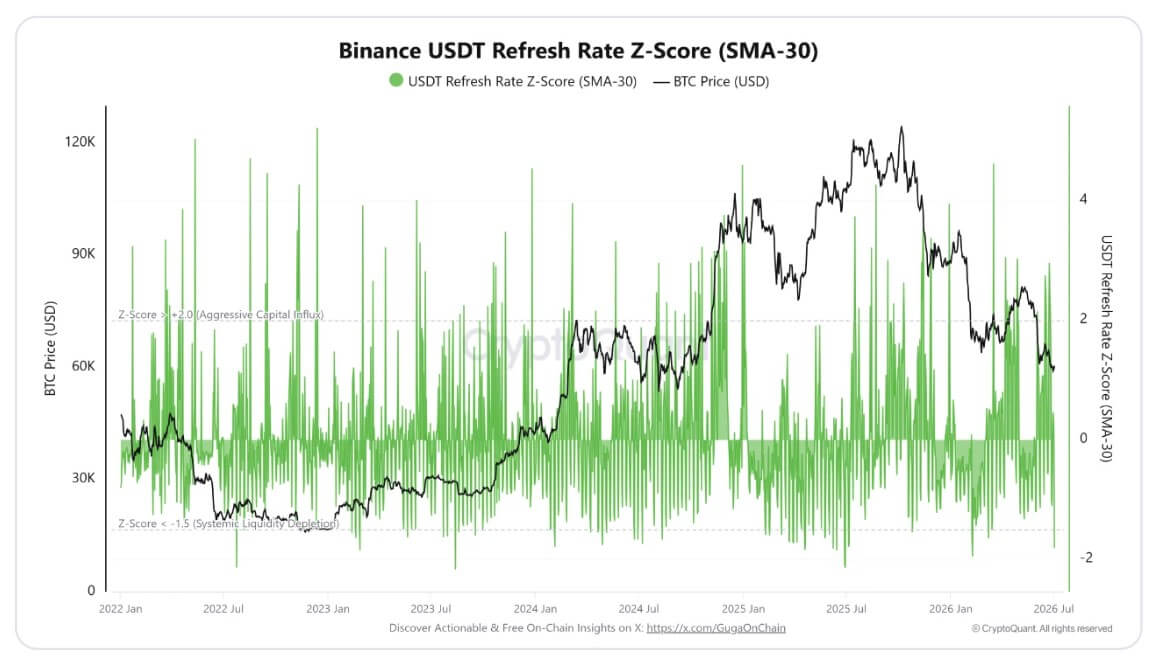
That puts more pressure on existing buyers. If new dollar liquidity remains limited, Bitcoin may need sustained spot demand from current market participants to offset exchange inflows and prevent another slide below $60,000.
But thin liquidity in the market can also magnify moves in both directions. While it can help a short squeeze carry prices higher quickly, it can also leave the market exposed if large holders use rebounds to sell into strength.
Bitcoin now needs follow-through
Bitcoin’s next move will likely depend on whether the market can turn the rebound into sustained demand rather than another short squeeze.
Holding above $60,000 would keep the immediate recovery alive and give buyers more time to challenge the $65,000 area. A clean move through that region would ease pressure from the recent breakdown and force traders to reassess the bearish chart setup.
But a failed rebound would leave the market exposed to the supply now sitting closer to exchanges. Another break below $60,000 would likely bring the realized price near $53,000 back into focus and raise the risk that losses broaden across more holders.
For now, the market is showing two competing signals. Buyers returned after Bitcoin fell below $58,000, but whale exchange flows, falling open interest, and weak stablecoin liquidity suggest the recovery still needs proof.


