

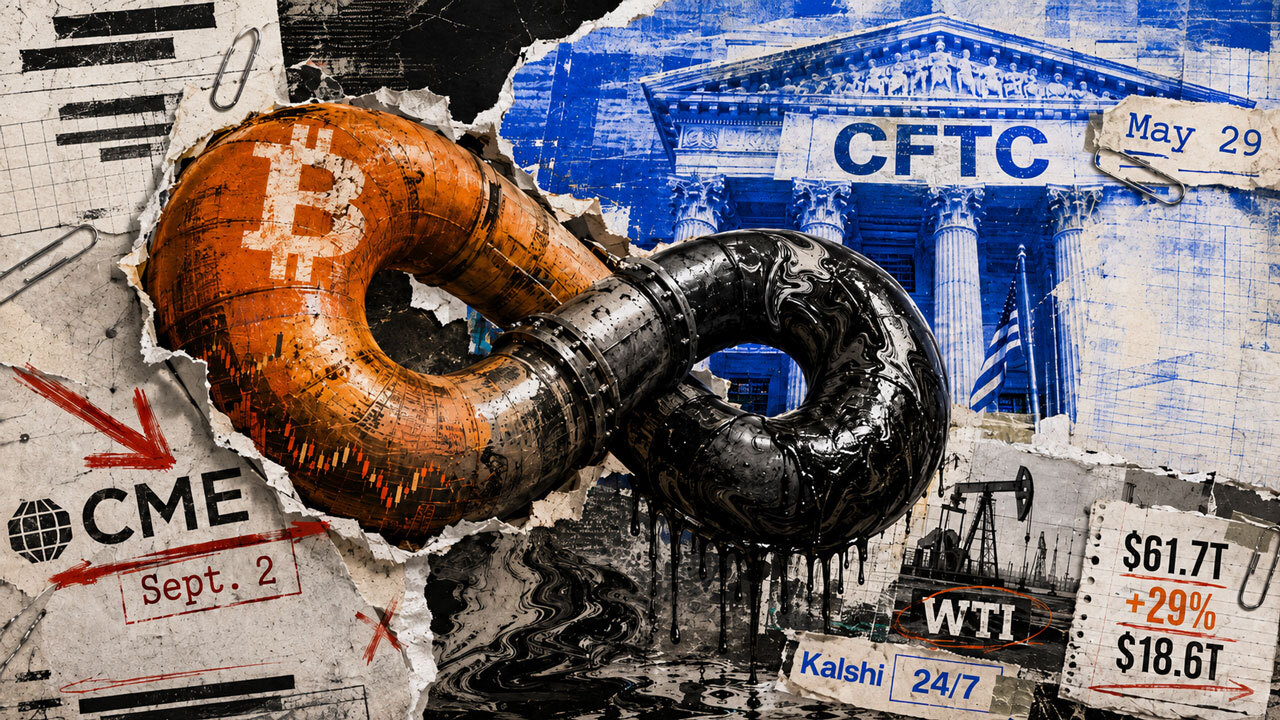
The Commodity Futures Trading Commission (CFTC) asked a federal court on Sept. 2 to dismiss CME’s challenge to Kalshi’s Bitcoin perpetual contract.
The lawsuit turns on whether a contract without a fixed expiration belongs in the US futures regime. Before the court reaches that question, the regulator says CME must first show an injury the court can fix.
The Commodity Futures Trading Commission says CME is free to list a comparable digital commodity product, so the exchange cannot blame the regulator for competitive harm caused by its choice to stay out.
That threshold argument turns a dispute over one Bitcoin contract into a test of how perpetual-style futures can spread through regulated US markets.
Bloomberg reported discussions about Coinbase seeking a regulated route to selected contracts linked to prices on Hyperliquid. Kalshi is reportedly preparing to seek approval for a West Texas Intermediate crude-oil version.
Together, the examples trace a contract structure popularized in offshore crypto markets as it enters the American regulatory perimeter one venue and asset class at a time.
CryptoQuant data shows that global crypto perpetual-futures volume reached about $61.7 trillion in 2025, up 29% from the previous year, while spot trading totaled $18.6 trillion over the same period.
The CME case could shape how much of that activity US exchanges can pursue through the CFTC’s futures framework.
The CFTC says CME can compete in Bitcoin perpetuals
CME sued the CFTC on June 18, seeking to overturn the agency’s May 29 approval of KalshiEX’s Bitcoin perpetual contracts and the accompanying policy statement. CME argued that a contract without a fixed expiration is a swap rather than a future under the Commodity Exchange Act.
The CFTC’s motion said the relief CME seeks would fail to remedy the exchange’s claimed competitive injury.
The agency added that CME may list similarly structured digital commodity perpetuals, characterizing any disadvantage from CME declining that opportunity as self-inflicted.
A judicial decision treating Kalshi’s product as a swap would not necessarily remove competing exposure from the market because another venue might offer it under that classification. In the agency’s view, a win for CME on that point would still fail to redress the alleged injury.
The current schedule gives CME until Oct. 2 to oppose the dismissal motion. A ruling on standing could leave the deeper line between futures and swaps unresolved.
The May 29 CFTC policy defined designated contract markets as those that could list similarly structured perpetuals tied to Bitcoin and digital commodities with deep, active, and continuous spot markets. Products outside that group were directed toward case-by-case review under Regulation 40.3.
The result is a faster path for qualifying digital commodity products and a separate review track for other assets. That distinction will matter as venues look from crypto toward energy and other established futures markets.
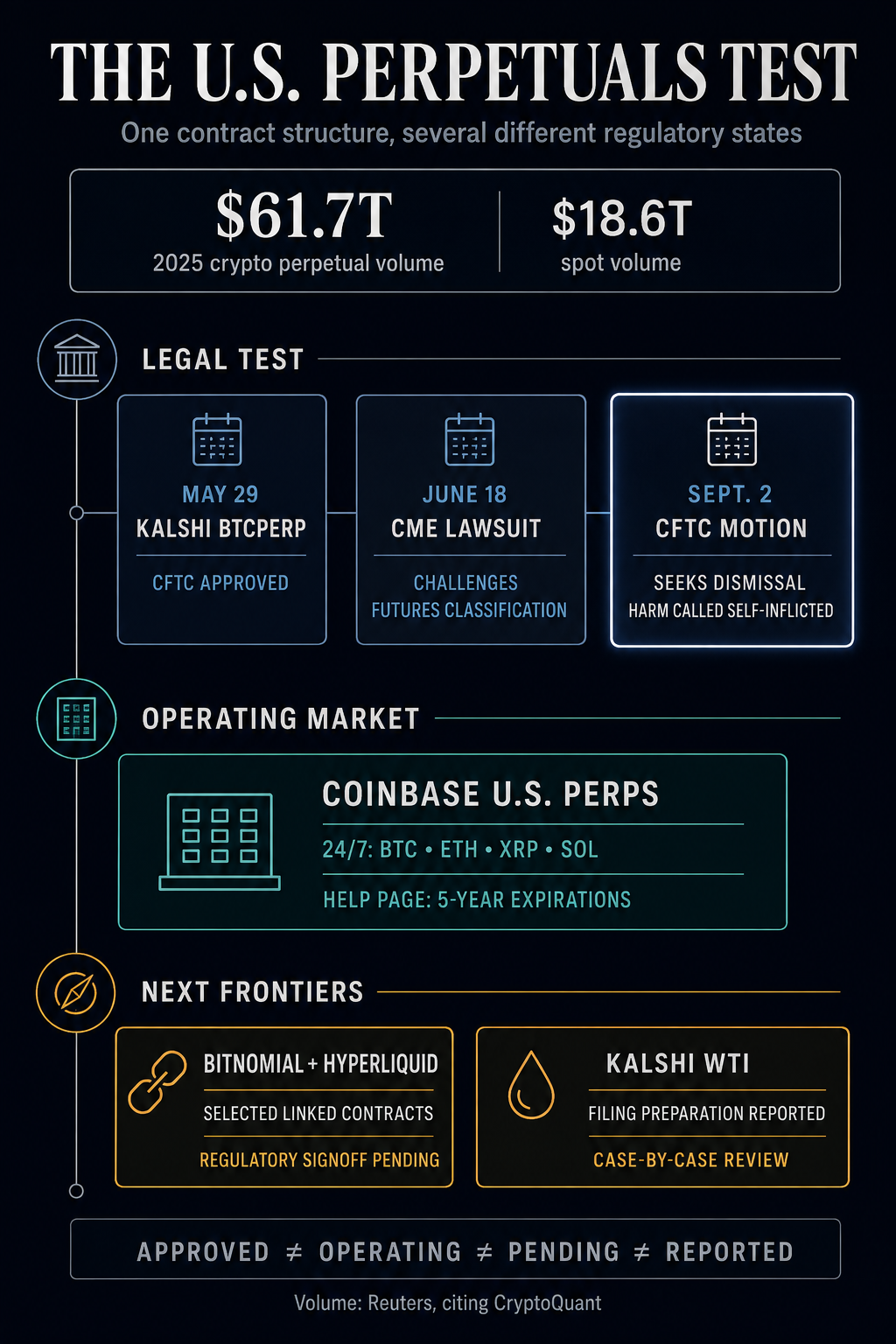
Coinbase’s derivatives market page markets US perpetual-style futures with 24/7 trading and contract families tied to Bitcoin, Ethereum, XRP, and Solana.
The name “perpetual” covers different contract mechanics in the emerging US market. Coinbase’s official help material describes the covered contracts as having five-year expirations, so they offer long-dated, continuously traded exposure, while a literal expiry-free contract requires different terms.
A June CFTC staff letter granted conditional relief for requests from Coinbase Derivatives and Bitnomial to remove expiration dates from existing digital commodity perpetual-style contracts that expired on June 30.
Regulated US perpetual-style crypto futures have moved from policy concept to operating category, even as the exact expiration mechanics vary by contract. CME’s suit challenges the agency approach behind that change as rival venues adapt one of crypto’s largest trading formats.
Hyperliquid would test an on-chain bridge
Hyperliquid and Payward are reportedly discussing a structure for registered US users. Payward subsidiary Bitnomial, a regulated derivatives venue, would offer selected contracts tied to token prices on Hyperliquid.
Payward completed its acquisition of Bitnomial in August, adding its US derivatives exchange and clearing infrastructure.
President Donald Trump supplied a political signal on Aug. 19, saying that his administration was working on a US route for Hyperliquid during a White House technology event.
A signed-off structure would test a bridge between a registered domestic venue and token prices formed in an on-chain market. Surveillance, market integrity, and the precise relationship between the venues would turn on the approved design.
Polymarket’s international site shows live leveraged crypto perpetual markets, while Polymarket US is a separate platform. The international product demonstrates how quickly crypto-native venues are expanding the format, supplying global context.
Oil brings the model into traditional futures
In June, the CFTC requested public comment on 24/7 futures trading and perpetual contracts for storable, physically delivered energy commodities, including crude oil. That consultation placed the structure under active review in a longstanding futures market.
Kalshi is reportedly preparing a CFTC filing for a perpetual contract tied to WTI crude oil, potentially as soon as the following week.
A WTI proposal would follow the CFTC’s case-by-case route. Its review would also confront the practical differences between a cash-referenced crypto contract and a market built around a physical commodity with established delivery infrastructure.
Perpetuals are being considered for a traditional commodity market where CME is an incumbent, placing the new structure closer to the core of established derivatives competition.
A quick CFTC victory on standing would preserve the agency’s framework without a ruling on the futures-versus-swaps question. Other exchanges could read that result as support for proposing similar contracts, subject to the applicable listing or review process.
Continued litigation on the merits would put the statutory classification question before the court. A decision on whether a no-expiry contract can qualify as a future would create a clearer legal boundary, while the period before a ruling could complicate product planning.
Regulatory sign-off for selected Bitnomial contracts linked to Hyperliquid prices would test the on-chain bridge. Acceptance of a WTI perpetual would show the structure crossing into a traditional commodity.
The CFTC is now defending its approach in court while exchanges probe its limits, with perpetual-style products entering the regulated US market.
The next phase will depend on whether CME has standing, how a court classifies the Kalshi contract, which venues can meet the CFTC’s conditions, and whether regulators allow the model to extend from digital commodities to on-chain prices and physical markets.


