


House Republicans have erased most of the remaining pre-election runway for the CLARITY Act despite mounting pressure to pass it.
House Republican leaders canceled votes for the weeks of Sept. 21 and Sept. 28, moving the chamber’s departure to Sept. 17 from Oct. 1. The House is scheduled to return Sept. 14 for four voting days before leaving Washington until after the November midterms.
That creates an immediate problem for the crypto market-structure bill. The Senate’s first major procedural vote is scheduled for Sept. 15, only two days before the House leaves.
Galaxy Digital Head of Research Alex Thorn said the change makes passage before the midterms “extremely unlikely.” The Senate still has roughly three weeks of session stretching into early October, but any version it passes must ultimately match the legislation approved by the House before it can reach President Donald Trump.
The House passed CLARITY 294-134 in July 2025. The Senate has since worked on amended language, meaning a Senate victory alone may not finish the job.
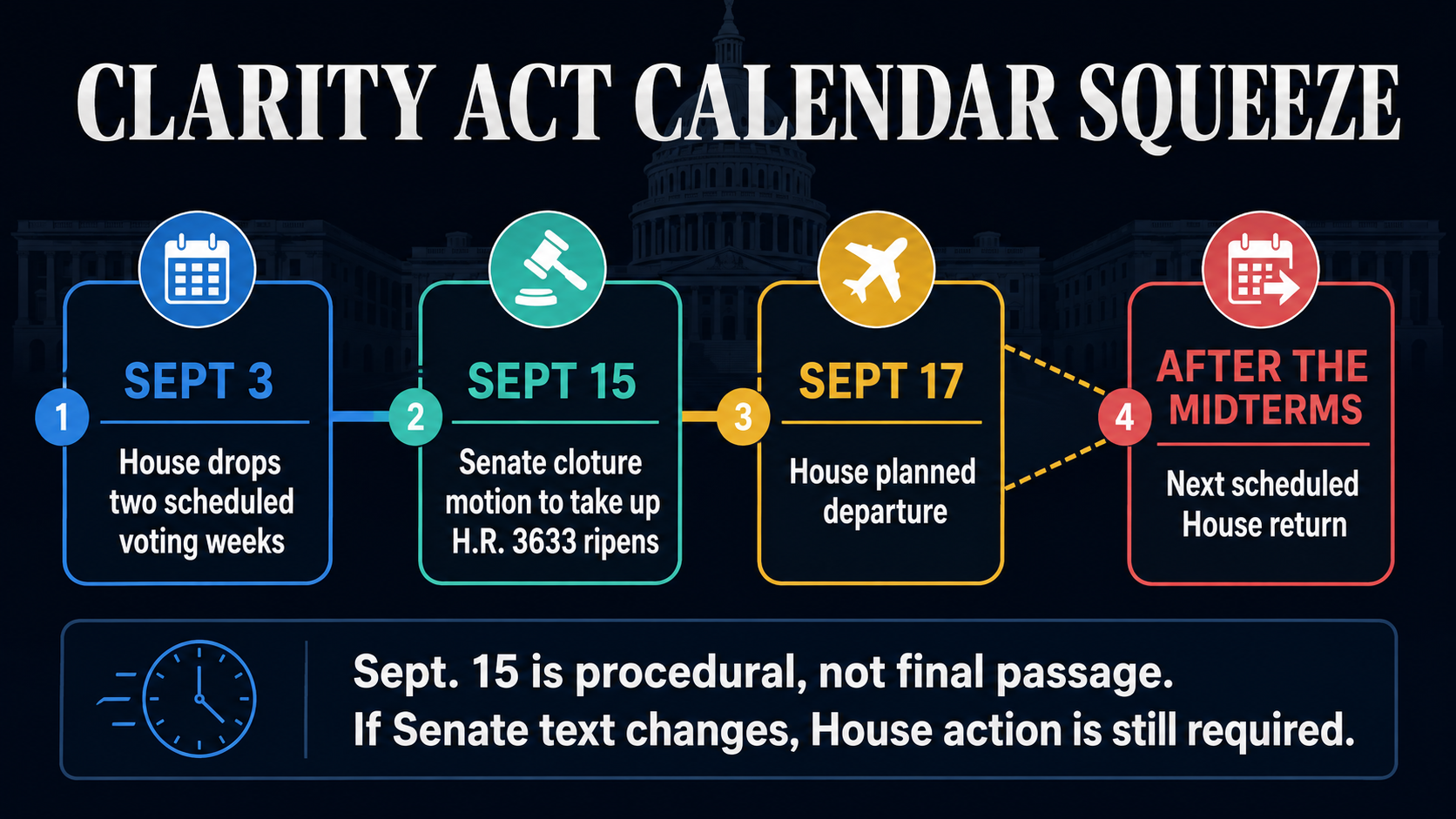
Punchbowl News reporter Brendan Pedersen said senators could potentially work through the required procedure in about a week and a half if everything went smoothly, depending on amendments. Before the calendar change, that still left the House enough time to take up a Senate bill quickly.
That late-September cushion is now gone.
Pressure is rising as the calendar closes
The squeeze comes as the White House, congressional Republicans and regulators intensify their push for legislation.
Trump called on Congress last week to pass “a fair version of the Clarity Act,” while SEC Chair Paul Atkins has said legislation remains “indispensable” even as the commission develops its own crypto rules.
House Financial Services Committee Chairman French Hill has also pressed the Senate to act, pointing to the 78 Democrats who joined Republicans when the House approved the bill.
In an X statement, he said:
“Can Democrats work with Republicans and make sure America leads the world in distributed ledger technology and financial services?”
Sen. Cynthia Lummis had already warned that the remaining legislative window was narrowing. When she released updated CLARITY text in July, she said the coming weeks were likely the “last real chance” for years to complete market-structure legislation.
Prediction markets have remained skeptical. Polymarket traders are pricing in less than a 20% chance that CLARITY would become law by Dec. 31.
Still, the calendar change does not end the bill’s prospects.
Lauren Belive, Ripple’s head of policy, argued that post-election lame-duck sessions have repeatedly produced major negotiated legislation even after elections that changed control of Congress.
Her argument shifts the immediate burden back to the Senate. If senators can produce a sufficiently settled bipartisan bill before Election Day, the House could still take it up in a lame-duck session.
That path carries a different political risk. One or both chambers could change hands in November, altering lawmakers’ incentives before they return to vote.
For now, the Sept. 15 Senate vote becomes the first test. CLARITY may still have a path to Trump’s desk in 2026, but the House calendar has made getting there before the midterms exceptionally difficult.


