

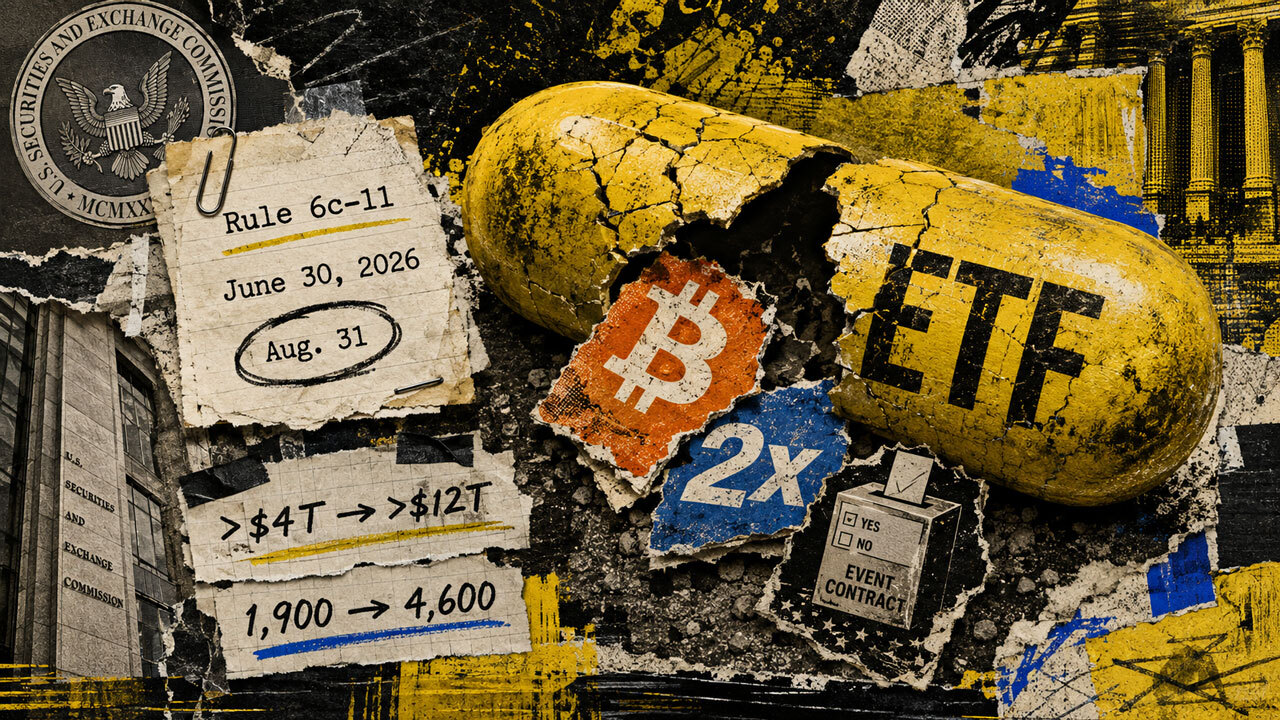
Wall Street now wants a ticker to hold almost any financial idea an investor might type into a brokerage search bar, from Bitcoin and funds promising two or three times a stock’s daily return to private assets and contracts tied to elections or economic events.
The ETF began as a cheap way to own a broad market portfolio, then became the distribution system for exposures that once required a futures account, a private placement, a crypto exchange, or a patient reading of a structured-note prospectus.
The SEC is reviewing how far that distribution system can stretch. Its June 30 request for public comment covers crypto assets, commodities, heightened gearing, single-stock products, blockchain-based opportunities, private assets, and event contracts, with comments due Aug. 31.
The review reaches beyond any single application because the agency is examining whether its existing rules give staff enough time and authority to assess products whose economic behavior can differ sharply from the diversified funds investors learned to trust.
Assets in US ETFs climbed from more than $4 trillion at the end of 2019 to more than $12 trillion at the end of 2025, while the product count rose from almost 1,900 to more than 4,600, according to the SEC’s concept release.
A format built for indexing has become the default shelf space for financial products whose risk can be hard to infer from the ticker alone.
The ticker is the product
An ETF packages a portfolio into shares that trade throughout the day on an exchange, letting investors buy exposure through the same account they use for ordinary stocks.
The creation and redemption process lets authorized participants exchange large blocks of fund shares for the underlying basket or its cash equivalent, which helps keep the trading price close to the portfolio’s value.
That mechanism turned what was essentially operational design into a retail habit by giving investors intraday trading, transparent pricing, broad brokerage access and, in many structures, better tax handling than a comparable mutual fund.
Asset managers gained a product they could put inside model portfolios and trading apps, and every successful launch encouraged sponsors to place a more specialized exposure behind the same interface.
The regulatory framework grew around that original bargain because early ETFs needed individual exemptive orders for features, including exchange trading and in-kind redemptions, that didn’t fit neatly within rules written for open-end mutual funds.
In 2019, the SEC adopted Rule 6c-11, allowing qualifying ETFs registered under the Investment Company Act of 1940 to operate without seeking an order for each launch, provided they met conditions involving portfolio information, trading data, and the arbitrage mechanism.
Rule 6c-11 made launches faster and more standardized, helping the product count more than double by the end of 2025. A plain index fund, a concentrated thematic portfolio, and a derivatives strategy can now look almost identical on a brokerage screen, even though their holdings, valuation methods, and loss profiles bear little resemblance to one another.
The term ETF just describes the container, while the assets and contracts inside determine what an investor owns.
The common brokerage screen hides several legal categories because many stock and bond ETFs are registered investment companies under the 1940 Act, while spot Bitcoin and Ethereum products commonly use commodity-trust structures registered under the Securities Act of 1933.
Exchange-traded notes add another category: unsecured debt obligations whose return depends on the issuer’s promise, and brokerage interfaces often place all three side by side under a broad exchange-traded product heading.
Those legal categories govern custody, board oversight, diversification, borrowing, derivatives use, valuation, and the remedies available when an issuer or service provider fails. A familiar ticker reduces the effort required to buy an exposure while leaving those differences intact, which is why the SEC is examining the conditions attached to the wrapper as closely as the portfolio inside it.
Crypto taught the old ETF a new trick
Spot crypto products became the cultural turning point because investors treated exchange listing as a bridge between an unfamiliar asset and an established account.
The SEC’s approval of spot Bitcoin products in 2024 gave advisers and institutions a regulated trading venue, standardized disclosures, and conventional custody relationships, while the agency stressed that its order wasn’t an endorsement of Bitcoin itself.
The distinction between legal approval and perceived legitimacy became harder to see as the product menu widened.
Many investors encounter an ETF ticker at a major broker and infer that the underlying exposure has passed through a common filter, even when one product owns a broad equity basket and another holds a volatile commodity or rolls derivatives that can drift from the reference asset. Crypto showed sponsors how much commercial value sits inside that familiarity.
Sponsors have since applied the same distribution logic to staking, options overlays, token products promising a multiple of the daily move, and baskets of digital assets. Each design can serve an investment use while adding its own custody, valuation, market-hours, and concentration issues.
Crypto trades around the clock, ETF shares trade during exchange hours, and the creation process has to bridge those clocks when prices move sharply overnight or across a weekend.
Event-contract funds expand into more unfamiliar territory by tying returns to election outcomes, economic releases, or other defined events inside shares that trade like ordinary funds. CryptoSlate identified more than two dozen event-linked ETF proposals, showing how quickly a niche contract market could reach retail brokerage accounts once an ETF supplies the route.
The regulatory difficulty comes from function because an event contract can trade on an exchange overseen by the CFTC while the fund shares and disclosures sit within the SEC’s remit.
Risks can spread across several rulebooks, requiring the review to examine how the contract settles, who supplies prices, what happens when trading halts, and whether the fund can meet redemptions near the event date.
Those criteria apply differently to every category in the concept release.
A private-asset fund can face stale valuations and limited exits, a single-stock multiplier product can reset daily and compound away from its stated multiple over longer periods, and a token-based product can depend on custody or staking arrangements that have no close counterpart in a traditional index fund.
A product-by-product framework can attach conditions to each source of risk more precisely than a single definition of novelty.
The SEC fast lane reached unfamiliar territory
The SEC also has to decide whether its filing process gives staff enough time to examine unfamiliar structures before shares reach the market.
Certain registration statements or post-effective amendments can become effective automatically once a statutory or rule-based waiting period expires, and some amendments filed under Rule 485 can take effect immediately when they meet specified conditions.
Those pathways make routine fund updates and launches efficient, and the same route can carry a portfolio that staff hasn’t encountered before.
SEC Chair Paul Atkins said in May that several sponsors had agreed to delay novel ETF launches, including event-contract products, while the agency evaluated the issues.
A voluntary delay gives staff breathing room for the current set of filings, while a durable policy could require rule amendments, added disclosure conditions, a different review track, or a clearer boundary around which products qualify for automatic treatment.
Every revision carries a cost because a broad restriction could slow ordinary fund launches and give established issuers an advantage over smaller sponsors, while a narrow rule could leave staff racing against automatic deadlines whenever a new payoff structure appears.
The agency also has to preserve the arbitrage mechanism that keeps ETF shares close to net asset value, since disclosure alone can’t repair a portfolio whose assets are too hard to price or acquire during creations and redemptions.
Crypto issuers have a direct stake in the outcome even if event contracts command the most attention.
New staking structures, tokenized securities, multi-asset baskets, and products with daily return multiples could face added filing requirements based on how the SEC defines novelty and which safeguards it demands.
A framework centered on custody, valuation, liquidity, and payoff complexity could give sponsors a clearer route, while a wrapper-level restriction could group economically different crypto products together.
The SEC has already posted public comment letters and meeting records ahead of the Aug. 31 deadline. Once the current input period closes, the agency will have to weigh those submissions, decide whether current authority and disclosure standards are sufficient, and publish any proposed rule amendments through the normal notice-and-comment process.
Existing products and pending applications will keep supplying data about premiums, discounts, trading quality, and investor use during that process.
The ETF conquered Wall Street by making investment exposure easy to distribute, turning the wrapper into financial infrastructure for almost every kind of portfolio. A brokerage customer can move from an S&P 500 fund to Bitcoin, a two-times stock position, or an election-linked contract with a few taps, even though each trade enters a different economic world.
The SEC now has to decide which exposures require a different gate before the common ticker persuades investors that the gate has already done all the work.


