

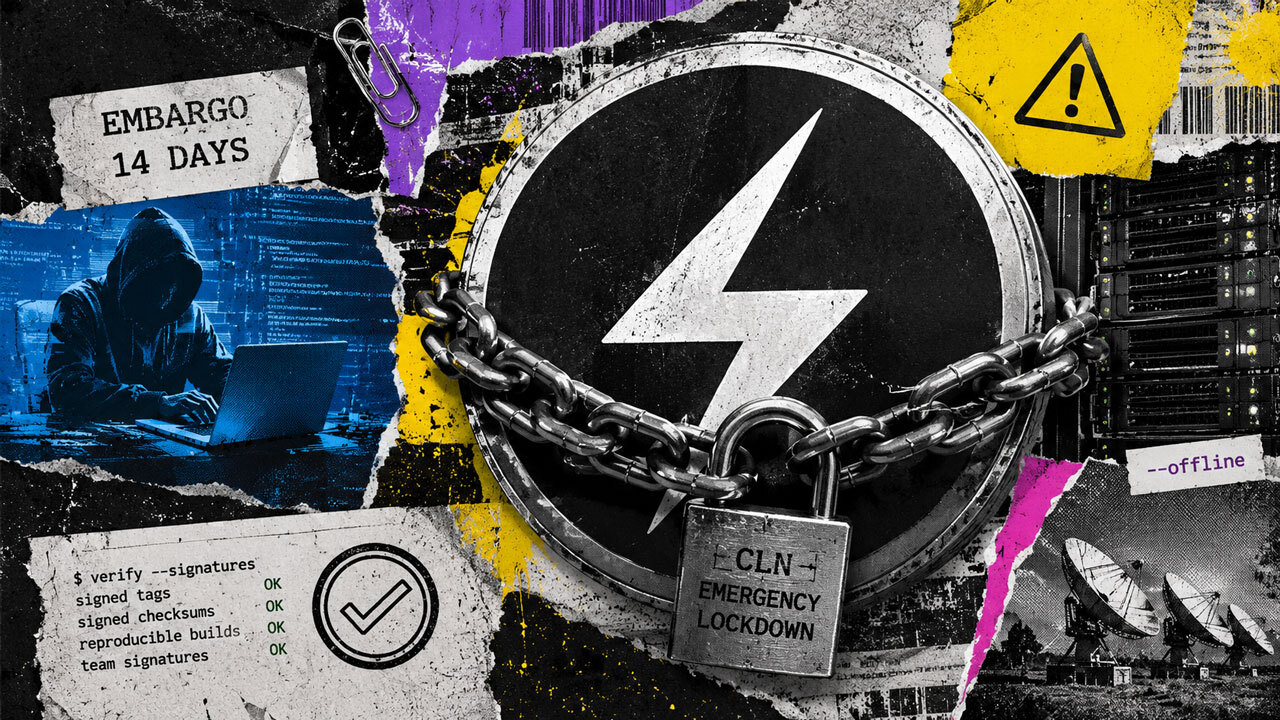
Core Lightning developers have asked node operators to make a security decision before they can fully assess the threat. An Aug. 23 message posted on Stacker News urged operators to install new binaries that fix multiple reported vulnerabilities.
CLN told operators who decline the upgrade to run their nodes offline, and the team plans to keep the technical details under embargo for two weeks.
CLN plans to attach team signatures to the binaries so users can check provenance and reproducibility. Core Lightning’s documented release process uses signed tags, signed checksums, and reproducible builds.
Those controls let operators confirm that the package came through the intended release process.
Operators cannot yet inspect the evidence behind CLN’s threat assessment or determine the exploit mechanism from the public material. They also lack enough information to assess whether a particular node configuration faces the same risk.
Bitcoin gives users tools to verify monetary rules without asking a bank or payment processor for permission.
A live software security incident operates under a different constraint, as giving every user enough evidence to verify an exploit can give an attacker the same information.
| Layer | What operators can verify now | What remains unknown during the embargo |
|---|---|---|
| Software provenance | The binaries came through CLN’s intended release process | Whether the patched issues affect every node setup |
| Release authenticity | Signed tags and signed checksums | The exact vulnerability mechanisms |
| Build integrity | Reproducible builds can link source and binary | Whether older binaries expose a specific attack path |
| Maintainer approval | Team signatures confirm release ownership | The severity of each reported issue |
| Operational response | CLN recommends upgrading or going offline | Whether --offline is necessary for every operator |
The embargo creates a temporary information hierarchy
The sequence started around Aug. 13, when CLN said it had received multiple AI-generated CVE reports from several sources over roughly 10 days. The CLN team began validating the reports, outside open-source contributors joined the work, and developers also began preparing fixes.
By Aug. 23, the CLN team planned binaries containing fixes for many of the reported vulnerabilities.
They also said it would stop supporting previous releases, including 26.04, “given the known risks.”
Blockstream shipped two CLN versions during the second quarter: 26.04 in April and 26.06 in June. Its second-quarter update placed version 26.09 on the third-quarter roadmap.
The available material provides no evidence of exploitation in the wild and no basis for treating every report as equally severe.
An operator therefore faces two verification layers, and the first covers the artifact itself. CLN’s release process gives users tools to authenticate release tags, checksums, and reproducible builds.
The second covers the threat, as operators still lack the technical detail needed to judge what the bugs can do or whether going offline fits their own exposure.
Coordinated security disclosure can delay that evidence because publication also alters the attacker’s information set.
Core Lightning delays full transparency to protect patch deployment
CERT’s coordinated vulnerability disclosure guidance says the process aims to minimize adversary advantage during remediation. Its deployment guidance also draws a line between patch availability and patch deployment.
| Disclosure choice | Benefit | Risk |
|---|---|---|
| Full technical disclosure immediately | Operators can independently assess the threat | Attackers can learn the exploit path before nodes patch |
| Embargo with signed binaries | Gives operators time to upgrade safely | Users must temporarily trust maintainer judgment |
| Patch available but not widely deployed | Fix exists for prepared operators | Unpatched nodes remain exposed |
| Delayed public details | Reduces attacker advantage during rollout | Can create suspicion or hesitation |
| Post-embargo disclosure | Restores independent verification | Trust only expires if the evidence is published clearly |
A detailed disclosure could help skilled attackers identify the vulnerable path in older software, and unpatched operators would then face a threat armed with the same technical evidence they wanted for independent verification.
Signed binaries narrow the trust requirement: operators can authenticate who produced the release, and reproducible builds can confirm the relationship between source and binary.
Bitcoin software already depends on human judgment at this layer, since maintainers decide whether a reported bug warrants emergency treatment. Release engineers decide when a fix can ship safely, and security teams decide how much information users can receive before disclosure creates additional risk.
Simultaneous disclosure would erase the temporary information advantage defenders are trying to preserve.
The bull case comes from that process working cleanly, with operators authenticating the release and moving on to patched software. Core Lightning then publishes technical details that support the urgency of its warning.
That sequence would strengthen confidence in the maintainers and the release process because the temporary trust would expire into independently inspectable evidence.
The bear case begins with hesitation. Some node operators may resist an upgrade whose threat model they cannot inspect, and others may choose –offline.
Core Lightning documents that mode as preventing the node from binding to ports or reconnecting to peers. Enough delayed upgrades or offline nodes could reduce routing availability in parts of the network.
A prolonged gap between the warning and the evidence could also turn a technical disclosure process into a credibility problem for maintainers.
AI compresses the window for “verify later”
AI adds another constraint to the disclosure model. Google revised its Open Source Software Vulnerability Reward Program in March because it saw a “massive surge” in AI-generated reports.
Google said many submissions contained incorrect information or hallucinated exploit paths. The company began demanding stronger proof for some report tiers so triage teams could focus on credible threats.
| Disclosure phase | Traditional pressure | AI-era pressure |
|---|---|---|
| Report intake | Human researchers submit findings at limited scale | AI-generated reports can arrive in large bursts |
| Triage | Maintainers separate valid bugs from noise | Teams must filter hallucinated or weak reports faster |
| Validation | Developers reproduce and rank credible issues | Automation can increase volume before humans can confirm severity |
| Patch development | Fixes are built before public detail emerges | More parties may rediscover similar flaws during the embargo |
| User rollout | Operators patch before full disclosure | Attackers may use diffs, binaries, or clues to search faster |
| Final disclosure | Evidence becomes independently inspectable | The “verify later” window may shrink |
CLN’s messages describe a related burden: multiple AI-generated reports arrived from several sources within roughly 10 days. Humans still had to validate the findings before developers could treat them as vulnerabilities.
Google has already demonstrated that AI-generated fuzzing can uncover vulnerabilities in mature open-source projects, including OpenSSL. Tools that reduce the cost of vulnerability discovery can also make rediscovery easier once researchers have a patched binary, a code difference, or another technical clue.
Maintainers need a window to validate a flaw, and another window to distribute a fix before exploit knowledge spreads. AI can consume the first window with report volume and compress the second through cheaper automated searching.
Cryptography can minimize the trust required to verify transactions, balances, and software artifacts. Operational security can require temporary trust in maintainer judgment when immediate disclosure would also improve an attacker’s position.
Core Lightning’s eventual disclosure can close that gap. Until then, operators who upgrade accept a limited form of trust inside software built around independent verification. The model succeeds when that trust has an expiration date, and the evidence arrives.


