


Solana’s live monetary-policy vote is forcing the network to confront a basic governance question: what happens when the validator setting a default vote for delegated stake has a disclosed interest in preserving staking yield?
Solana Company provides the clearest test case. The Nasdaq-listed SOL treasury company and validator operator announced on Aug. 21 that it would oppose SGP-0002, a proposal to accelerate disinflation. Its earlier financial results showed that staking on company-held SOL produced $2.512 million of its $2.526 million in second-quarter revenue, or 99.4%.
Under Solana’s new governance design, delegated stake follows a validator’s position by default. A native staker can override that position for an individual stake account before the validator votes, after it votes or when it abstains from voting. This makes the company’s position influential while preserving a direct choice for the owners of its delegated stake.
On Aug. 23, SGP-0002 remained in voting with about 5.27 million SOL For, 547,019 SOL Against and zero Abstain across 24 votes. For represented about 90.6% of decisive stake at that moment. This was a timestamped snapshot, and the totals were already changing.
The public voter table and decoded Against ballots showed no vote attributable to Solana Company, HSDT or its validator operation at that observation. Unknown address labels limit entity-level attribution, so the record establishes the company’s announced intention rather than a verified company ballot.
An accepted SGP would record a directional mandate. Protocol implementation and activation require later technical work, which means the live tally measures stakeholder preference rather than an immediate change to SOL issuance.
The validator’s stake in the result
Solana Company says predictable inflation and staking yield help institutions model returns and adopt SOL. Its opposition follows the economics described in its own financial statements, while its advance disclosure lets delegators decide whether that default position matches their own preference.
The company’s second-quarter results classify $2.512 million as GAAP staking revenue on company-held SOL. Cash flow and validator commission revenue are separate measures. The company also said the 31,200 SOL earned as quarterly staking rewards were automatically restaked.
Its income statement reported a $32.7 million operating loss and a $30.3 million net loss, including $25.4 million of realized digital-asset losses. These figures describe different parts of the company’s finances. Together, they show why the staking-revenue share cannot serve as a direct estimate of the proposal’s effect on cash or profitability.
Timing adds another boundary. The 99.4% share covers the quarter ended June 30, while the company’s own validator cluster launched in July. Its quarterly filing says a portion of company SOL depends on third-party custody, staking or infrastructure providers. By the filing date, outside parties had delegated roughly 500,000 SOL to the new cluster.
The headline number therefore measures the company’s exposure to staking economics. Revenue from operating its own validator remains a separate question. Any future effect from faster disinflation would vary with its SOL balance, staking participation, commissions, SOL price, fees, MEV and activation timing.
Delegators hold the practical check on that alignment. Solana’s documentation says a native staker can override a validator’s position without undelegating. The override reallocates the stake account’s effective vote while leaving the economic delegation in place.
That mechanism was already in use. One override recorded at 14:52:53 UTC on Aug. 23 directed 15.585838993 SOL For SGP-0002. Its size confirms only that the path was functioning; it offers no basis for inferring broad delegator resistance.
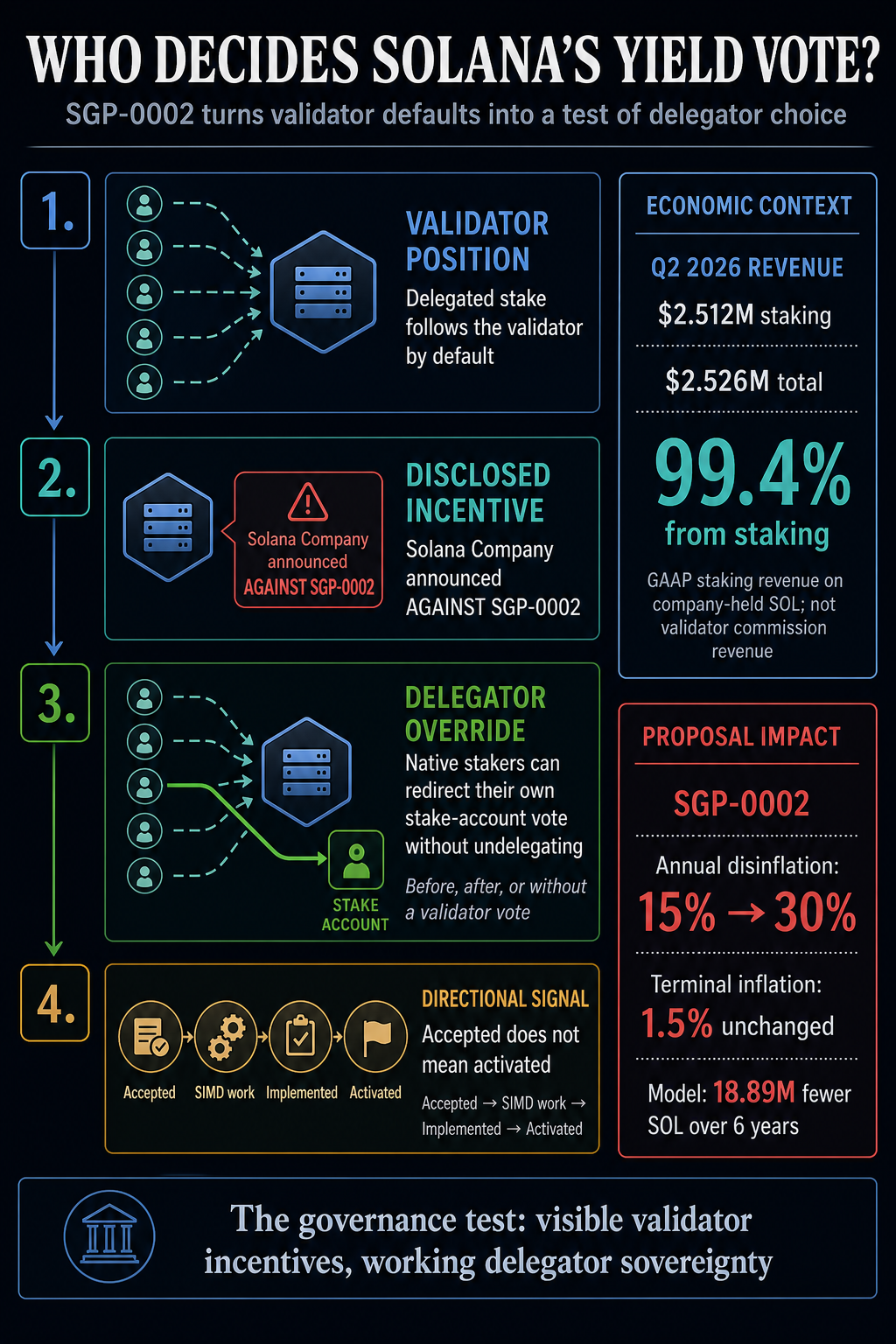
Solana Company highlighted the same power in its announcement, saying holders could override an operator and that it disclosed its positions so delegators could act. The governance design surfaces a validator’s economic alignment and lets stake owners separate their governance choice from their staking relationship.
What SGP-0002 can actually change
SGP-0002 asks Solana to double annual disinflation from 15% to 30% while leaving the 1.5% terminal inflation rate unchanged. The related SIMD-0550 model estimates about 18.89 million fewer SOL issued over six years under the faster schedule.
At the model’s 68% staking-participation assumption, nominal staking yield moves from 5.84% under the current schedule to 4.34% in the first year of the faster path, followed by 3.00% and 2.25% in years two and three. These are proposal scenarios. Solana Company’s realized revenue could differ because the model excludes validator commissions and additional yield sources such as MEV and block rewards.
Faster disinflation reduces issuance and nominal staking yield relative to the current schedule. The resulting company-level effect has no fixed percentage because stake balances, prices, fees, participation, commissions and implementation timing can all change.
Solana’s public materials also conflict on the rule used to judge the live result. The governance proposal repository policy says there is no quorum and approval requires For stake to equal at least two-thirds of For plus Against. The governance FAQ and dashboard display a one-third participation requirement alongside a two-thirds approval threshold. Current finalization code locks and records the totals after the end epoch without resolving that policy conflict.
Voting runs through epoch 1023 and closes at the epoch-1024 boundary. Solana Developers estimated that boundary for Thursday at approximately 15:30 UTC, with live slot timing determining the actual wall-clock close.
A successful vote would move the proposal into an Accepted state. Solana’s governance policy separates that state from Implemented and Activated, with technical work normally proceeding through one or more Solana Improvement Documents.
The immediate test is therefore institutional. Solana has made validator preferences visible and given native stakers a working override. Credibility now depends on whether that mechanism keeps the governance choice with delegators when a validator’s economic interest is plain.


