

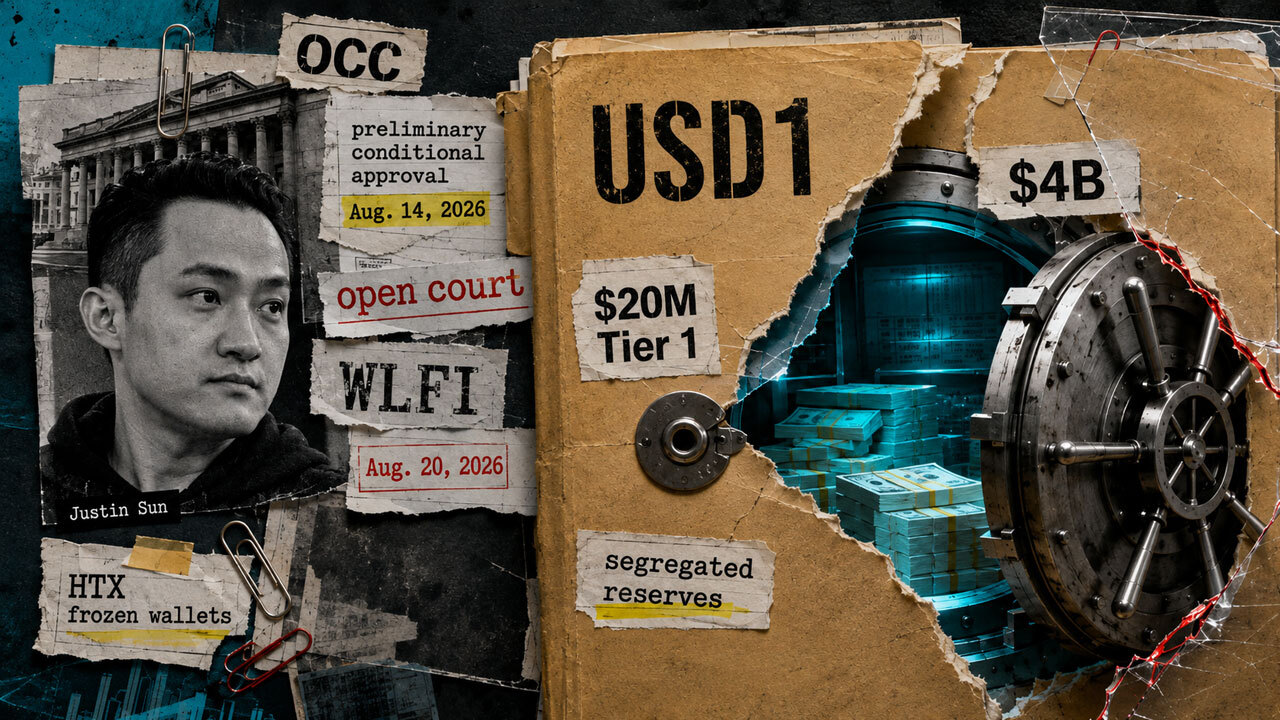
Justin Sun said on Aug. 20 that a California federal judge rejected World Liberty Financial’s attempt to force all of his claims into private arbitration, keeping his individual allegations in open court.
The public docket confirms World Liberty filed a motion to compel arbitration and a separate motion to seal case materials.
That news arrives six days after the Office of the Comptroller of the Currency granted preliminary conditional approval for World Liberty Trust Company. The national trust bank is meant to take over issuance of USD1 and its reserve assets.
The approval remains preliminary and conditional, so World Liberty Trust cannot commence operations until it satisfies a list of pre-opening requirements. The OCC explicitly reserved the authority to modify, suspend, or rescind its approval before final authorization if an intervening event warrants it.
The dispute over how World Liberty exercised control over WLFI tokens remains visible in court while regulators still have discretion over whether the bank opens at all.
Why the World Liberty dispute carries more weight now
The fight traces back to September 2025, when World Liberty restricted Sun-linked WLFI holdings once tokens moved toward exchanges. Sun sued in April, alleging the company froze his tokens and secretly built tools that could restrict sales once WLFI became transferable.
World Liberty disputes that account and has alleged Sun made prohibited transfers and acted against the project’s interests. The underlying question is who had authority to restrict WLFI ownership, under what procedures, and with what oversight.
That question stopped being purely theoretical in June, when the stablecoin issuer froze wallets connected to the exchange HTX during a separate dispute, prompting HTX to delist USD1 entirely and convert customer balances into USDT.
The same administrative powers that reached Sun’s personal holdings had already reached exchange-linked customer funds months before the OCC approval arrived.
| Date | Development | Why it matters |
|---|---|---|
| Sept. 2025 | World Liberty restricts Sun-linked WLFI holdings after tokens move toward exchanges | Token-control powers become practical, not theoretical |
| April 2026 | Sun sues World Liberty over frozen WLFI tokens | Governance fight moves into federal court |
| June 2026 | HTX-linked wallets are frozen during a separate dispute | Token controls reach exchange-linked customer funds |
| Aug. 14, 2026 | OCC grants preliminary conditional approval for World Liberty Trust Company | USD1 begins moving toward a federally supervised bank structure |
| Aug. 20, 2026 | Sun says individual claims will remain in open court | Litigation remains public during the bank’s pre-opening window |
USD1 moves behind a firewall
World Liberty Trust Company is expected to issue and redeem USD1 and manage its reserves, taking over that role from BitGo. The same OCC document states plainly that the bank will not issue, custody, or deal in WLFI tokens.
The OCC’s filing notes that World Liberty Financial LLC and the proposed trust bank share indirect common ownership, since USD1 has operated as one of World Liberty Financial’s core products.
Whatever surfaces in Sun’s litigation may test how cleanly that separation holds across shared executives, shared treasury decisions, and shared governance.
| Inside World Liberty Trust Company | Outside the trust bank | Why the boundary matters |
|---|---|---|
| USD1 issuance and redemption | WLFI token issuance | OCC says the bank will not issue, custody, or deal in WLFI |
| USD1 reserve management | WLFI token-control dispute | Sun’s lawsuit concerns powers used over WLFI, not USD1 reserves directly |
| Federally supervised trust-bank operations | World Liberty Financial LLC and affiliated entities | Common ownership means separation may be tested by governance facts |
| Required Tier 1 capital and liquidity | Corporate liabilities or litigation exposure | Bank capital, reserves, and outside corporate assets are different pools |
| Stablecoin compliance controls | Broader WLFI governance decisions | The issue is who controls administrative powers and under what oversight |
Why USD1’s size raises customer-protection stakes
Sun’s damages claim points toward hundreds of millions of dollars, and his public posts have invoked USD1’s roughly $4 billion market capitalization. That framing conflates two very different pools of money.
USD1’s reserves exist to back redemption obligations owed to stablecoin holders. Federal stablecoin rules under the GENIUS Act require issuers to maintain identifiable reserves backing outstanding tokens on at least a one-to-one basis, with those reserves segregated from an issuer’s other assets.
The OCC also requires World Liberty Trust to hold at least $20 million in Tier 1 capital, a separate pool from the reserves meant to cover USD1 redemptions.
The size of USD1 raises the stakes for stablecoin holders if governance breaks down somewhere in the World Liberty structure.
USD1 includes standard administrative functions like address freezing and pausing, tools nearly every centralized stablecoin issuer maintains for sanctions compliance, court orders, and law-enforcement requests. Circle and Tether both reserve similar authority over USDC and USDT.
The question World Liberty now faces is who controls those powers, under what internal procedures, and with what oversight. Whether any of that changes once USD1 sits inside a bank the OCC directly supervises remains to be seen.
Whether World Liberty’s firewall holds up once tested
The bull case has a written court order narrowing Sun’s public claims and World Liberty demonstrating clean separation between WLFI and the bank as it satisfies pre-opening conditions.
The OCC grants final authorization without new complications. Under that path, the trust-bank structure becomes the answer to governance doubts around USD1, a step beyond being another source of them.
The bear case has public filings surfacing facts that connect WLFI’s token-control decisions to USD1 governance, shared executives, or shared treasury arrangements inside the broader World Liberty structure.
| Scenario | What would have to happen | What it would mean |
|---|---|---|
| Bull case | Court order narrows public claims; World Liberty satisfies OCC pre-opening conditions; USD1 governance appears separate from WLFI | Trust-bank structure strengthens confidence in USD1 oversight |
| Base case | Sun’s claims proceed publicly, but filings do not directly implicate USD1 reserves or bank operations | Litigation remains a headline risk while the bank transition continues |
| Bear case | Public filings connect WLFI token-control decisions to USD1 governance, shared executives, or treasury arrangements | The issue broadens from Sun’s dispute to group-level controls |
| Black-swan case | New freeze, reserve, redemption, or adverse court development raises customer-confidence concerns | USD1 faces reputational or counterparty pressure even if reserves are not shown to be impaired |
In that scenario, the question shifts from Sun’s individual dispute to controls across the entire group, right as the OCC still has discretion over whether World Liberty Trust opens at all.
The next material fact in this story will likely surface in the written court order and any filings that follow. That record should show how World Liberty’s entities, executives, and token controls relate to each other while the bank waits to open.


