

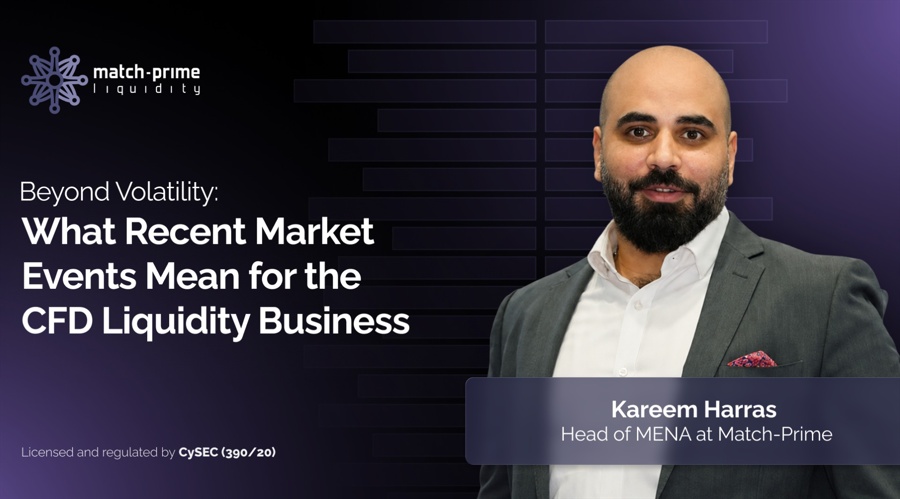
My journey in this industry began in 2006 in the stock market before I transitioned into CFDs. Staying active as a trader alongside my career – and moving through client-facing roles from retail to the institutional space – has deeply influenced what I notice. From where I stand today, the ground is clearly shifting under some of the industry’s oldest assumptions.
The reminder itself was familiar. The CFD business has never operated in isolation, and geopolitics, policy uncertainty and fast-turning sentiment have always fed directly into how brokers, liquidity providers and traders interact. What struck me this time was not the volatility. We have seen volatile markets before. What struck me was how liquidity behaved once activity surged and conditions stopped being predictable.
Consider the scale of the change. Gold went more than four years without a single session in which the intraday range exceeded 8%. And at the beginning of 2026, there have been six. The World Gold Council’s own analysis shows 2026 volatility breaching gold’s historical upper quartile, reaching the top fifth percentile of readings since 1971. This is a different regime, and it has been testing arrangements that were priced for the old one.
The spread conversation is ending
For years, the liquidity conversation was simple. Who has the tightest spread?
I think that conversation is closing, because the economics behind it closed first. At the peak of the compression, the yield on one cent of price improvement in gold had fallen below two dollars per million — pricing too thin to fund the capacity that a fast market demands. When the metals moves arrived in January, some providers discovered they had extended more credit than their own hedge capacity could support, and responded by cutting client limits or raising margins while the event was still running.
The brokers who lived through that are asking different questions now. Can my LP keep pricing stable when markets move fast? How consistent is execution under pressure? Will depth still be there when clients need it, and how quickly does it recover after a sharp move? What happened to your other clients’ terms in January?
A tighter spread means very little if the capacity behind it disappears under stress. The brokers asking these new questions have understood that, and they are asking for dated, event-level data rather than annual averages, because a claim without a date cannot be checked.
Flow quality became measurable
The second shift is in how the industry talks about flow.
Periods of uncertainty attract more aggressive trading, more algorithmic activity, and more concentration in a handful of products. Managing that flow has become as important as pricing it. What has changed this year is that the topic acquired numbers. Published benchmarks put toxic density on oil trades at CFD brokers around 23% in May, measured through post-trade markout — trades where the market moves in the client’s favour unusually fast after execution.
Once flow quality is a published statistic, it stops being a private conversation between dealing desks and becomes something brokers can compare and act on. The technology follows the same logic. Aggregation, smart routing, real-time monitoring and serious risk management have moved from useful to essential, and the detection has to run at the session level, where the behaviour actually concentrates, with responses precise enough to address the account rather than the book.
Just as importantly, the relationship between brokers and LPs is evolving alongside the tooling. The strongest partnerships this year were visible in conduct rather than in commercial terms — in whether limits held, whether communication came early, and whether the provider was watching the same screens as the broker while the event was live. That kind of relationship compounds. In the long run it builds a stronger business on both sides of the arrangement.
Concentration has a number now
Another trend worth watching is where activity gathers.
Gold continues to dominate during uncertainty, with growing interest in oil and the major equity indices.
Traders gravitate towards volatility, and the gravitation is measurable. Metals CFDs accounted for more than 60% of global broker volumes in H1 2025 according to Finance Magnates Intelligence, nearly 80% of it in gold – and 2026 has concentrated the pattern further. In January, gold alone reached 59% of monthly platform volume at Capital.com as prices hit successive records, and when the Iran conflict pushed volatility into energy in March, CMC Markets’ Australian client data showed Brent trade counts rising 1,193% in a single month.
The bigger question is what that concentration does to a brokerage. A book that concentrated behaves like a single position. It moves together, it needs hedging together, and it consumes LP capacity together, all at the worst possible moment. Broadening the offering across asset classes carries a genuine operational cost in sourcing, depth and monitoring. I would still pay it, because the alternative is a business whose worst day is decided by one instrument.
The weekend stopped being safe
Weekend risk has also become far more relevant than it was a few years ago. Major geopolitical announcements no longer wait for Monday morning, and markets can reopen with significant gaps. In March, Brent opened more than 30% away from Friday’s close after a weekend of escalation around the Strait of Hormuz. An adjustment of that size, compressed into a single opening print, is a risk management problem for everyone in the chain.
So it is no surprise that the industry’s answer arrived quickly. Continuous gold products launched across the CFD sector between February and August, Match-Prime’s among them – a whole category built in six months. The direction extends well beyond CFDs: CME’s 1-Ounce Gold futures began trading 24/7 on 26 July, its 10-Barrel WTI contract follows on 30 August, while NYSE and Nasdaq have formally proposed extended and 24/7 equity sessions. The weekend gap is closing across the whole market, and the CFD industry happens to be moving first.
I would add one caution as this category matures. A continuous product relocates weekend risk rather than removing it, and the question that separates one product from another is where the price comes from once the underlying stops printing, and what constrains it. Brokers should ask for that mechanical detail before they distribute, because the honest providers can answer it.
The lesson
The biggest lesson of recent months is that liquidity has outgrown its old definition. Price still matters, but the qualities that carried brokers through this year were the ones a spread comparison never shows: capacity that holds when hedging demand steps up, infrastructure that keeps quoting through outages and gaps, execution that stays consistent while conditions degrade, and partners who communicate while the event is still running.
It is why, at Match-Prime, so much of our investment in recent years has gone into the layer brokers rarely see until they need it. Risk systems that watch flow at the session level, where abusive behaviour actually concentrates, and respond at the account level, so one bad actor never degrades conditions for the rest of the book. Aggregation built to keep quoting when a pricing source fails. Capacity planned for the fast regime rather than the quiet one.
Those qualities are built years before they are tested. The past few months tested them all at once. My advice to any broker reviewing their arrangements is simple: ask what your provider built before this year began.
My journey in this industry began in 2006 in the stock market before I transitioned into CFDs. Staying active as a trader alongside my career – and moving through client-facing roles from retail to the institutional space – has deeply influenced what I notice. From where I stand today, the ground is clearly shifting under some of the industry’s oldest assumptions.
The reminder itself was familiar. The CFD business has never operated in isolation, and geopolitics, policy uncertainty and fast-turning sentiment have always fed directly into how brokers, liquidity providers and traders interact. What struck me this time was not the volatility. We have seen volatile markets before. What struck me was how liquidity behaved once activity surged and conditions stopped being predictable.
Consider the scale of the change. Gold went more than four years without a single session in which the intraday range exceeded 8%. And at the beginning of 2026, there have been six. The World Gold Council’s own analysis shows 2026 volatility breaching gold’s historical upper quartile, reaching the top fifth percentile of readings since 1971. This is a different regime, and it has been testing arrangements that were priced for the old one.
The spread conversation is ending
For years, the liquidity conversation was simple. Who has the tightest spread?
I think that conversation is closing, because the economics behind it closed first. At the peak of the compression, the yield on one cent of price improvement in gold had fallen below two dollars per million — pricing too thin to fund the capacity that a fast market demands. When the metals moves arrived in January, some providers discovered they had extended more credit than their own hedge capacity could support, and responded by cutting client limits or raising margins while the event was still running.
The brokers who lived through that are asking different questions now. Can my LP keep pricing stable when markets move fast? How consistent is execution under pressure? Will depth still be there when clients need it, and how quickly does it recover after a sharp move? What happened to your other clients’ terms in January?
A tighter spread means very little if the capacity behind it disappears under stress. The brokers asking these new questions have understood that, and they are asking for dated, event-level data rather than annual averages, because a claim without a date cannot be checked.
Flow quality became measurable
The second shift is in how the industry talks about flow.
Periods of uncertainty attract more aggressive trading, more algorithmic activity, and more concentration in a handful of products. Managing that flow has become as important as pricing it. What has changed this year is that the topic acquired numbers. Published benchmarks put toxic density on oil trades at CFD brokers around 23% in May, measured through post-trade markout — trades where the market moves in the client’s favour unusually fast after execution.
Once flow quality is a published statistic, it stops being a private conversation between dealing desks and becomes something brokers can compare and act on. The technology follows the same logic. Aggregation, smart routing, real-time monitoring and serious risk management have moved from useful to essential, and the detection has to run at the session level, where the behaviour actually concentrates, with responses precise enough to address the account rather than the book.
Just as importantly, the relationship between brokers and LPs is evolving alongside the tooling. The strongest partnerships this year were visible in conduct rather than in commercial terms — in whether limits held, whether communication came early, and whether the provider was watching the same screens as the broker while the event was live. That kind of relationship compounds. In the long run it builds a stronger business on both sides of the arrangement.
Concentration has a number now
Another trend worth watching is where activity gathers.
Gold continues to dominate during uncertainty, with growing interest in oil and the major equity indices.
Traders gravitate towards volatility, and the gravitation is measurable. Metals CFDs accounted for more than 60% of global broker volumes in H1 2025 according to Finance Magnates Intelligence, nearly 80% of it in gold – and 2026 has concentrated the pattern further. In January, gold alone reached 59% of monthly platform volume at Capital.com as prices hit successive records, and when the Iran conflict pushed volatility into energy in March, CMC Markets’ Australian client data showed Brent trade counts rising 1,193% in a single month.
The bigger question is what that concentration does to a brokerage. A book that concentrated behaves like a single position. It moves together, it needs hedging together, and it consumes LP capacity together, all at the worst possible moment. Broadening the offering across asset classes carries a genuine operational cost in sourcing, depth and monitoring. I would still pay it, because the alternative is a business whose worst day is decided by one instrument.
The weekend stopped being safe
Weekend risk has also become far more relevant than it was a few years ago. Major geopolitical announcements no longer wait for Monday morning, and markets can reopen with significant gaps. In March, Brent opened more than 30% away from Friday’s close after a weekend of escalation around the Strait of Hormuz. An adjustment of that size, compressed into a single opening print, is a risk management problem for everyone in the chain.
So it is no surprise that the industry’s answer arrived quickly. Continuous gold products launched across the CFD sector between February and August, Match-Prime’s among them – a whole category built in six months. The direction extends well beyond CFDs: CME’s 1-Ounce Gold futures began trading 24/7 on 26 July, its 10-Barrel WTI contract follows on 30 August, while NYSE and Nasdaq have formally proposed extended and 24/7 equity sessions. The weekend gap is closing across the whole market, and the CFD industry happens to be moving first.
I would add one caution as this category matures. A continuous product relocates weekend risk rather than removing it, and the question that separates one product from another is where the price comes from once the underlying stops printing, and what constrains it. Brokers should ask for that mechanical detail before they distribute, because the honest providers can answer it.
The lesson
The biggest lesson of recent months is that liquidity has outgrown its old definition. Price still matters, but the qualities that carried brokers through this year were the ones a spread comparison never shows: capacity that holds when hedging demand steps up, infrastructure that keeps quoting through outages and gaps, execution that stays consistent while conditions degrade, and partners who communicate while the event is still running.
It is why, at Match-Prime, so much of our investment in recent years has gone into the layer brokers rarely see until they need it. Risk systems that watch flow at the session level, where abusive behaviour actually concentrates, and respond at the account level, so one bad actor never degrades conditions for the rest of the book. Aggregation built to keep quoting when a pricing source fails. Capacity planned for the fast regime rather than the quiet one.
Those qualities are built years before they are tested. The past few months tested them all at once. My advice to any broker reviewing their arrangements is simple: ask what your provider built before this year began.


