

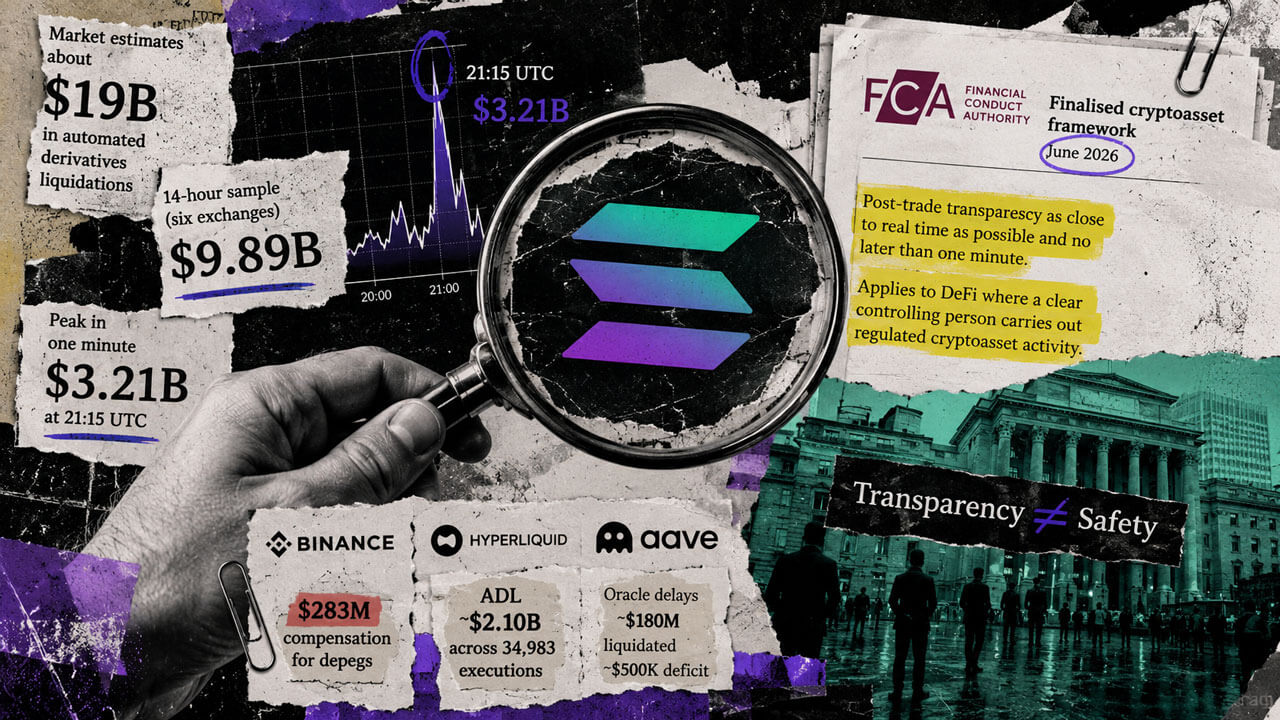
Solana Research Institute, a Solana-aligned research group, used an Aug. 14 post to revive a July open letter by Angus Scott to the UK Financial Conduct Authority and other regulators. SRI reported roughly $18 billion in liquidations over 14 hours during the Oct. 10, 2025 crypto crash, including $3.21 billion in a single minute, and argued that opaque centralized venues failed while transparent on-chain finance kept functioning.
The crash records point to a more specific conclusion. Public data made it possible to reconstruct a large auto-deleveraging event on Hyperliquid, as well as deficits and oracle delays at Aave. ESMA later said Binance’s internal collateral pricing amplified forced selling. Transparency exposed the mechanics of stress across market structures; it did not turn one venue category into a proxy for safety.
Auto-deleveraging, or ADL, is a last-resort derivatives mechanism that reduces profitable traders’ positions when liquidations and risk buffers cannot keep a venue solvent. It differs from ordinary liquidation, which closes a losing position after its collateral falls below a required threshold. Regulators need comparable records to separate either mechanism from an outage, an oracle delay or a venue-local pricing failure.
Solana Research Institute: What the $18B liquidation total hides
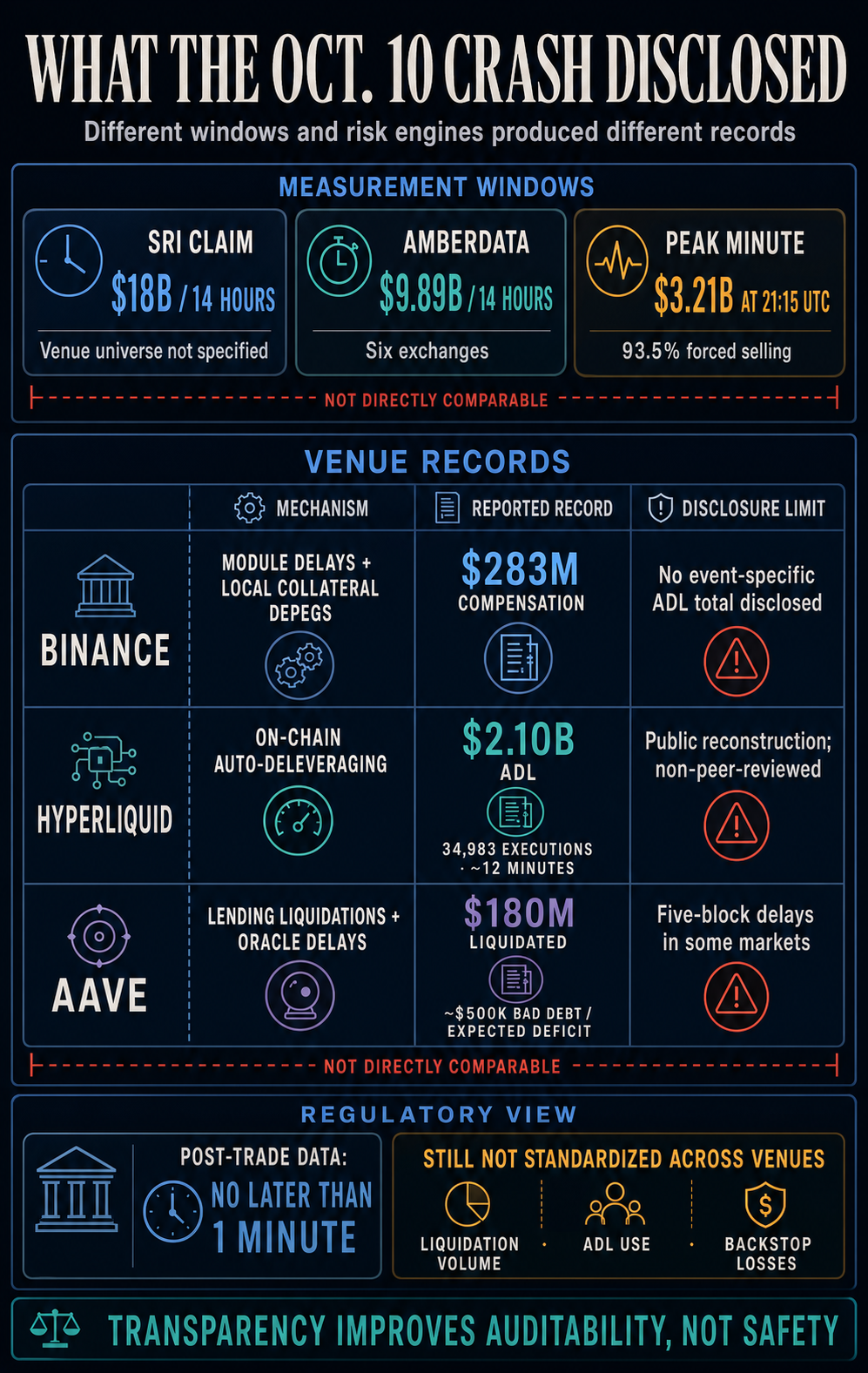
Solana Research Institute’s post paired the $18 billion total with a $3.21 billion peak in one minute. Amberdata’s six-exchange analysis also put the peak at $3.21 billion at 21:15 UTC and said 93.5% of that minute’s liquidations came from forced selling. For its full 14-hour window, however, Amberdata reported $9.89 billion, including $6.93 billion in the 40 minutes from 20:50 to 21:30 UTC.
Solana Research Institute announced the $18 billion figure, but its July 23 letter provides no common venue universe or aggregation method that reconciles it with Amberdata’s $9.89 billion. The available records establish a measurement gap rather than a calculation error. An ESMA review separately cited market estimates of about $19 billion in automated derivatives liquidations for the day.
Those numbers describe different scopes. A day-wide market estimate, a six-exchange 14-hour sample, a one-minute peak and a venue-specific loss mechanism answer different questions. Collapsing them into one total obscures the market plumbing that the policy debate is supposed to expose.

Binance’s postmortem illustrates the problem. The exchange said its spot and futures matching engines and API trading remained operational, while some modules glitched after 21:18 UTC, internal transfers and Earn redemptions lagged, and local prices for collateral assets including USDe, BNSOL and WBETH dislocated after 21:36 UTC. Binance said two compensation batches for users liquidated because of those depegs totaled about $283 million.
ESMA said Binance’s use of internal collateral prices enabled local depegs to erase collateral value, triggering forced liquidations and cascading selling. The regulator reported no observable spillover into traditional markets, but its account identifies venue design as an amplifier that a market-wide liquidation total cannot isolate.
The cited Binance account gives no event-specific ADL total. Centralized-exchange ADL therefore cannot be ranked as the crash’s dominant systemic failure from the available evidence. The record instead separates module delays, transfer constraints, collateral-pricing dislocations and ordinary forced liquidations.
Public records exposed on-chain stress too
Hyperliquid and Aave disclose different risk engines, denominators and loss outcomes. Their records make comparison possible only after those distinctions remain visible.
| Venue or system | Observed mechanism | Reported measure | Disclosure limit |
|---|---|---|---|
| Binance | Module delays, internal-transfer constraints and local collateral depegs | About $283 million in described compensation | The supplied postmortem gives no event-specific ADL total |
| Hyperliquid | On-chain auto-deleveraging | About $2.10 billion across 34,983 individual ADL executions in roughly 12 minutes | A non-peer-reviewed reconstruction of a derivatives mechanism |
| Aave | Lending liquidations, deficits and price-update delays | About $180 million liquidated and roughly $500,000 in bad debt and expected deficit | Lending outcomes rather than derivatives ADL |
The Hyperliquid figures come from a non-peer-reviewed study using public venue data. They establish that large-scale ADL also occurred on an on-chain derivatives venue, while leaving the design and outcomes distinct from Binance.

A Chaos Labs report on Aave said some markets experienced five-block price-update delays. Chaos Labs estimated that liquidation fees and SVR revenue left the protocol about $1.5 million net positive after the reported deficits.
Public records made parts of Hyperliquid’s loss allocation and Aave’s lending stress measurable. The same records documented ADL, oracle latency and bad debt. Observability gave outsiders a better audit trail, while the mechanisms themselves still imposed losses and operational risks.
Faster trade data still leaves the loss chain fragmented. Solana Research Institute says its 33-page letter followed discussions between the FCA and Solana Foundation, although the available material contains no independent FCA confirmation. The letter covers seven domains, including identity, resilience, custody, market abuse, systemic risk and prudential capital. The Oct. 10 crash is one case study inside that broader argument.
The FCA has already addressed part of the transparency problem. Its June 2026 final cryptoasset framework requires UK qualifying cryptoasset trading platforms and principal dealers to publish post-trade information as close to real time as possible and no later than one minute. Larger UK platform operators also face pre-trade transparency requirements.

The framework applies to DeFi where a clear controlling person carries out regulated cryptoasset activity. Genuinely decentralized activity can fall outside the perimeter, with a separate consultation on DeFi guidance still expected.
The cited final framework does not expressly require standardized cross-venue reporting of liquidation volumes, ADL use or backstop losses. Faster trade data improves the view of execution, but the Oct. 10 records show how operational delays, pricing failures and loss-allocation mechanisms can remain hard to compare after a common shock.
Solana Research Institute’s policy case is strongest when it focuses on that observability gap. The crash showed public records can make venue failures measurable, including failures on transparent platforms. Comparable event disclosures could help regulators distinguish routine solvency controls from venue-specific operational or pricing breakdowns without treating transparency itself as proof of safety.


