


Bitcoin traders are rebuilding bets on a run toward $70,000 while still paying for protection against a fall to $60,000, showing that softer US inflation data has done little to break the market’s defensive positioning.
The split held after the Consumer Price Index rose 0.1% in July and 3.4% from a year earlier, while core inflation increased 0.2% for the month and 2.5% annually. Both yearly readings eased from June and matched expectations, reducing pressure for the Federal Reserve to tighten policy further.
However, Bitcoin barely reacted. CryptoSlate data showed BTC trading around $63,270 as of press time, extending a three-week stretch in which the asset has largely remained trapped between $63,000 and $65,000.
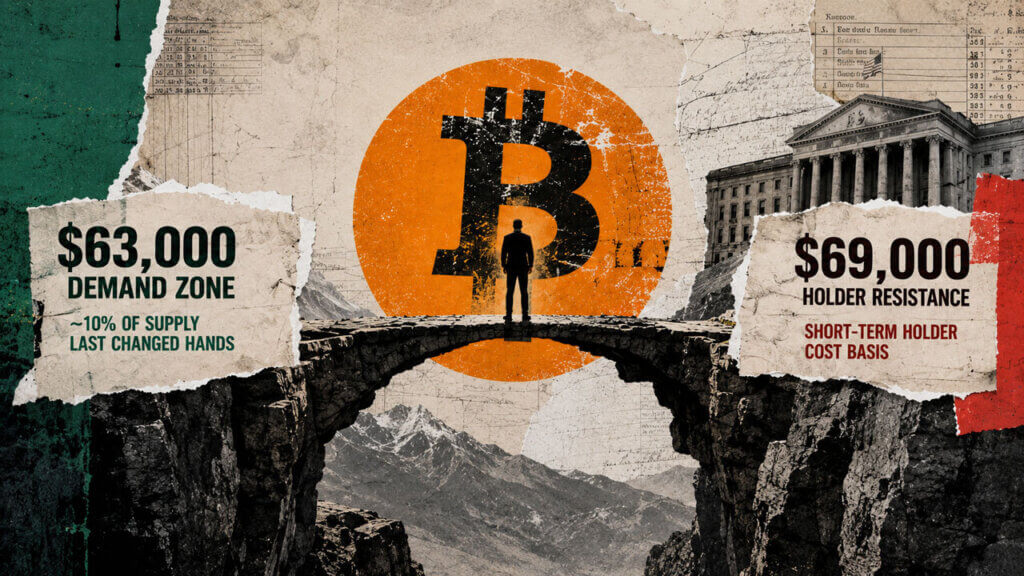
September hike odds barely move as CPI leaves Fed path unresolved
The muted Bitcoin reaction was mirrored in interest-rate markets, where July’s inflation report produced only a modest shift in expectations for the Fed’s September meeting.
The market-implied probability of a rate increase slipped to about 42% after the release from roughly 46% beforehand, showing that the in-line print did little to settle the policy outlook.
Samuel Tombs, chief US economist at Pantheon Macroeconomics, said the report was still firm enough for policymakers to leave rates unchanged in September.
He estimated that the 0.22% unrounded increase in core CPI would translate into roughly a 0.16% rise in the core Personal Consumption Expenditures price index, the Fed’s preferred inflation gauge.
Meanwhile, Ryan Lee, chief analyst at Bitget Research, told CryptoSlate that the CPI reading “neither forces a hawkish re-pricing nor delivers a clear dovish catalyst.”
That leaves monetary policy providing little directional impulse for Bitcoin.
Fabian Dori, chief investment officer at Sygnum Bank, said broader liquidity conditions could therefore become more important for digital assets, pointing to Treasury cash balances, changes linked to the supplementary leverage ratio, private credit creation and stablecoin adoption.
$60,000 protection stays expensive as $70,000 exposure rebuilds
That unresolved backdrop is increasingly visible in Bitcoin’s derivatives market, where traders are adding upside exposure while continuing to protect against another decline.
Coinbase-owned Deribit data showed about $1.1 billion of call open interest at the $70,000 strike, compared with roughly $1 billion of put open interest at $60,000, placing two of the market’s largest concentrations near opposite ends of Bitcoin’s recent trading range.
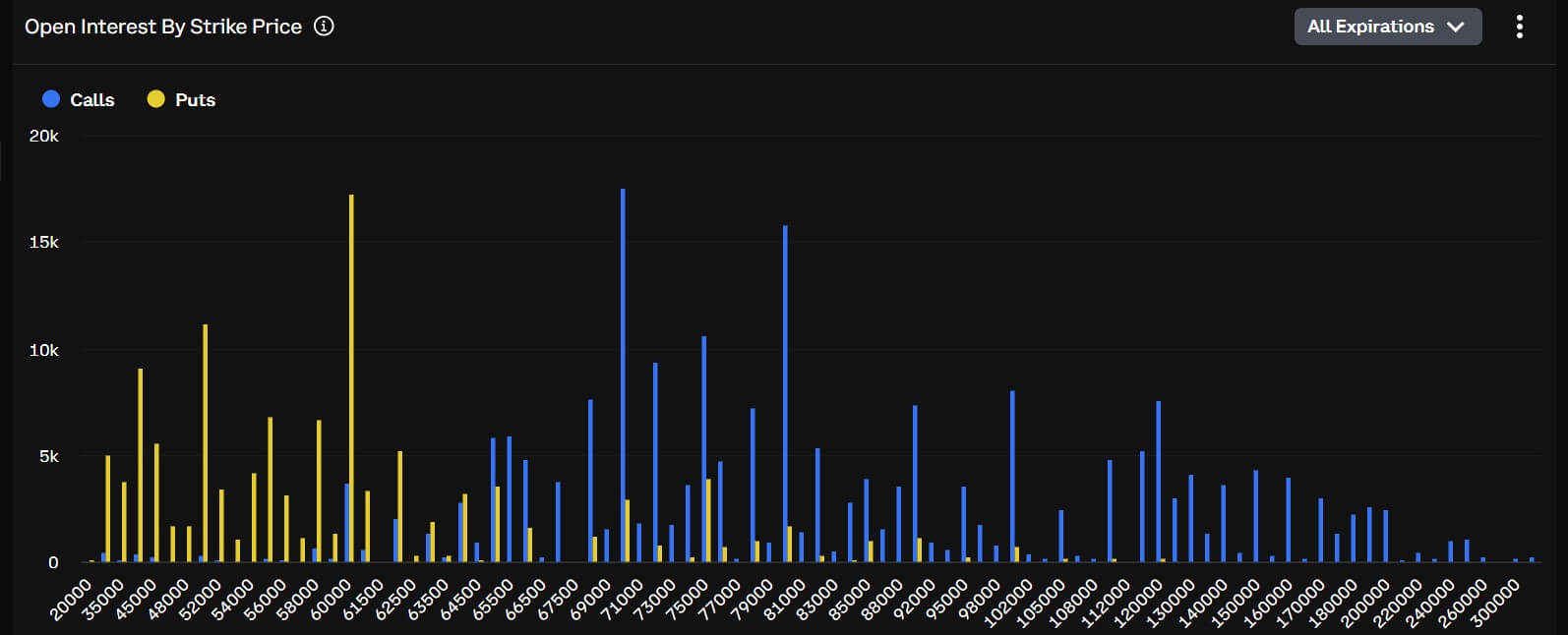
Open interest alone does not reveal whether those contracts were bought or sold, but recent flows show traders have been actively adding upside exposure.
Laevitas, a crypto options platform, said the dominant Bitcoin options activity on Deribit since Tuesday has centered on the Sept. 25 $70,000 call, with traders buying 2,026 BTC worth of contracts for about $2.58 million.
Two blocks totaling roughly 1,000 contracts traded while Bitcoin was near $64,800 and implied volatility stood at 33.53%. Another wave of about 1,000 contracts followed as spot slipped toward the $63,800-$64,000 range and implied volatility firmed to between 34% and 35%.
Notably, this second wave arrived as Bitcoin weakened, showing traders were adding upside exposure before spot had cleared resistance.
However, downside protection continues to command a relative premium.
Andrei Grachev, managing partner at DWF Labs, told CryptoSlate that downside strikes near $60,000 remained more expensive than comparable upside strikes around $70,000 after the CPI release.
At the same time, exposure at the higher strike has been rebuilt, leaving the options book constructive while its pricing remains defensive.
The defensive skew is occurring against unusually cheap volatility overall.
In a report shared with CryptoSlate, Bitfinex analysts said Bitcoin’s 30-day implied volatility fell to 33.8 on Aug. 8, near the bottom of its range over the past year, while downside skew remained negative through September.
The combination shows that volatility remains cheap overall even as traders continue to pay relatively more for protection against declines.
The renewed $70,000 interest nevertheless faces a more immediate obstacle in the spot market.
Bitfinex estimated that about 1.79 million BTC, or 8.93% of circulating supply, carries a realized cost basis between $62,000 and $65,000, with the largest concentration near $63,800.
That puts a substantial pool of holders near break-even whenever Bitcoin pushes toward the upper end of its recent range.
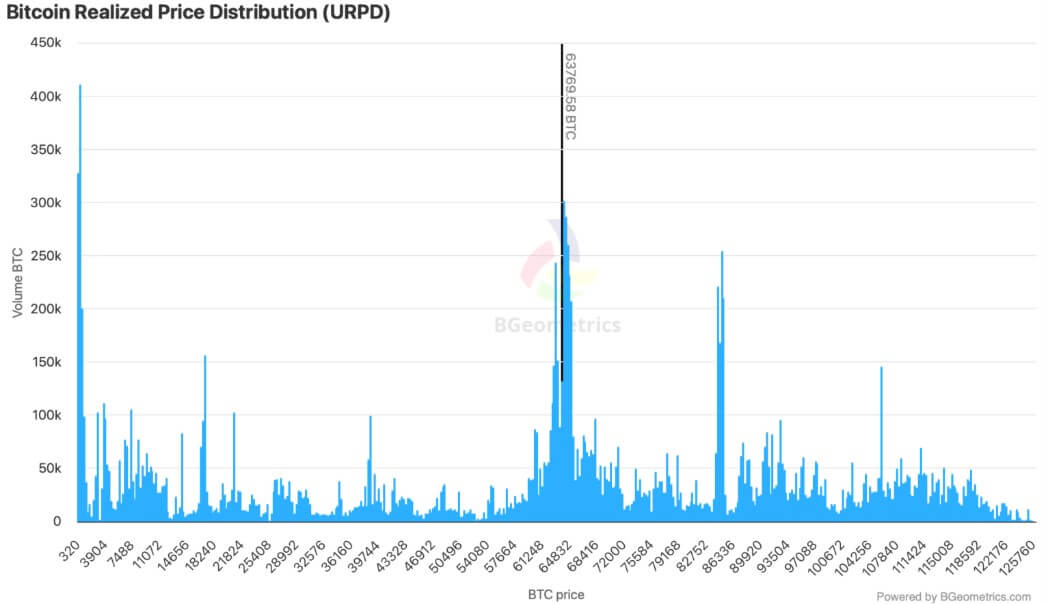
The resistance has already appeared repeatedly in the market. Bitcoin traded above $65,000 during six consecutive sessions between Aug. 5 and Aug. 10 but failed to record a daily close above the level, according to Bitfinex.
This repeated price failure suggests supply is returning as holders near break-even get another opportunity to exit, leaving $65,000 as the immediate hurdle before the rebuilt $70,000 calls can come into play.


