

XRP slipped below $1 as leverage rebuilt and selling pressure deepened across the market.
Data from CryptoSlate showed that the digital asset fell as low as $0.99 during the session, its weakest level since November 2024, when Donald Trump won the US presidential election.
The move unwinds one of the most important thresholds from XRP’s post-election rally. The token first crossed $1 on Nov. 16, 2024, less than two weeks after the election, before accelerating to a peak of $3.42 in July 2025.
Since then, the broader crypto market downturn has erased much of that advance, while XRP’s exchange activity increasingly points to sellers controlling the near-term trade.
Leverage returns as XRP traders lean bearish
The shift in XRP positioning is most visible in the derivatives market, where traders are rebuilding exposure even as order flow continues to favor sellers.
CryptoQuant data showed Binance’s seven-day change in XRP open interest swung from about -13% on Aug. 1 to 7.4% by Aug. 11, a reversal of more than 20 percentage points. The move suggests traders have begun adding leveraged positions again after cutting exposure at the start of the month.
CryptoQuant analyst JA Maartunn separately highlighted the speed of that rebound, noting that XRP open interest had increased by another $171 million, or 20.5%, according to the data he tracked.
However, the additional leverage has yet to translate into stronger buying pressure.
Binance’s perpetual cumulative volume delta, or CVD, fell from roughly -$251 million at the beginning of August to -$349.5 million by Aug. 11.
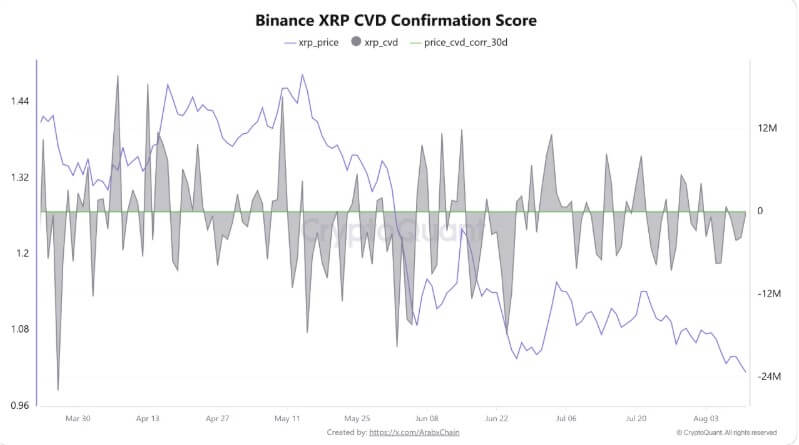
The metric measures the balance between market-buy and market-sell orders, with increasingly negative readings showing that sellers are crossing the spread more aggressively than buyers.
A similar deterioration has emerged in the spot market. CryptoQuant’s estimated CVD across centralized exchanges dropped from approximately $193 million to -$34.3 million over the same period. This represents a reversal of about $227 million.
CoinGlass’s XRP positioning data further reinforces that bearish tilt.
XRP’s long-to-short account ratio stood at 0.8432 as the token traded near $1, implying that roughly 45.7% of positioned accounts were long compared with 54.3% that were short.
Taken together, the data show that leverage is returning while executed trades remain skewed toward selling.
Rising open interest alone does not reveal whether traders are adding longs or shorts because every derivatives contract has counterparties on both sides.
But its increase alongside deteriorating spot and perpetual CVD indicates that fresh exposure is entering a market where sellers continue to dictate short-term order flow.
Falling trading activity leaves less depth behind XRP
Bearish positioning has developed in a derivatives market that remains much smaller than it was during XRP’s stronger periods earlier this year.
CoinGlass showed XRP futures open interest around $2.69 billion Tuesday, while 24-hour futures turnover was roughly $2.17 billion.
By comparison, XRP derivatives volume reached $5.93 billion on Jan. 5, when open interest stood around $3.86 billion. As recently as Aug. 5, futures volume had fallen to approximately $1.35 billion and open interest to about $2.25 billion.
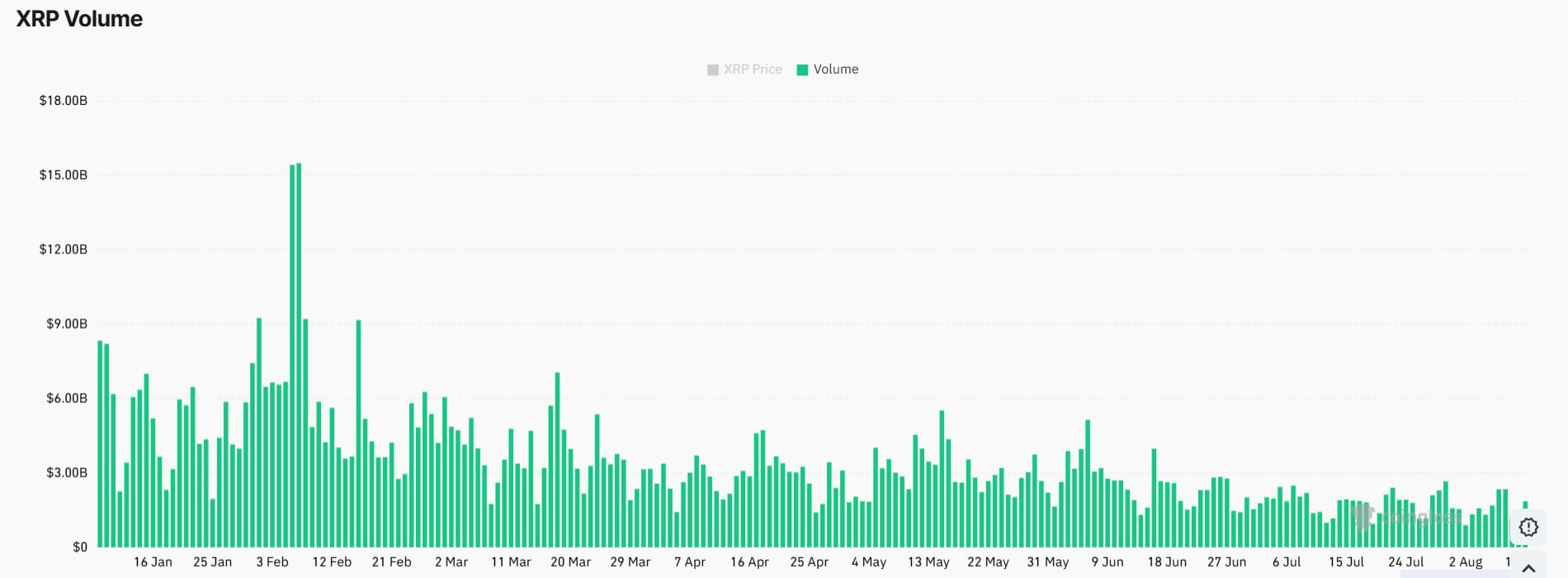
Tuesday’s pickup in activity therefore does not erase the broader contraction. Open interest is recovering from recent lows, but the market is doing so from a substantially smaller base than at the beginning of 2026.
That decline in liquidity has become a concern for some XRP traders.
XRP commentator Vincent Van Code warned before the break below $1 that Binance’s 24-hour XRP volume had fallen to about $68 million from levels above $1 billion. He argued that thinner order books could allow comparatively small sell orders to move the market further than they would during periods of deeper liquidity.
Van Code estimated that roughly $4 million of sell orders could push XRP toward 95 cents under the order-book conditions he observed, potentially forcing leveraged longs to close.
His broader liquidity concern is consistent with the contraction visible in XRP derivatives activity, where less trading depth can increase price impact when a rush of market orders arrives.
That is particularly relevant after the loss of $1. The threshold had served as both a psychological marker and a reference point for traders attempting to identify a bottom after XRP’s prolonged decline.
Coreum bridge incident adds another source of anxiety
The market weakness has also coincided with a security scare involving infrastructure connecting the XRP Ledger to Coreum.
On Aug. 9, the XRP Ledger (XRPL) account used by the Coreum bridge sent 199,916.3 XRP to two newly created wallets across 94 payments, reducing its balance from roughly 200,000 XRP to just 493.5 XRP, an investigation by XRPL.to found.
An initial warning circulating within the XRP community blamed the loss on “rippling,” a feature involving issued assets and trust lines on the XRP Ledger. That explanation quickly raised fears that the problem could involve the ledger itself.
However, subsequent analysis pointed elsewhere.
XRPL.to found that native XRP could not have moved through the mechanism described in the warning and that all 94 outgoing payments were authorized by the bridge’s own multisignature arrangement.
Its reconstruction instead traced the incident to relayer software that treated transactions between the attacker’s own wallets as legitimate deposits, allowing unbacked bridge balances to be created and later redeemed for XRP.
The analysis therefore points to a flaw in the Coreum bridge logic rather than a vulnerability in native XRP or the XRP Ledger.
Still, the episode landed at an awkward time. With XRP already sliding toward $1 and traders showing increasingly defensive positioning, the initial alarm added another source of concern around an ecosystem whose token price was already struggling to find buyers.
Institutional demand persists despite XRP’s bearish market structure
Despite the bearish positioning across XRP’s spot and derivatives markets, the token continues to show signs of institutional demand and broader ecosystem expansion.
US-listed XRP investment products have continued attracting capital even as the token’s price weakened.
The funds recorded $81.59 million of inflows in April, $131.94 million in May, $59.46 million in June, and $27.29 million in July, extending their monthly inflow streak to four months.
Those additions totaled just over $300 million and lifted cumulative inflows into the products to roughly $1.5 billion.
At the same time, Santiment data shows that wallets holding more than 1 million XRP tokens increased by 32 during the last three months.
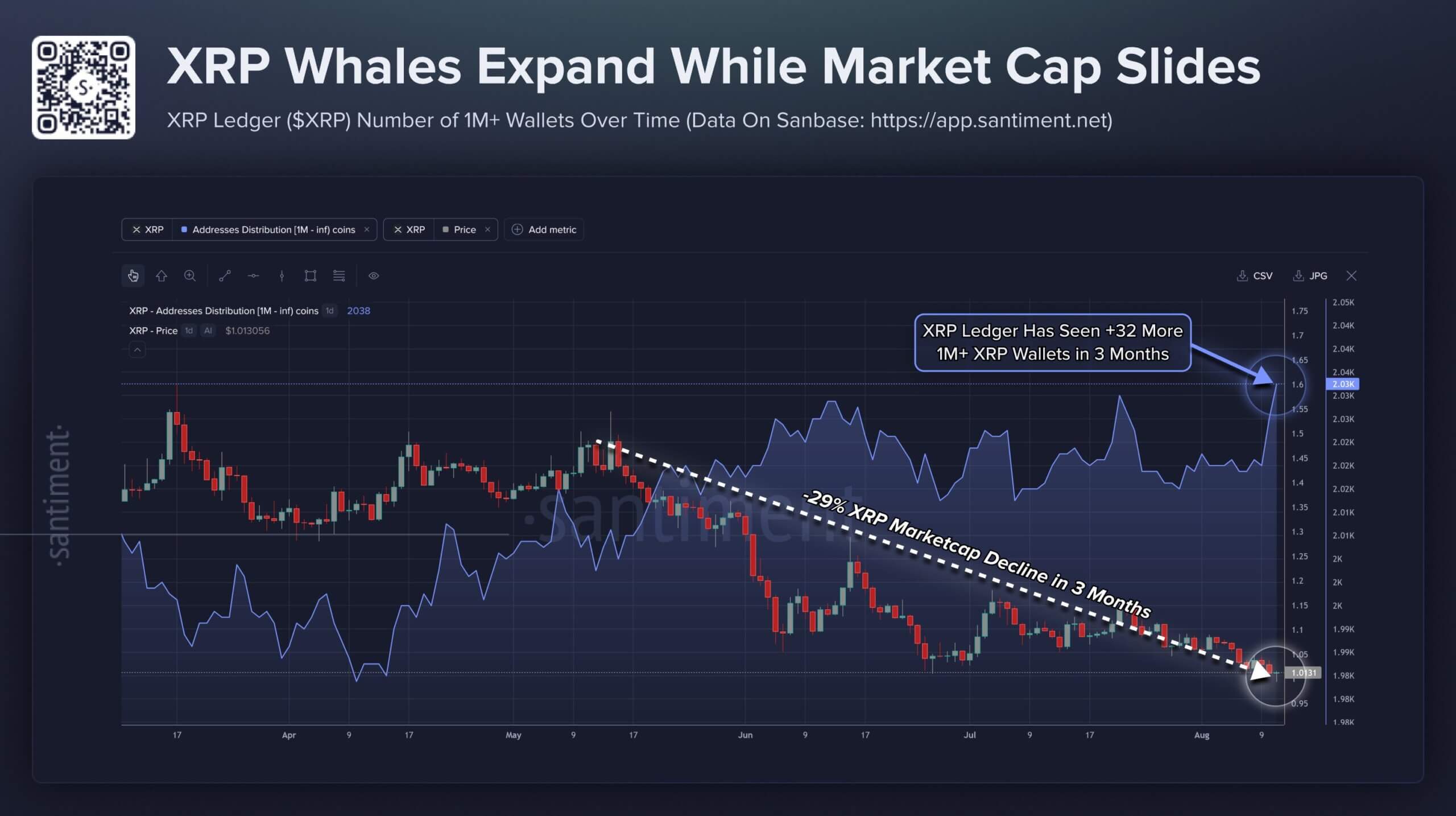
This suggests that demand through regulated investment vehicles and whale interest has remained resilient even as exchange traders have become increasingly defensive.
Moreover, Ripple has also continued expanding its regulatory footprint.
The firm recently secured full authorization as a crypto-asset service provider under the European Union’s MiCA framework in July. This allows it to offer covered crypto services across the European Economic Area.
Beyond that, the XRPL is expanding its role in tokenized finance. A newly introduced proposal would allow institutions to encrypt token balances and transaction amounts while granting issuers, auditors, and regulators selective access to the underlying data.
The network already ranks among the top 10 blockchains for tokenized real-world assets, with more than $4 billion in total value locked.
These developments may not translate directly into demand for XRP, but they highlight a widening gap between the token’s weak near-term market structure and the continued growth of regulated and institutional activity around its ecosystem.


