

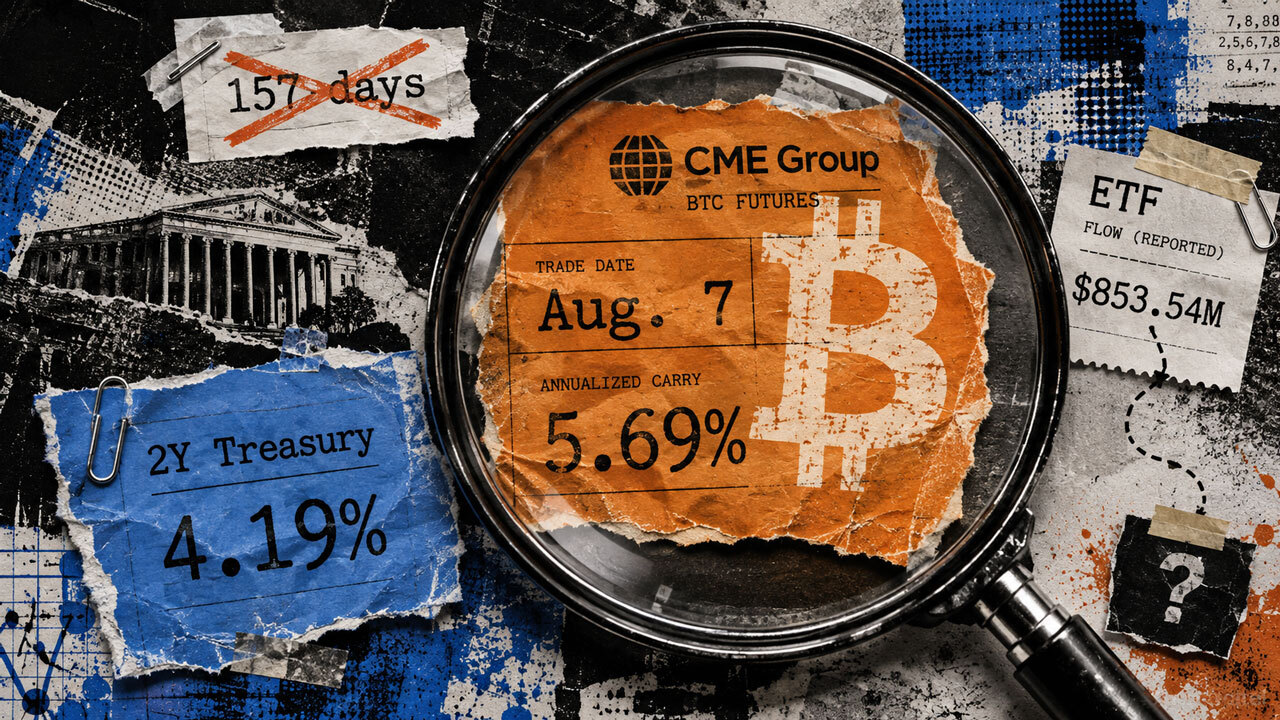
Synchronized CME and Treasury observations from Aug. 7 put Bitcoin futures carry above government debt, undercutting a comparison that is circulated across crypto markets.
Analyst Marc Baumann put annualized Bitcoin futures basis near 3% and the two-year Treasury yield at 3.8%, saying the crypto spread had trailed the government benchmark for 157 consecutive days. The official Treasury curve recorded the two-year par yield at 4.19% on Aug. 7 and 4.25% on Aug. 10.
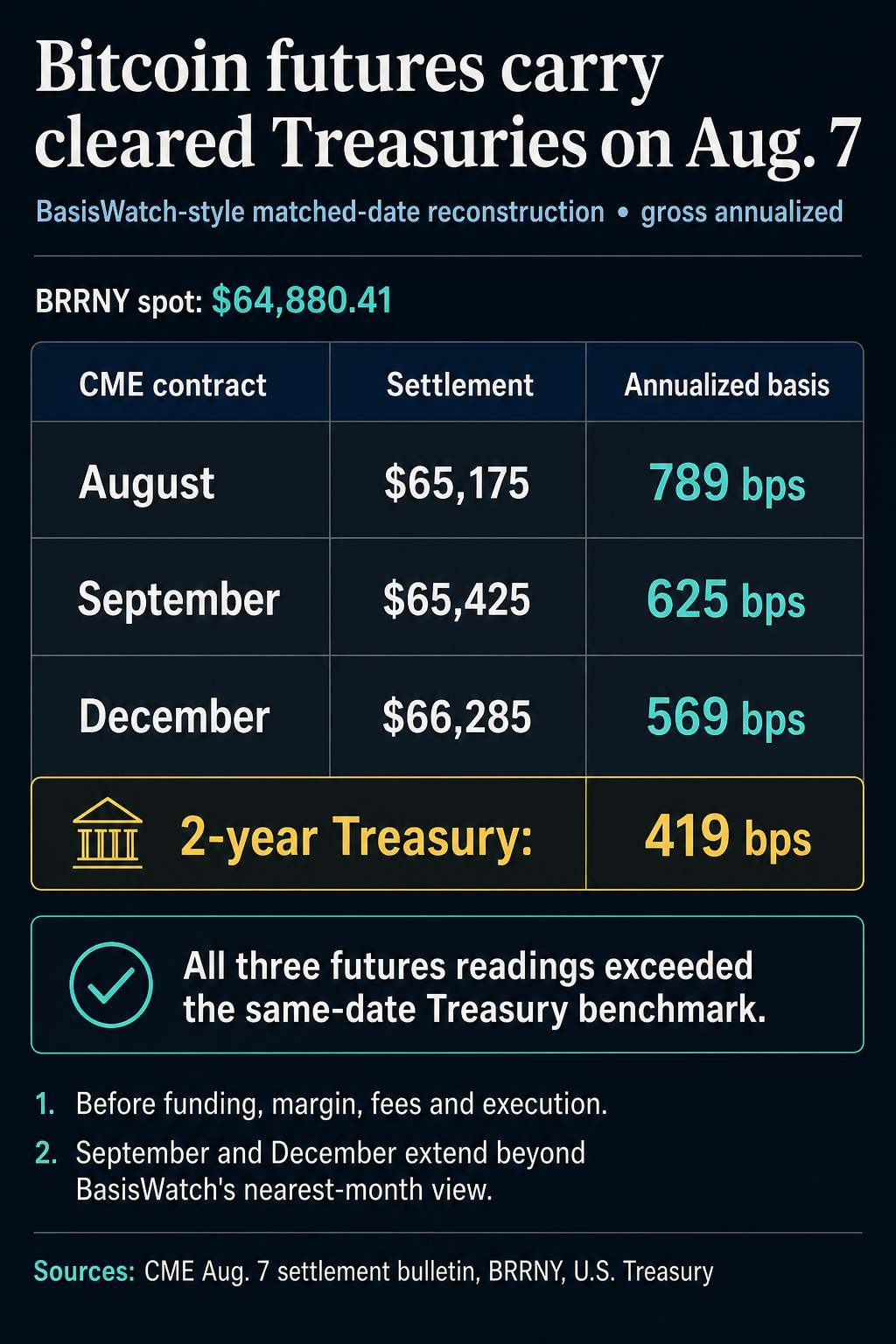
A matched-date calculation using the Aug. 7 CME settlement bulletin and the 4 p.m. ET New York Bitcoin benchmark of $64,880 produced three gross annualized readings above the same day’s 4.19% Treasury yield. The December contract produced the smallest reading at 5.69% on that basis.
Aug. 7 falls inside the proposed 157-day window, so that observation breaks a streak calculated from comparable CME and BRRNY inputs. A different venue, tenor, roll rule, or net-cost series may produce another figure; Baumann’s thread did not disclose those parameters.
How Bitcoin futures carry works
A Bitcoin cash-and-carry position generally pairs a spot purchase with a short futures contract. The trader seeks to capture the premium of futures over spot as the prices converge, while the annualized figure varies with the contract and time remaining to expiry.
CME’s BasisWatch methodology uses a 60-second spot time-weighted average from 3:59 p.m. to 4 p.m. ET and the nearest monthly futures contract at 4 p.m., with a stated roll convention. The table applies similar matched-date arithmetic to the August contract and extends it across the September and December term structure. The latter two sit beyond BasisWatch’s nearest-contract view.
| CME contract | Aug. 7 settlement | Gross annualized basis | Two-year Treasury yield |
|---|---|---|---|
| August | $65,175 | 789 basis points | 419 basis points |
| September | $65,425 | 625 basis points | 419 basis points |
| December | $66,285 | 569 basis points | 419 basis points |
The August contract produced the highest gross annualized basis at 7.89%, followed by September at 6.25% and December at 5.69%.
The Treasury rate supplies a same-date opportunity-cost benchmark. Monthly futures sit on different horizons, and each trading desk faces its own financing rate. An investable calculation would also account for the cost of financing the spot leg, margin, fees, and execution on both sides.
Calling the trade “riskless” obscures those paths. A Bank for International Settlements study of crypto carry found that one-month CME Bitcoin carry exceeded 20% at points in 2021 while documenting financing, leverage, margin, and liquidation risks that could interrupt a position before convergence.
For an arbitrage desk, the relevant Bitcoin futures carry is the premium left after funding, balance-sheet and execution costs. A small net spread can push that capital elsewhere even as institutions continue buying Bitcoin for other reasons.

U.S. spot Bitcoin ETFs recorded $853.54 million of net inflows in the week ended Aug. 7, with positive flows in every session. The weekly total records money entering the products, but it cannot show how much spot exposure was paired with short futures.

The July comparison mixed a daily reading with a monthly total. U.S. spot Bitcoin ETFs took in about $172 million net during July, while July 21 alone contributed roughly $203 million. The cited $205 million appears closer to a rounded daily figure.
The Commodity Futures Trading Commission’s trader categories add aggregate positions by participant type, yet they do not identify the spot or ETF hedge behind a futures short. CryptoSlate’s analysis of ETF and CME market structure describes the recurring carry mechanism. What remains unavailable is trader-level data joining an ETF purchase to its futures leg.

Baumann’s historical parallel ran from August 2022 to January 2023. Bitcoin traded near $15,863 on Nov. 9, 2022 during the FTX collapse, placing the documented low inside the window rather than at its January endpoint. That chronology provides no basis for treating the end of another low-carry spell as a cycle-bottom signal.
Returning cash-and-carry demand should leave three observable traces. The futures basis would clear a funding benchmark matched to the contract horizon after costs. ETF net inflows would persist as the spread widened. CME open interest and trader positioning would show greater use of short futures.
Together, those moves would be consistent with more arbitrage capital in the market. ETF and CFTC aggregates still cannot prove that the same investors own both legs, because neither dataset supplies trader-level linkage.
Bitcoin’s price can rise on directional buying while the carry spread remains unattractive. The more useful institutional gauge is the net basis after funding costs, read beside ETF flows and CME positioning rather than substituted by any one of them.


