


Robinhood launched the public mainnet of Robinhood Chain this month, describing it as a permissionless Layer 2 built on Arbitrum for tokenized stocks, real-world assets, DeFi lending, and AI-native finance.
One week in, the chain’s loudest retail activity is driven by CASHCAT, a memecoin built on Robinhood’s own discarded “CashCat” name. The token reached nearly $150 million in market cap and over $159 million in 24-hour volume.
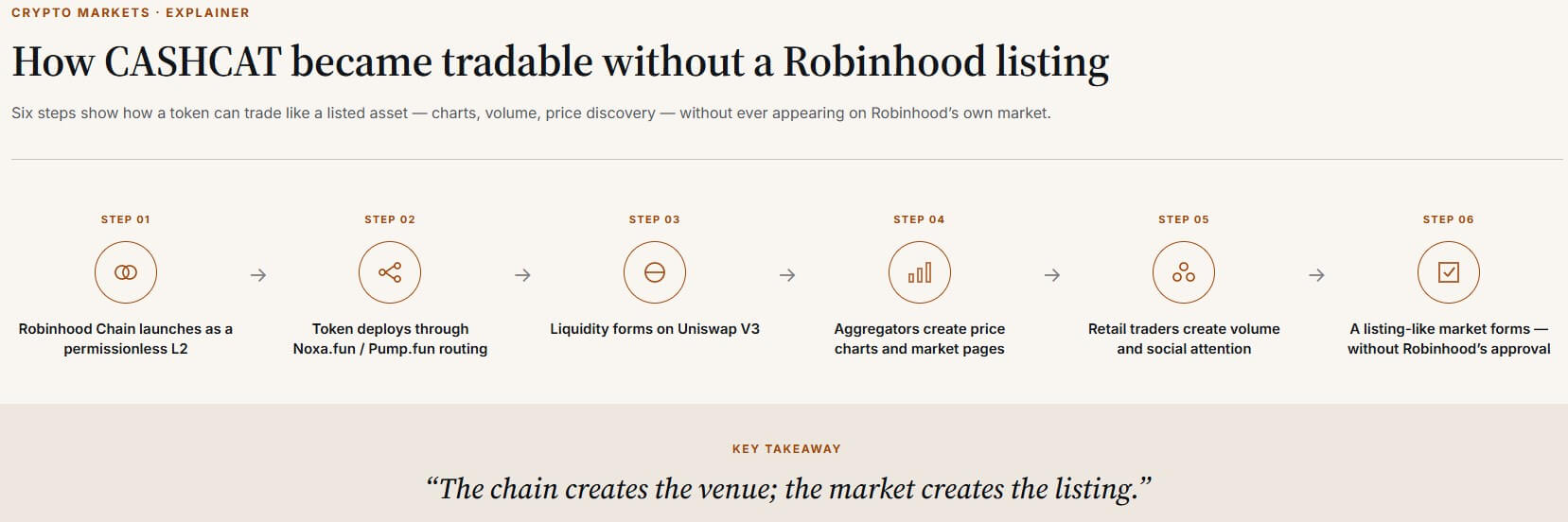
CASHCAT gained liquidity, price charts, and social attention through Uniswap V3 pools and third-party launch and routing infrastructure, including Noxa.fun and Pump.fun, rather than through Robinhood’s own app-listing process.
Behind an unapproved listing
Robinhood built Robinhood Chain with Uniswap and other partners live on day one, connected to Robinhood’s own on-chain wallet users.
That same open architecture, designed to support tokenized equities and RWA collateral, also lets any token deployed on the chain reach external DEX liquidity, charting pages and aggregator surfaces that can resemble parts of a formal listing without passing through Robinhood’s app-level approval process.
Vlad Tenev and Baiju Bhatt called the company CashCat before settling on Robinhood, a name tied in company lore to Bhatt’s fondness for cats. That history gave an anonymous memecoin a reference drawn directly from Robinhood’s own origin story.
A Dune dashboard built by user Adam_tehc showed CASHCAT accounting for roughly 79% of the aggregate market cap and 74% of the volume among the top 25 Robinhood Chain memecoins. The next-largest token, Dog In Hood, sat about 16 times smaller.
The same Dune dashboard shows the chain’s trading activity accelerated, with daily transactions moving from about 1.2 million on July 7 to nearly 2.8 million on July 8, a 133% jump in a single day.
Deployments through the Noxa.fun launchpad climbed from 1,858 to 6,675 tokens over the same period, a 259% increase.
| Robinhood Chain memecoin activity | July 7 | July 8 | One-day change |
|---|---|---|---|
| Daily transactions | 1.2 million | 2.8 million | +133% |
| Noxa.fun token deployments | 1,858 | 6,675 | +259% |
| Deployments as share of transactions | 0.155% | 0.238% | +54% |
| Implied transactions per new token | ~646 | ~419 | Supply creation accelerated |
By July 8, new-token creation was accelerating faster than overall transaction growth, with Noxa.fun deployments accounting for 0.155% of daily transactions on July 7 and 0.238% the next day.
That pace raises the possibility that new tickers are fragmenting attention across the chain rather than deepening liquidity in the few tokens already proving durable.
DefiLlama data show the chain’s total value locked at around $107.8 million, with the stablecoin market cap near $246.8 million and the active RWA market cap around $12.5 million.
CASHCAT’s volume-to-market-cap ratio points to same-day turnover, a pattern more consistent with high-velocity trading than long-horizon holding.
The risk sitting underneath the rally
Vlad Tenev told CNBC on July 2 that crypto’s future runs through real-world assets, and days later, he posted that Robinhood Chain is being built to be the best chain for RWAs, adding that it “works great for memes too.”
That turn reveals something about permissionless infrastructure, as once Robinhood opened the chain to any builder, the market picked its own breakout asset, and CASHCAT’s Robinhood-coded name pulled the chain’s founder into the meme narrative around a token built outside the company.
Copycat tokens and impersonator accounts are already circulating, and liquidity sits concentrated in a single new-chain DEX pair prone to slippage and sharp wicks.
A 2026 academic study covering 34,988 memecoins across Ethereum, BNB Chain, Solana, and Base found that 1,801 tokens, or 5.15%, stopped trading entirely within 24 hours of launch.
CASHCAT’s size puts it well outside that failure group today, and the same permissionless rails that lifted it also host thousands of tokens built to fail fast.
What the next 60 days could show
In the bull scenario, CASHCAT or the broader meme category holds above $100 million, weekly average transactions are still above 2 million, the stablecoin market cap holds above $200 million, and the active RWA market cap climbs toward the $50 million to $100 million range.
Under that path, meme liquidity becomes the bootloader for Robinhood Chain’s user base, and the RWA thesis Robinhood pitched on July 1 finally gets wallets and stablecoins to build on.
In the bear scenario, CASHCAT falls between $30 million and $50 million, daily transactions drop below 600,000, Noxa.fun deployments fall below 700 per day, and the active RWA market cap sits flat near its current level.
Under that path, CASHCAT reads as an attention spike the chain absorbed and moved past, leaving Robinhood Chain’s RWA ambitions to build their own user base separately.
| Metric to watch | Current / recent level | Bull case | Bear case |
|---|---|---|---|
| CASHCAT or meme-category market cap | ~$135M–$150M zone | Holds above $100M | Falls to $30M–$50M |
| Daily transactions | Nearly 2.8M on July 8 | Weekly average stays above 2M | Drops below 600K |
| Noxa.fun deployments | 6,675 on July 8 | Normalizes without fragmenting liquidity | Falls below 700/day |
| Stablecoin market cap | ~$246.8M | Holds above $200M | Liquidity leaves the chain |
| Active RWA market cap | ~$12.5M | Climbs toward $50M–$100M | Stays flat near current level |
| Article implication | Meme cold start underway | Memes bootstrap Robinhood Chain activity | CASHCAT was a launch-week attention spike |
Citi’s 2026 tokenization research puts today’s global tokenized-asset market near $17 billion and projects $5.5 trillion by 2030 in its base case, with public equities and Treasuries expected to lead early adoption.
The report estimates that just 10% of US retail investors moving to on-chain solutions by 2030 could create $2.6 trillion in demand for tokenized public equities alone.
Robinhood’s crypto revenue fell 47% year over year to $134 million in the first quarter of 2026. Total net revenue for the same quarter climbed 15% to $1.07 billion, with platform assets reaching $307 billion.
A chain that captures activity outside app-listed tokens gives Robinhood a second crypto engagement surface, one that grows independently from individual memecoin survival.
Robinhood Chain’s RWA ambitions still depend on years of institutional adoption that Citi’s own forecast treats as a decade-long build.
CASHCAT already delivered proof that the moment permissionless infrastructure goes live, the market builds its own hundred-million-dollar listing, with or without Robinhood’s approval.


