

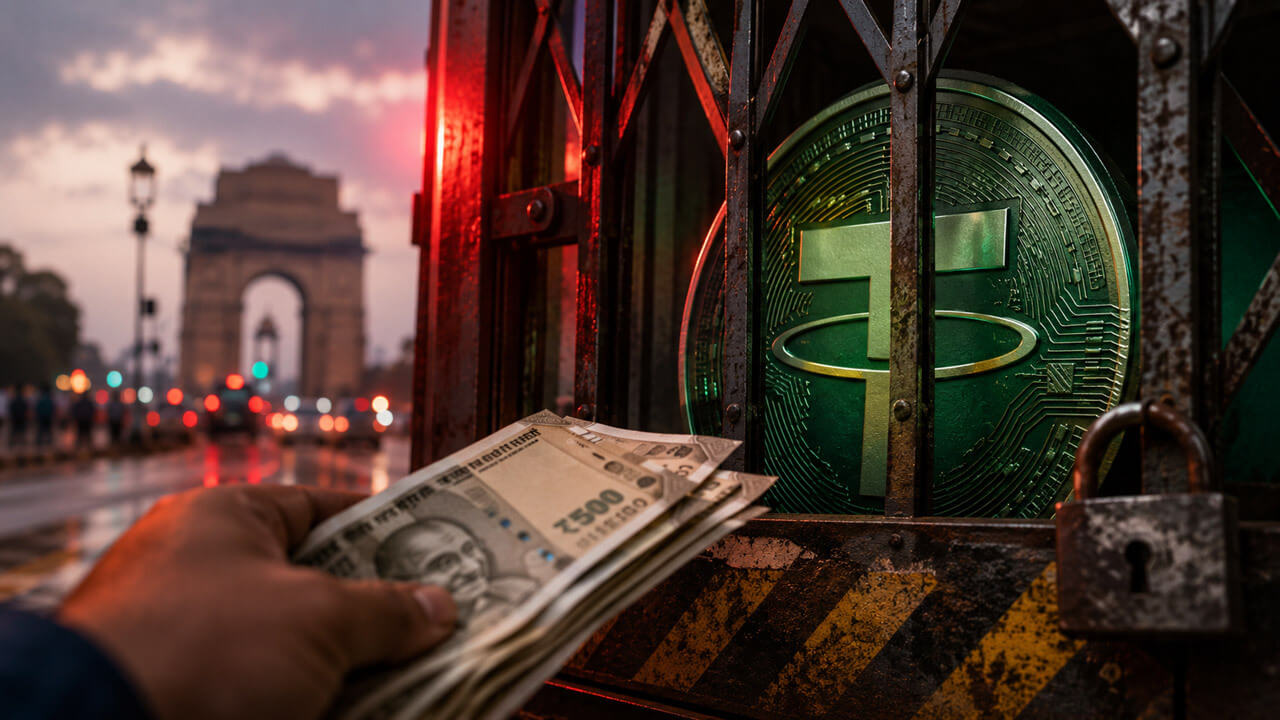
India’s USDT premium has turned local enforcement into a live price signal for dollar access.
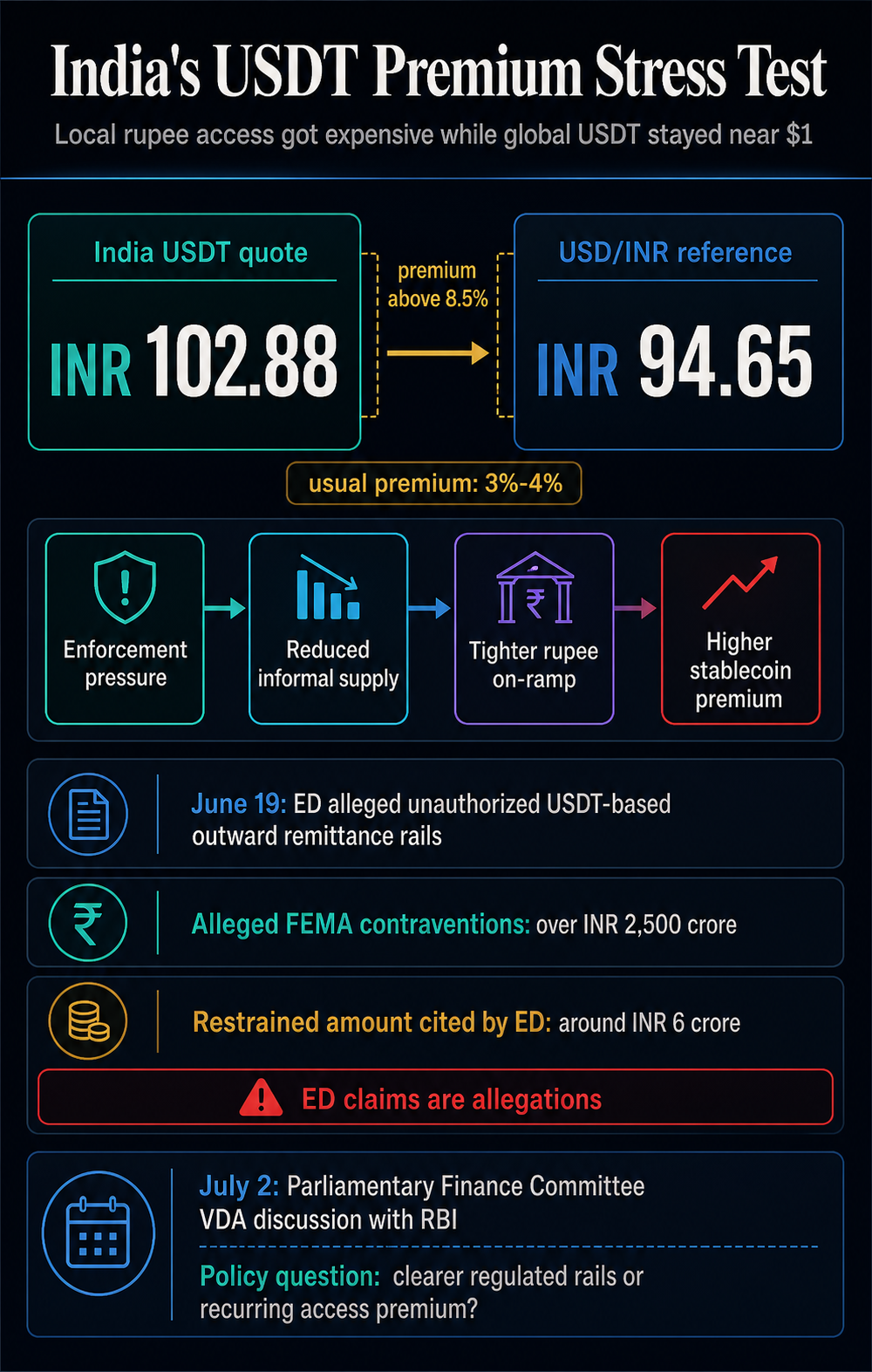
A stablecoin premium report said on June 29 that a supply crunch pushed India’s local premium above 8.5%, with USDT quoted around INR 102.88 while USD/INR closed near INR 94.65.
That spread is far above the usual 3% to 4% premium range cited in the report. It points to an India-specific shortage of accessible dollar-linked crypto liquidity, with the extra cost falling on buyers who still need rupee routes into USDT.
Global market data for Tether USDt showed the token trading around $1 on June 29 with substantial centralized exchange volume. The two readings create a split picture: USDT remained close to its global peg while rupee access inside India became expensive.
The timing is tied to enforcement pressure. The Enforcement Directorate said on June 19 that searches tied to several crypto and fintech platforms found alleged USDT-based outward remittance activity without Reserve Bank of India authorization.
The agency alleged suspected FEMA contraventions above INR 2,500 crore and said around INR 6 crore had been restrained. The release remains an allegation by the agency.
The premium turns that backdrop into a practical cost. India’s crypto users, exchanges, payment intermediaries, and remittance-linked flows can still seek dollar liquidity when some routes become riskier or less available. Demand can persist, but the price of meeting it can rise.
A Local Price Shock Around A Global Peg
The core market split is between USDT as a global stablecoin and USDT as a token that Indian users can buy with rupees. A dollar-pegged asset can trade close to $1 globally while local buyers pay far more because the route into the asset has become scarce, legally uncertain, or expensive.
India’s premium reflects that access layer. The token itself still tracks its global peg; the local path to obtain it is under stress.
Possible local frictions include banking access, market-maker caution, reduced P2P supply, tax costs, compliance uncertainty, and less willingness to intermediate flows that could attract regulatory scrutiny. Those factors are plausible pressure points, with no single confirmed explanation for the June 29 price move.
| Signal | What it shows | Market implication |
|---|---|---|
| India USDT quote | ET reported USDT near INR 102.88 | Local buyers were paying much more than the ordinary dollar rate |
| USD/INR reference | ET reported USD/INR near INR 94.65 | The gap makes the premium visible in rupee terms |
| Global USDT context | CryptoSlate showed USDT around $1 | The stress sits in local access around a global stablecoin peg |
Stablecoins often function as financial plumbing. A premium can show that the route to obtain the token has become scarce, risky, or expensive.
CryptoSlate has previously reported that users in emerging markets with dollar-access friction can pay more for stablecoins because the token performs a job local rails handle too expensively.

India’s premium is sharper because it combines that familiar dollar-access pattern with a fresh enforcement backdrop and a live policy calendar. The price signal is also easy for ordinary users to feel.
A buyer trying to obtain USDT in India may face a materially higher rupee cost than the ordinary dollar exchange rate suggests. That extra cost can affect traders moving between venues, users seeking stablecoin liquidity, and remittance-linked demand that had relied on faster or less formal rails.
Policy Pressure Meets Persistent Demand
The ED release is the immediate legal context. The agency named Transak, Carret, Xpat/Remit2any, Onramp.money, and Onmeta in connection with searches and alleged that some entities facilitated outward remittances through USDT without RBI authorization.
The release also alleged that customers deposited Indian rupees into domestic bank accounts, equivalent crypto was transferred to overseas wallets, and foreign beneficiaries received equivalent fiat or crypto.
The boundary is important. The ED’s allegations concern specific conduct and named entities. Legitimate remittance users, Indian crypto users, and FIU-registered VDA service providers belong in separate categories unless a source ties them to the alleged activity.
The same distinction applies to compliance status. Anti-money-laundering registration and remittance authorization are separate questions.
A March Lok Sabha answer said 54 VDA service providers were registered with FIU-IND as of March 9, 2026, and that 53 apps or URLs had been directed for takedown.
That speaks to AML and compliance supervision. RBI authorization for remittance business is a different legal threshold.
That gap is where the policy wall becomes visible. India has tax rules, AML obligations, takedown actions, and enforcement activity, while crypto assets still sit outside a settled comprehensive framework.
A separate Rajya Sabha answer described VDAs and crypto assets as currently unregulated while also noting tighter reporting and tax obligations from April 1.
For firms and market makers, that mix can create incentives to reduce exposure or widen spreads until the rules for remittance-linked activity are clearer. The exact response by each venue or intermediary remains unresolved.
India also remains one of crypto’s largest retail markets. TRM Labs’ Q1 2026 Global Crypto Adoption Index described India as a major retail crypto market, with activity supported by P2P and domestic exchange use.
CryptoSlate’s explainers on India’s VDA tax regime and AML framework show why that demand operates inside a difficult mix of high tax friction and tighter compliance expectations.

This is the pressure point. Enforcement can reduce risky or unauthorized flows, while persistent demand can shift into price. Wider spreads are one result.
Another risk is that unclear or expensive compliant rails push some activity toward P2P or offshore routes that are harder to monitor. A March Rajya Sabha answer already described official scrutiny of offshore VDA service providers and private-wallet cross-border flows, showing that the concern predates the latest premium spike.
The premium is landing just before another policy marker. India’s Parliamentary Standing Committee on Finance is expected to meet RBI officials on July 2 to discuss virtual digital assets and the way forward, with the Institute of Chartered Accountants of India also expected to be involved on taxation and compliance issues.
Official committee material shows the discussion belongs to an ongoing process. A May 20 Standing Committee notice referred to the same study on virtual digital assets and the way forward, with exchanges and government bodies called into the process.
The RBI’s posture is already visible. In a speech hosted by the Bank for International Settlements, RBI Deputy Governor T. Rabi Sankar warned that crypto assets and stablecoins can raise concerns around dollarization, currency substitution, weakened capital-flow controls, and unmonitored cross-border flows.
That context suggests the central bank will approach stablecoin remittance channels through the lens of monetary and capital-flow risk.
The market price exposes the tradeoff. When rules focus mainly on restriction and enforcement before usable compliant channels are fully established, users may still seek the instrument that solves their immediate problem. In this case, that instrument is USDT.

The July 2 discussion is a signal, with no indication of immediate rulemaking deadlines. The key question is whether policymakers respond to the premium as evidence that demand requires clearer, regulated rails, or as evidence that enforcement pressure should intensify.
If the first path wins, exchanges and payment companies could eventually get clearer boundaries for INR on/off-ramps, remittance-adjacent activity, reporting, and stablecoin liquidity. If the second path dominates without a workable alternative, the premium can remain a recurring tax on access.
India’s USDT premium has become a simple number with a larger warning: stablecoin demand can push through policy friction, but it does so at a cost. The higher the wall around informal dollar rails becomes, the more visible the price of crossing it may get.


