

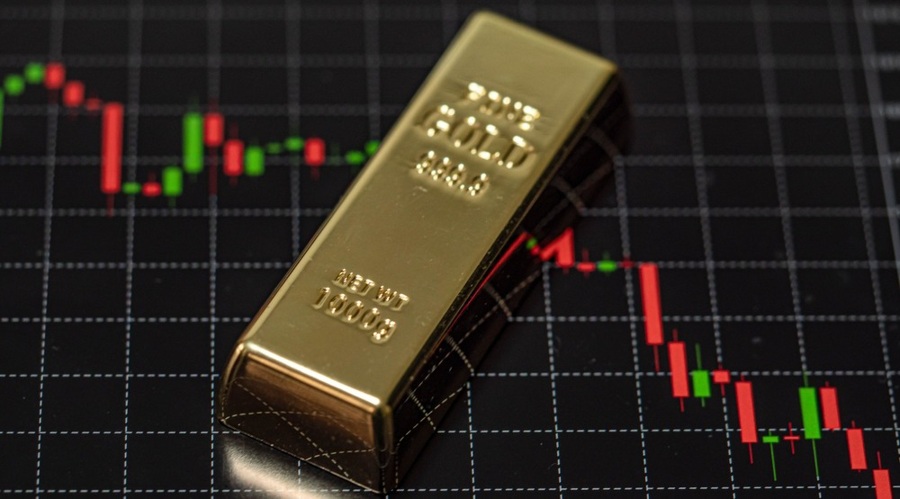
Gold (XAU/USD) traded at $3,976.90 per ounce on Thursday,
June 25, 2026, holding below the $4,000 level for the first time since November
2025 after Wednesday’s close at $3,991 marked the first sub-$4,000 daily close
in seven months.
The metal
is down roughly 5% year-to-date and about 29% below the $5,595 record set on
January 29, with a stronger dollar and rising Federal Reserve rate-hike odds
driving the slide. This week’s catalyst is the May PCE inflation report, due
Thursday.
In this
article, I am answering the question why gold is falling down today and how low
its price may go.
Follow me on X for real-time market analysis:
@ChmielDk
The story
on my chart this week is a polarity change. The $4,000 area, which acted as
support at the March 2026 lows and again through June, broke on Wednesday’s
close and is now being retested from below as resistance.
Price
tagged an intraday low of $3,959 on Wednesday before stabilizing near $3,976 on
Thursday. In 15+ years as a trader and analyst, 10 of them at
FinanceMagnates.com, I have watched gold defend the $4,000 zone repeatedly,
which is why this first close beneath it carries weight on my analyst page read of the trend.
The 50-day
and 200-day moving averages continue to converge toward a death cross, and they
sit closer now than when my June 22 analysis first flagged the setup. The trend
turned lower in early June, when gold lost its 200-day average, the level I
tracked in my June 8 analysis.
My
Fibonacci extension off the 2025 advance still points to $3,440, the 100%
level, roughly 15% below spot and about 39% under the January record.
|
Level |
Type |
Notes |
|
$4,300 |
Resistance / 200 EMA |
Bull/bear |
|
$4,000 |
Resistance (flipped) |
Former |
|
$3,976 |
Spot |
June 25 price |
|
$3,959 |
Support |
June 24 intraday low |
|
$3,440 |
Target |
100% |
The bias
stays bearish below $4,000. A daily close back above it would reset the flip,
and only a reclaim of the 200 EMA near $4,300 would reopen the upside, the same
boundary I mapped in my early-May chart work.
Gold price prediction: can the $4,000 polarity flip cap the next bounce? Source: Tradingview.com
Why Is Gold Falling Below
$4,000?
Gold is
falling because the rate story turned against it. The Federal Reserve held in
June but signaled a hawkish bias, and markets now price roughly 68% odds of a
September hike, up from 29% a week earlier. That repricing lifted real Treasury
yields and pushed the dollar to its highest level in more than a year, both
negative for a non-yielding asset.
“Gold
prices remain under pressure, reaching multi-month lows,” said Bas
Kooijman, CEO and Asset Manager at DHF Capital S.A. He attributes the move to
expectations of tighter policy and a firm dollar.
The
geopolitical bid also faded. Progress in US-Iran talks pulled oil back to a
four-month low, removing the war premium that had supported bullion and easing
the inflation concern that kept the Fed hawkish. Gold failed to rally during
the conflict and is now selling off on its resolution, an unusual sequence that
underlines how much the rate channel dominates this tape.
The drivers
behind the break below $4,000:
- Fed repricing: September hike odds near 68%,
up from 29% a week earlier - Dollar strength: DXY at a one-year-plus high,
raising the cost of gold abroad - Iran de-escalation: oil at a four-month low, war
premium drained - Real yields: higher carry cost on
non-yielding bullion
Institutional Flows and
the Rate-Hike Repricing
Attention
turns to Thursday’s PCE report, which Kooijman expects could prove decisive for
the Fed’s next move. A hotter reading would reinforce the hike case and
pressure gold further, while a soft print could spark a technical bounce into
the $4,000 retest. The longer-term bid has not vanished.
Central
banks bought 244 net tonnes in the first quarter of 2026, and Kooijman noted
that “ongoing central bank purchases support the longer-term outlook for
gold.” My read is that this official-sector demand limits the depth of the
correction over time but has not stopped the rate-driven leg lower.
How Low Can Gold Go?
XAU/USD Price Predictions
The
institutional range remains wide, and most desks still sit above spot even
after trimming targets. Deutsche Bank cut its year-end call to $4,800 from
$6,000, a downgrade that still implies a bounce of about 20% from current
levels.
Brandon
Aversano, founder of Alloy, called the “$4,800 year-end target”
reasonable, adding that he does not expect a straight line and sees gold
capable of revisiting $5,000 before year-end if geopolitical risk and
central-bank buying re-accelerate. My view is that this is the credible upper
path, but it needs a catalyst my chart does not show today.
Goldman
Sachs still targets $4,900 and the Reuters poll median sits at $4,746, both
above spot. My read is that these figures have trailed the 2026 reversal all
year and assume a Fed pivot that has not arrived.
The extreme
upside belongs to Wells Fargo at $6,100 to $6,300 and JPMorgan at $6,000, both
of which I covered when UBP rebuilt its bullion book at
$6,000. I track
those as ceilings, not near-term paths.
|
Source |
Target |
Notes |
|
Deutsche Bank |
$4,800 (Q4 2026) |
Cut from |
|
Deutsche Bank (bear) |
~$3,800 |
If Fed |
|
Goldman Sachs |
$4,900 |
Central-bank buying thesis |
|
Reuters poll median |
$4,746 |
30 analysts, above spot |
|
JPMorgan |
$6,000 |
Year-end, structural call |
|
Wells Fargo |
$6,100 to $6,300 |
Retained March target |
|
My technical analysis |
$3,440 |
100% Fibonacci extension, downside |
Deutsche
Bank’s own bear scenario near $3,800 is the closest mainstream forecast to my
$3,440 target, and it triggers on the same input I am watching, three to four
Fed hikes.
FAQ, Gold Price Analysis
Why is gold falling below
$4,000?
Gold lost
the $4,000 level because the Federal Reserve signaled a hawkish hold and
markets moved to price roughly 68% odds of a September rate hike. That lifted
real yields and pushed the dollar to a one-year high. US-Iran de-escalation
also drained the war premium, sending oil to a four-month low and removing a
key support for bullion.
How low can gold go in
2026?
My
Fibonacci extension off the 2025 advance targets $3,440, the 100% level,
roughly 15% below the current $3,976 price and about 39% under the January
record of $5,595. That objective stays in play while gold trades below $4,000.
A daily close back above the 200 EMA near $4,300 would neutralize the bearish
setup.
Is the $4,000 level still
support for gold?
No.
Wednesday’s close at $3,991 was the first below $4,000 since November 2025, and
on my chart the level has flipped from support to resistance. Gold is now
retesting it from below, a polarity change that strengthens the bearish case
unless price reclaims $4,000 on a daily closing basis.
What is a death cross and
is gold forming one?
A death
cross forms when the 50-day moving average falls below the 200-day, a signal
traders read as a shift to a bearish medium-term trend. Gold’s 50-day and
200-day lines are converging now and sit closer than they did on June 22. The
cross is not confirmed yet, but the gap continues to narrow.
Gold (XAU/USD) traded at $3,976.90 per ounce on Thursday,
June 25, 2026, holding below the $4,000 level for the first time since November
2025 after Wednesday’s close at $3,991 marked the first sub-$4,000 daily close
in seven months.
The metal
is down roughly 5% year-to-date and about 29% below the $5,595 record set on
January 29, with a stronger dollar and rising Federal Reserve rate-hike odds
driving the slide. This week’s catalyst is the May PCE inflation report, due
Thursday.
In this
article, I am answering the question why gold is falling down today and how low
its price may go.
Follow me on X for real-time market analysis:
@ChmielDk
The story
on my chart this week is a polarity change. The $4,000 area, which acted as
support at the March 2026 lows and again through June, broke on Wednesday’s
close and is now being retested from below as resistance.
Price
tagged an intraday low of $3,959 on Wednesday before stabilizing near $3,976 on
Thursday. In 15+ years as a trader and analyst, 10 of them at
FinanceMagnates.com, I have watched gold defend the $4,000 zone repeatedly,
which is why this first close beneath it carries weight on my analyst page read of the trend.
The 50-day
and 200-day moving averages continue to converge toward a death cross, and they
sit closer now than when my June 22 analysis first flagged the setup. The trend
turned lower in early June, when gold lost its 200-day average, the level I
tracked in my June 8 analysis.
My
Fibonacci extension off the 2025 advance still points to $3,440, the 100%
level, roughly 15% below spot and about 39% under the January record.
|
Level |
Type |
Notes |
|
$4,300 |
Resistance / 200 EMA |
Bull/bear |
|
$4,000 |
Resistance (flipped) |
Former |
|
$3,976 |
Spot |
June 25 price |
|
$3,959 |
Support |
June 24 intraday low |
|
$3,440 |
Target |
100% |
The bias
stays bearish below $4,000. A daily close back above it would reset the flip,
and only a reclaim of the 200 EMA near $4,300 would reopen the upside, the same
boundary I mapped in my early-May chart work.
Gold price prediction: can the $4,000 polarity flip cap the next bounce? Source: Tradingview.com
Why Is Gold Falling Below
$4,000?
Gold is
falling because the rate story turned against it. The Federal Reserve held in
June but signaled a hawkish bias, and markets now price roughly 68% odds of a
September hike, up from 29% a week earlier. That repricing lifted real Treasury
yields and pushed the dollar to its highest level in more than a year, both
negative for a non-yielding asset.
“Gold
prices remain under pressure, reaching multi-month lows,” said Bas
Kooijman, CEO and Asset Manager at DHF Capital S.A. He attributes the move to
expectations of tighter policy and a firm dollar.
The
geopolitical bid also faded. Progress in US-Iran talks pulled oil back to a
four-month low, removing the war premium that had supported bullion and easing
the inflation concern that kept the Fed hawkish. Gold failed to rally during
the conflict and is now selling off on its resolution, an unusual sequence that
underlines how much the rate channel dominates this tape.
The drivers
behind the break below $4,000:
- Fed repricing: September hike odds near 68%,
up from 29% a week earlier - Dollar strength: DXY at a one-year-plus high,
raising the cost of gold abroad - Iran de-escalation: oil at a four-month low, war
premium drained - Real yields: higher carry cost on
non-yielding bullion
Institutional Flows and
the Rate-Hike Repricing
Attention
turns to Thursday’s PCE report, which Kooijman expects could prove decisive for
the Fed’s next move. A hotter reading would reinforce the hike case and
pressure gold further, while a soft print could spark a technical bounce into
the $4,000 retest. The longer-term bid has not vanished.
Central
banks bought 244 net tonnes in the first quarter of 2026, and Kooijman noted
that “ongoing central bank purchases support the longer-term outlook for
gold.” My read is that this official-sector demand limits the depth of the
correction over time but has not stopped the rate-driven leg lower.
How Low Can Gold Go?
XAU/USD Price Predictions
The
institutional range remains wide, and most desks still sit above spot even
after trimming targets. Deutsche Bank cut its year-end call to $4,800 from
$6,000, a downgrade that still implies a bounce of about 20% from current
levels.
Brandon
Aversano, founder of Alloy, called the “$4,800 year-end target”
reasonable, adding that he does not expect a straight line and sees gold
capable of revisiting $5,000 before year-end if geopolitical risk and
central-bank buying re-accelerate. My view is that this is the credible upper
path, but it needs a catalyst my chart does not show today.
Goldman
Sachs still targets $4,900 and the Reuters poll median sits at $4,746, both
above spot. My read is that these figures have trailed the 2026 reversal all
year and assume a Fed pivot that has not arrived.
The extreme
upside belongs to Wells Fargo at $6,100 to $6,300 and JPMorgan at $6,000, both
of which I covered when UBP rebuilt its bullion book at
$6,000. I track
those as ceilings, not near-term paths.
|
Source |
Target |
Notes |
|
Deutsche Bank |
$4,800 (Q4 2026) |
Cut from |
|
Deutsche Bank (bear) |
~$3,800 |
If Fed |
|
Goldman Sachs |
$4,900 |
Central-bank buying thesis |
|
Reuters poll median |
$4,746 |
30 analysts, above spot |
|
JPMorgan |
$6,000 |
Year-end, structural call |
|
Wells Fargo |
$6,100 to $6,300 |
Retained March target |
|
My technical analysis |
$3,440 |
100% Fibonacci extension, downside |
Deutsche
Bank’s own bear scenario near $3,800 is the closest mainstream forecast to my
$3,440 target, and it triggers on the same input I am watching, three to four
Fed hikes.
FAQ, Gold Price Analysis
Why is gold falling below
$4,000?
Gold lost
the $4,000 level because the Federal Reserve signaled a hawkish hold and
markets moved to price roughly 68% odds of a September rate hike. That lifted
real yields and pushed the dollar to a one-year high. US-Iran de-escalation
also drained the war premium, sending oil to a four-month low and removing a
key support for bullion.
How low can gold go in
2026?
My
Fibonacci extension off the 2025 advance targets $3,440, the 100% level,
roughly 15% below the current $3,976 price and about 39% under the January
record of $5,595. That objective stays in play while gold trades below $4,000.
A daily close back above the 200 EMA near $4,300 would neutralize the bearish
setup.
Is the $4,000 level still
support for gold?
No.
Wednesday’s close at $3,991 was the first below $4,000 since November 2025, and
on my chart the level has flipped from support to resistance. Gold is now
retesting it from below, a polarity change that strengthens the bearish case
unless price reclaims $4,000 on a daily closing basis.
What is a death cross and
is gold forming one?
A death
cross forms when the 50-day moving average falls below the 200-day, a signal
traders read as a shift to a bearish medium-term trend. Gold’s 50-day and
200-day lines are converging now and sit closer than they did on June 22. The
cross is not confirmed yet, but the gap continues to narrow.


